D351 Functions of Human Resource
Management: Section 1 - HR Roles Qs & Ans
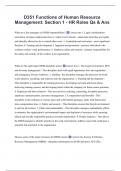
What are a line managers six HRM responsibilities? Correct Ans-1. Legal considerations -
must know all major employment laws 2. Labor Cost Controls - understand what they are legally
and ethically allowed to do to control labor costs. 3. Leadership and motivation - most significant
function. 4. Training and development 5. Appraisal and promotion - primary individuals who
evaluate workers' work performance. 6. Employee safety and security - primary responsibility for
the safety and security of the workers in an organization.
What are the eight major HRM discipline areas? Correct Ans-1. The Legal environment: EEO
and diversity management - This discipline deals with equal opportunity laws and regulations
and managing a diverse workforce. 2. Staffing - this discipline manages the processes involved
in job anaylsis, recruiting, and selection into the organization. 3. Training and development -
This discipline is responsible for training processes, developing curricula and lesson plans,
delivering training courses, and developing talent within the company for future senior positions.
4. Employee and labor relations - This area involves coaching, counseling, discipline processes,
employee communication, and stress management. 5. Compensation and benefits - This
discipline works with pay of various types and with benefits packages. deals with federal and
state compensation laws. 6. Safety and security - This discipline ensures that the job environment
is safe for all workers. 7. Ethics and sustainability - This discipline manages sustainability efforts
to minimize the organization's environmental impact and depletion of resources while ensuring
ethical and socially responsible practices towards stakeholders. 8. People Analytics - This allows
the HRM manager to identify patterns in the work environment. Address issues that could pose a
potential risk and harm to the organization.
Discuss some of the major resources for HRM careers Correct Ans-Society for Human
Resource Management (SHRM) - maintains information on all HR functions. ATD (The
, Association for Talent Development) -focuses on training and developing employees in
organizations. The Human Resource Certification Institute (HRCI) - provides some of the most
respected certifications for HR personnel anywhere in the world. WorldatWork - primarily
focuses on total compensation of the workforce in all types of organizations.
Identify and explain the five parts of the practitioner's model for HRM Correct Ans-First
Level: consists of fundamental items necessary for an organization to operate and remain stable
while complying with federal and state laws. Second Level: focuses on determining the required
jobs, recruiting and selecting the right individuals for those jobs, and maximizing long-term
productivity. Third Tier: HRM concerns itself with managing the human resources chosen in the
second level, including providing training, performance appraisal, coaching, counseling, and
disciplinary processes while maintaining positive relationships with employees. Fourth Tier:
examines how HRM can reward and retain employees through compensation and benefits. Top
Tier: aims to minimize turnover and dissatisfaction by offering fair and reasonable compensation
planning and creating a safe and secure workplace.
What are the factors impacting how an organization makes strategic decisions? Correct Ans-
The vision - outlines the future state of the organization. The mission - outlines what the different
units within the organization will do to achieve the vision. There are 3 types of strategies: cost
leadership - keeping production costs low and selling products or services at lower prices.
differentiation - focuses on creating a unique impression and charging higher prices. focus or
niche - involves targeting a specific segment of a larger market.
What are the major components of organizational structure? Correct Ans-Complexity is the
degree to which three types of differentiation exist within the organization: vertical, horizontal,
and spatial. The more the organization is divided - vertically, horizontally, or spatially - the more
difficult it is to manage. Formalization is the degree to which jobs are standardized within the
organization. The more we can standardize the organization and its processes, the easier it is to
Management: Section 1 - HR Roles Qs & Ans
What are a line managers six HRM responsibilities? Correct Ans-1. Legal considerations -
must know all major employment laws 2. Labor Cost Controls - understand what they are legally
and ethically allowed to do to control labor costs. 3. Leadership and motivation - most significant
function. 4. Training and development 5. Appraisal and promotion - primary individuals who
evaluate workers' work performance. 6. Employee safety and security - primary responsibility for
the safety and security of the workers in an organization.
What are the eight major HRM discipline areas? Correct Ans-1. The Legal environment: EEO
and diversity management - This discipline deals with equal opportunity laws and regulations
and managing a diverse workforce. 2. Staffing - this discipline manages the processes involved
in job anaylsis, recruiting, and selection into the organization. 3. Training and development -
This discipline is responsible for training processes, developing curricula and lesson plans,
delivering training courses, and developing talent within the company for future senior positions.
4. Employee and labor relations - This area involves coaching, counseling, discipline processes,
employee communication, and stress management. 5. Compensation and benefits - This
discipline works with pay of various types and with benefits packages. deals with federal and
state compensation laws. 6. Safety and security - This discipline ensures that the job environment
is safe for all workers. 7. Ethics and sustainability - This discipline manages sustainability efforts
to minimize the organization's environmental impact and depletion of resources while ensuring
ethical and socially responsible practices towards stakeholders. 8. People Analytics - This allows
the HRM manager to identify patterns in the work environment. Address issues that could pose a
potential risk and harm to the organization.
Discuss some of the major resources for HRM careers Correct Ans-Society for Human
Resource Management (SHRM) - maintains information on all HR functions. ATD (The
, Association for Talent Development) -focuses on training and developing employees in
organizations. The Human Resource Certification Institute (HRCI) - provides some of the most
respected certifications for HR personnel anywhere in the world. WorldatWork - primarily
focuses on total compensation of the workforce in all types of organizations.
Identify and explain the five parts of the practitioner's model for HRM Correct Ans-First
Level: consists of fundamental items necessary for an organization to operate and remain stable
while complying with federal and state laws. Second Level: focuses on determining the required
jobs, recruiting and selecting the right individuals for those jobs, and maximizing long-term
productivity. Third Tier: HRM concerns itself with managing the human resources chosen in the
second level, including providing training, performance appraisal, coaching, counseling, and
disciplinary processes while maintaining positive relationships with employees. Fourth Tier:
examines how HRM can reward and retain employees through compensation and benefits. Top
Tier: aims to minimize turnover and dissatisfaction by offering fair and reasonable compensation
planning and creating a safe and secure workplace.
What are the factors impacting how an organization makes strategic decisions? Correct Ans-
The vision - outlines the future state of the organization. The mission - outlines what the different
units within the organization will do to achieve the vision. There are 3 types of strategies: cost
leadership - keeping production costs low and selling products or services at lower prices.
differentiation - focuses on creating a unique impression and charging higher prices. focus or
niche - involves targeting a specific segment of a larger market.
What are the major components of organizational structure? Correct Ans-Complexity is the
degree to which three types of differentiation exist within the organization: vertical, horizontal,
and spatial. The more the organization is divided - vertically, horizontally, or spatially - the more
difficult it is to manage. Formalization is the degree to which jobs are standardized within the
organization. The more we can standardize the organization and its processes, the easier it is to