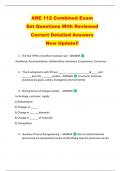
ARE 112 Combined Exam
Set Questions With Reviewed
Correct Detailed Answers
New Update!!
1. The five TYPES of conflict resolution are - ANSWER
Avoidance, Accommodation, Authoritative command, Compromise, Consensus -
2. The 4 subsystems with STS are _____, _____, _____, ____&____, and
______; plus the _______ system - ANSWER structural, technical,
psychosocial, goals, values, managerial, environmental
3. Driving forces of change include: - ANSWER
technology, customer, supply
1) Globalization
2) Changes in _____
3) Change in ______ demands
4) Change in ______ of materials
5) Competition
4. Business Process Reengineering - ANSWER Not a transformational
process but an operational process of identifying how the processes can be
, made more efficient and effective. Usually focused on the SUPPLY CHAIN
and enabling information technology.
5. A drawback to BPR is that BPR:
a. is not related to the IT function in the organization
b. requires changing what the "process does"
c. assumes the processes are the limiting factors
d. only addresses the supply chain issues
- ANSWER c
5. The business process reengineering approach is best described as-
ANSWER operational
a. operational
b. market driven such as new products
c. both external and internal to the organization
d. strategic
6. The topic of the "patterns in the middle" was from:
a. the value chain
b. the link between the agent and the principals
c. span of control
d. the component business model - ANSWER D
7. Planning and scheduling work and assigning tasks and quality control are
examples of:
a. team tasks
,b. horizontal management
c. the flow in the component model
d. ways to limit the span of control
e. the decision making model - ANSWER A
8. In the component business model we discussed type of procurement such as:
a. Direct
b. Indirect
c. Supply chain driven
d. all three answers are correct
e. two of the answers are correct - ANSWER d
9. Learning based on the consequences of responding. - ANSWER operant
conditioning
10. Structure - ANSWER the formal and informal system of tasks and
reporting relationships that control and coordinate employees so they can
cooperate to achieve organizational goals. Examples are organizational charts,
specializations, and rights to make decisions.
11. Herbert ______'s Theory of _____ ______: "Whereas economic man or
woman _______,selects the best alternative from among all those available to
him," he wrote, "his cousin, administrative manor woman, ______,looks for a
course of action that is satisfactory or 'good enough'." - ANSWER Simon,
Bounded Rationality, maximizes, satisfices
, 12. Components of the ____ _____ framework: ANSWER organization design,
culture -
1) Strategy
2) Buy-side
3) Sell-side
4) Systems (ie. HR, budgeting)
5) Structure
6) People
7) ______: core values, norms, and beliefs that guide and direct the organization/
how it interacts
8) Tasks
13. The integrated management of core business processes, often in real-time
and mediated by software and technology; found within _____ _____ ____ -
ANSWER ERP, business process reengineering
14. Systems that can help a firm manage aspects of its value chain, from the flow
of raw materials into the firm, through delivery of finished products and services
at the point-of-consumption. - ANSWER SCM (Supply Chain Management)
15. The set of activities through which a product or service is created and
delivered to customers. - ANSWER Value Chain
16. ______ procurement: acquiring goods for use in end-products- ANSWER
Direct
Set Questions With Reviewed
Correct Detailed Answers
New Update!!
1. The five TYPES of conflict resolution are - ANSWER
Avoidance, Accommodation, Authoritative command, Compromise, Consensus -
2. The 4 subsystems with STS are _____, _____, _____, ____&____, and
______; plus the _______ system - ANSWER structural, technical,
psychosocial, goals, values, managerial, environmental
3. Driving forces of change include: - ANSWER
technology, customer, supply
1) Globalization
2) Changes in _____
3) Change in ______ demands
4) Change in ______ of materials
5) Competition
4. Business Process Reengineering - ANSWER Not a transformational
process but an operational process of identifying how the processes can be
, made more efficient and effective. Usually focused on the SUPPLY CHAIN
and enabling information technology.
5. A drawback to BPR is that BPR:
a. is not related to the IT function in the organization
b. requires changing what the "process does"
c. assumes the processes are the limiting factors
d. only addresses the supply chain issues
- ANSWER c
5. The business process reengineering approach is best described as-
ANSWER operational
a. operational
b. market driven such as new products
c. both external and internal to the organization
d. strategic
6. The topic of the "patterns in the middle" was from:
a. the value chain
b. the link between the agent and the principals
c. span of control
d. the component business model - ANSWER D
7. Planning and scheduling work and assigning tasks and quality control are
examples of:
a. team tasks
,b. horizontal management
c. the flow in the component model
d. ways to limit the span of control
e. the decision making model - ANSWER A
8. In the component business model we discussed type of procurement such as:
a. Direct
b. Indirect
c. Supply chain driven
d. all three answers are correct
e. two of the answers are correct - ANSWER d
9. Learning based on the consequences of responding. - ANSWER operant
conditioning
10. Structure - ANSWER the formal and informal system of tasks and
reporting relationships that control and coordinate employees so they can
cooperate to achieve organizational goals. Examples are organizational charts,
specializations, and rights to make decisions.
11. Herbert ______'s Theory of _____ ______: "Whereas economic man or
woman _______,selects the best alternative from among all those available to
him," he wrote, "his cousin, administrative manor woman, ______,looks for a
course of action that is satisfactory or 'good enough'." - ANSWER Simon,
Bounded Rationality, maximizes, satisfices
, 12. Components of the ____ _____ framework: ANSWER organization design,
culture -
1) Strategy
2) Buy-side
3) Sell-side
4) Systems (ie. HR, budgeting)
5) Structure
6) People
7) ______: core values, norms, and beliefs that guide and direct the organization/
how it interacts
8) Tasks
13. The integrated management of core business processes, often in real-time
and mediated by software and technology; found within _____ _____ ____ -
ANSWER ERP, business process reengineering
14. Systems that can help a firm manage aspects of its value chain, from the flow
of raw materials into the firm, through delivery of finished products and services
at the point-of-consumption. - ANSWER SCM (Supply Chain Management)
15. The set of activities through which a product or service is created and
delivered to customers. - ANSWER Value Chain
16. ______ procurement: acquiring goods for use in end-products- ANSWER
Direct