1
Surface Integrals of Scalar Functions
⃗ : 𝐷 ⊂ ℝ2 → ℝ3 be a parametrization of a surface 𝑆 and 𝐷 an Elementary
Let 𝛷
Region (ie, 𝑦 ∈ [𝑐, 𝑑] and ℎ1 (𝑦) ≤ 𝑥 ≤ ℎ2 (𝑦), and/or 𝑥 ∈ [𝑎, 𝑏] and
𝑘1 (𝑥) ≤ 𝑦 ≤ 𝑘2 (𝑥)): ⃗ (𝑢, 𝑣 ) =< 𝑥 (𝑢, 𝑣 ), 𝑦(𝑢, 𝑣 ), 𝑧(𝑢, 𝑣 ) >.
𝛷
Def. If 𝑓(𝑥, 𝑦, 𝑧) is a real-valued continuous function on a parametrized surface 𝑆,
we define the integral of 𝑓(𝑥, 𝑦, 𝑧) over 𝑆 to be:
⃗⃗⃗ (𝒖, 𝒗))|𝑻
∬𝑺 𝒇(𝒙, 𝒚, 𝒛)𝒅𝑺 = ∬𝑫 𝒇( 𝜱 ⃗ 𝒖×𝑻
⃗ 𝒗 |𝒅𝒖𝒅𝒗.
Notice that if 𝑓 (𝑥, 𝑦, 𝑧) = 1, then this integral equals the surface area of 𝑆.
The motivation for this definition is similar to that for surface area.
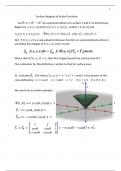
Ex. Evaluate ∬𝑆 𝑓𝑑𝑆 when 𝑓 (𝑥, 𝑦, 𝑧) = 𝑥 2 + 𝑦 2 + 𝑧 and 𝑆 is the portion of the
cone defined by: 𝑥 = 𝑟𝑐𝑜𝑠𝜃 𝑦 = 𝑟𝑠𝑖𝑛𝜃 𝑧 = 𝑟; 0 ≤ 𝑟 ≤ 1 0 ≤ 𝜃 ≤ 2𝜋.
𝑧
We saw from an earlier example:
⃗ (𝑟, 𝜃) =< 𝑟𝑐𝑜𝑠𝜃, 𝑟𝑠𝑖𝑛𝜃, 𝑟 >
𝛷 𝑦
⃗ 𝑟 =< 𝑐𝑜𝑠𝜃, 𝑠𝑖𝑛𝜃, 0 >
𝑇
𝑥
⃗ 𝜃 =< −𝑟𝑠𝑖𝑛𝜃, 𝑟𝑐𝑜𝑠𝜃, 1 >
𝑇
𝑖 𝑗 𝑘⃗
⃗𝑇𝑟 × 𝑇
⃗ 𝜃 = | 𝑐𝑜𝑠𝜃 𝑠𝑖𝑛𝜃 1| = −𝑟𝑐𝑜𝑠𝜃𝑖 − 𝑟𝑠𝑖𝑛𝜃𝑗 + 𝑟𝑘⃗ ;
−𝑟𝑠𝑖𝑛𝜃 𝑟𝑐𝑜𝑠𝜃 0
, 2
So we have:
⃗𝑟 × 𝑇
|𝑇 ⃗ 𝜃 | = √𝑟 2 𝑐𝑜𝑠 2 𝜃 + 𝑟 2 𝑠𝑖𝑛2 𝜃 + 𝑟 2
= |𝑟|√2 . (𝑟 ≥ 0, so don’t need | |).
⃗ (𝑟, 𝜃)) = 𝑥 2 + 𝑦 2 + 𝑧 = 𝑟 2 𝑐𝑜𝑠 2 𝜃 + 𝑟 2 𝑠𝑖𝑛2 𝜃 + 𝑟.
𝑓 (𝛷
2𝜋 1
∬𝑆 𝑓𝑑𝑆 = ∫𝜃=0 ∫𝑟=0(𝑟 2 𝑐𝑜𝑠 2𝜃 + 𝑟 2 𝑠𝑖𝑛2 𝜃 + 𝑟)𝑟√2𝑑𝑟𝑑𝜃
2𝜋 1 2𝜋 1
= √2 ∫𝜃=0 ∫𝑟=0(𝑟 2 + 𝑟)𝑟𝑑𝑟𝑑𝜃 = √2 ∫𝜃=0 ∫𝑟=0(𝑟 3 + 𝑟 2 )𝑑𝑟𝑑𝜃
2𝜋 1 𝑟4 𝑟3 1 7√2𝜋
= √2 ∫𝜃=0 𝑑𝜃 ∫𝑟=0(𝑟 3 + 𝑟 2 )𝑑𝑟 = √2(2𝜋)( 4 + 3 ⃒ = 6 .
0
Ex. Compute the surface integral ∬𝑆 𝑥 2 𝑑𝑆, where S is the unit sphere.
𝑥 = 𝑐𝑜𝑠𝜃𝑠𝑖𝑛𝜙 𝑦 = 𝑠𝑖𝑛𝜃𝑠𝑖𝑛𝜙 𝑧 = 𝑐𝑜𝑠𝜙; 0 ≤ 𝜙 ≤ 𝜋, 0 ≤ 𝜃 ≤ 2𝜋.
⃗ (𝜙, 𝜃) =< 𝑐𝑜𝑠𝜃𝑠𝑖𝑛𝜙, 𝑠𝑖𝑛𝜃𝑠𝑖𝑛𝜙, 𝑐𝑜𝑠𝜙 >; 0 ≤ 𝜙 ≤ 𝜋 0 ≤ 𝜃 ≤ 2𝜋.
𝛷
⃗ 𝜙 =< 𝑐𝑜𝑠𝜃𝑐𝑜𝑠𝜙, 𝑠𝑖𝑛𝜃𝑐𝑜𝑠𝜙, −𝑠𝑖𝑛𝜙 >
𝑇
⃗ 𝜃 =< −𝑠𝑖𝑛𝜃𝑠𝑖𝑛𝜙, 𝑐𝑜𝑠𝜃𝑠𝑖𝑛𝜙, 0 >
𝑇
𝑖 𝑗 𝑘⃗
⃗𝜙 × 𝑇
𝑇 ⃗ 𝜃 = | 𝑐𝑜𝑠𝜃𝑐𝑜𝑠𝜙 𝑠𝑖𝑛𝜃𝑐𝑜𝑠𝜙 −𝑠𝑖𝑛𝜙 |
−𝑠𝑖𝑛𝜃𝑠𝑖𝑛𝜙 𝑐𝑜𝑠𝜃𝑠𝑖𝑛𝜙 0
Surface Integrals of Scalar Functions
⃗ : 𝐷 ⊂ ℝ2 → ℝ3 be a parametrization of a surface 𝑆 and 𝐷 an Elementary
Let 𝛷
Region (ie, 𝑦 ∈ [𝑐, 𝑑] and ℎ1 (𝑦) ≤ 𝑥 ≤ ℎ2 (𝑦), and/or 𝑥 ∈ [𝑎, 𝑏] and
𝑘1 (𝑥) ≤ 𝑦 ≤ 𝑘2 (𝑥)): ⃗ (𝑢, 𝑣 ) =< 𝑥 (𝑢, 𝑣 ), 𝑦(𝑢, 𝑣 ), 𝑧(𝑢, 𝑣 ) >.
𝛷
Def. If 𝑓(𝑥, 𝑦, 𝑧) is a real-valued continuous function on a parametrized surface 𝑆,
we define the integral of 𝑓(𝑥, 𝑦, 𝑧) over 𝑆 to be:
⃗⃗⃗ (𝒖, 𝒗))|𝑻
∬𝑺 𝒇(𝒙, 𝒚, 𝒛)𝒅𝑺 = ∬𝑫 𝒇( 𝜱 ⃗ 𝒖×𝑻
⃗ 𝒗 |𝒅𝒖𝒅𝒗.
Notice that if 𝑓 (𝑥, 𝑦, 𝑧) = 1, then this integral equals the surface area of 𝑆.
The motivation for this definition is similar to that for surface area.
Ex. Evaluate ∬𝑆 𝑓𝑑𝑆 when 𝑓 (𝑥, 𝑦, 𝑧) = 𝑥 2 + 𝑦 2 + 𝑧 and 𝑆 is the portion of the
cone defined by: 𝑥 = 𝑟𝑐𝑜𝑠𝜃 𝑦 = 𝑟𝑠𝑖𝑛𝜃 𝑧 = 𝑟; 0 ≤ 𝑟 ≤ 1 0 ≤ 𝜃 ≤ 2𝜋.
𝑧
We saw from an earlier example:
⃗ (𝑟, 𝜃) =< 𝑟𝑐𝑜𝑠𝜃, 𝑟𝑠𝑖𝑛𝜃, 𝑟 >
𝛷 𝑦
⃗ 𝑟 =< 𝑐𝑜𝑠𝜃, 𝑠𝑖𝑛𝜃, 0 >
𝑇
𝑥
⃗ 𝜃 =< −𝑟𝑠𝑖𝑛𝜃, 𝑟𝑐𝑜𝑠𝜃, 1 >
𝑇
𝑖 𝑗 𝑘⃗
⃗𝑇𝑟 × 𝑇
⃗ 𝜃 = | 𝑐𝑜𝑠𝜃 𝑠𝑖𝑛𝜃 1| = −𝑟𝑐𝑜𝑠𝜃𝑖 − 𝑟𝑠𝑖𝑛𝜃𝑗 + 𝑟𝑘⃗ ;
−𝑟𝑠𝑖𝑛𝜃 𝑟𝑐𝑜𝑠𝜃 0
, 2
So we have:
⃗𝑟 × 𝑇
|𝑇 ⃗ 𝜃 | = √𝑟 2 𝑐𝑜𝑠 2 𝜃 + 𝑟 2 𝑠𝑖𝑛2 𝜃 + 𝑟 2
= |𝑟|√2 . (𝑟 ≥ 0, so don’t need | |).
⃗ (𝑟, 𝜃)) = 𝑥 2 + 𝑦 2 + 𝑧 = 𝑟 2 𝑐𝑜𝑠 2 𝜃 + 𝑟 2 𝑠𝑖𝑛2 𝜃 + 𝑟.
𝑓 (𝛷
2𝜋 1
∬𝑆 𝑓𝑑𝑆 = ∫𝜃=0 ∫𝑟=0(𝑟 2 𝑐𝑜𝑠 2𝜃 + 𝑟 2 𝑠𝑖𝑛2 𝜃 + 𝑟)𝑟√2𝑑𝑟𝑑𝜃
2𝜋 1 2𝜋 1
= √2 ∫𝜃=0 ∫𝑟=0(𝑟 2 + 𝑟)𝑟𝑑𝑟𝑑𝜃 = √2 ∫𝜃=0 ∫𝑟=0(𝑟 3 + 𝑟 2 )𝑑𝑟𝑑𝜃
2𝜋 1 𝑟4 𝑟3 1 7√2𝜋
= √2 ∫𝜃=0 𝑑𝜃 ∫𝑟=0(𝑟 3 + 𝑟 2 )𝑑𝑟 = √2(2𝜋)( 4 + 3 ⃒ = 6 .
0
Ex. Compute the surface integral ∬𝑆 𝑥 2 𝑑𝑆, where S is the unit sphere.
𝑥 = 𝑐𝑜𝑠𝜃𝑠𝑖𝑛𝜙 𝑦 = 𝑠𝑖𝑛𝜃𝑠𝑖𝑛𝜙 𝑧 = 𝑐𝑜𝑠𝜙; 0 ≤ 𝜙 ≤ 𝜋, 0 ≤ 𝜃 ≤ 2𝜋.
⃗ (𝜙, 𝜃) =< 𝑐𝑜𝑠𝜃𝑠𝑖𝑛𝜙, 𝑠𝑖𝑛𝜃𝑠𝑖𝑛𝜙, 𝑐𝑜𝑠𝜙 >; 0 ≤ 𝜙 ≤ 𝜋 0 ≤ 𝜃 ≤ 2𝜋.
𝛷
⃗ 𝜙 =< 𝑐𝑜𝑠𝜃𝑐𝑜𝑠𝜙, 𝑠𝑖𝑛𝜃𝑐𝑜𝑠𝜙, −𝑠𝑖𝑛𝜙 >
𝑇
⃗ 𝜃 =< −𝑠𝑖𝑛𝜃𝑠𝑖𝑛𝜙, 𝑐𝑜𝑠𝜃𝑠𝑖𝑛𝜙, 0 >
𝑇
𝑖 𝑗 𝑘⃗
⃗𝜙 × 𝑇
𝑇 ⃗ 𝜃 = | 𝑐𝑜𝑠𝜃𝑐𝑜𝑠𝜙 𝑠𝑖𝑛𝜃𝑐𝑜𝑠𝜙 −𝑠𝑖𝑛𝜙 |
−𝑠𝑖𝑛𝜃𝑠𝑖𝑛𝜙 𝑐𝑜𝑠𝜃𝑠𝑖𝑛𝜙 0