1
The Formal Definition of a Limit
Recall that lim 𝑓 (𝑥 ) = 𝐿 means that 𝑓(𝑥) can be forced to be arbitrarily close to 𝐿
𝑥→𝑎
for all 𝑥 sufficiently close to 𝑎 (but not including 𝑥 = 𝑎 ).
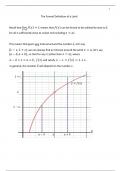
This means that given any interval around the number 𝐿, let’s say
(𝐿 − 𝜖, 𝐿 + 𝜖), we can always find an interval around the point 𝑥 = 𝑎, let’s say
(𝑎 − 𝛿, 𝑎 + 𝛿), so that for any 𝑥 (other than 𝑥 = 𝑎), where
𝑎 − 𝛿 < 𝑥 < 𝑎 + 𝛿, 𝑓(𝑥) will satisfy 𝐿 − 𝜖 < 𝑓 (𝑥 ) < 𝐿 + 𝜖.
In general, the number 𝛿 will depend on the number 𝜖.
𝐿+𝜖
𝑦 = 𝑓(𝑥)
𝐿
𝐿−𝜖
lim 𝑓 (𝑥 ) = 𝐷𝑁𝐸
𝑎−𝛿 𝑎 𝑎 +𝑥→3
𝛿
, 2
So in order to prove that lim 𝑓 (𝑥 ) = 𝐿, we will need to show that given ANY 𝜖 > 0
𝑥→𝑎
we can find a 𝛿 > 0 (where 𝛿 is a function of 𝜖 ) so that if
𝑎 − 𝛿 < 𝑥 < 𝑎 + 𝛿 , with 𝑥 ≠ 𝑎, then 𝐿 − 𝜖 < 𝑓(𝑥 ) < 𝐿 + 𝜖 .
Notice that 𝑎 − 𝛿 < 𝑥 < 𝑎 + 𝛿 , with 𝑥 ≠ 𝑎 is the same as:
0 < |𝑥 − 𝑎| < 𝛿 , and
𝐿 − 𝜖 < 𝑓(𝑥 ) < 𝐿 + 𝜖 is the same as:
|𝑓 (𝑥 ) − 𝐿| < 𝜖.
Thus one often sees the definition of lim 𝑓 (𝑥 ) = 𝐿 as
𝑥→𝑎
𝐥𝐢𝐦 𝒇(𝒙) = 𝑳 means given any 𝜖 > 0 there exists (or we can find) a 𝛿 > 0 such
𝒙→𝒂
that |𝑓 (𝑥 ) − 𝐿| < 𝜖 whenever 0 < |𝑥 − 𝑎| < 𝛿 .
The Formal Definition of a Limit
Recall that lim 𝑓 (𝑥 ) = 𝐿 means that 𝑓(𝑥) can be forced to be arbitrarily close to 𝐿
𝑥→𝑎
for all 𝑥 sufficiently close to 𝑎 (but not including 𝑥 = 𝑎 ).
This means that given any interval around the number 𝐿, let’s say
(𝐿 − 𝜖, 𝐿 + 𝜖), we can always find an interval around the point 𝑥 = 𝑎, let’s say
(𝑎 − 𝛿, 𝑎 + 𝛿), so that for any 𝑥 (other than 𝑥 = 𝑎), where
𝑎 − 𝛿 < 𝑥 < 𝑎 + 𝛿, 𝑓(𝑥) will satisfy 𝐿 − 𝜖 < 𝑓 (𝑥 ) < 𝐿 + 𝜖.
In general, the number 𝛿 will depend on the number 𝜖.
𝐿+𝜖
𝑦 = 𝑓(𝑥)
𝐿
𝐿−𝜖
lim 𝑓 (𝑥 ) = 𝐷𝑁𝐸
𝑎−𝛿 𝑎 𝑎 +𝑥→3
𝛿
, 2
So in order to prove that lim 𝑓 (𝑥 ) = 𝐿, we will need to show that given ANY 𝜖 > 0
𝑥→𝑎
we can find a 𝛿 > 0 (where 𝛿 is a function of 𝜖 ) so that if
𝑎 − 𝛿 < 𝑥 < 𝑎 + 𝛿 , with 𝑥 ≠ 𝑎, then 𝐿 − 𝜖 < 𝑓(𝑥 ) < 𝐿 + 𝜖 .
Notice that 𝑎 − 𝛿 < 𝑥 < 𝑎 + 𝛿 , with 𝑥 ≠ 𝑎 is the same as:
0 < |𝑥 − 𝑎| < 𝛿 , and
𝐿 − 𝜖 < 𝑓(𝑥 ) < 𝐿 + 𝜖 is the same as:
|𝑓 (𝑥 ) − 𝐿| < 𝜖.
Thus one often sees the definition of lim 𝑓 (𝑥 ) = 𝐿 as
𝑥→𝑎
𝐥𝐢𝐦 𝒇(𝒙) = 𝑳 means given any 𝜖 > 0 there exists (or we can find) a 𝛿 > 0 such
𝒙→𝒂
that |𝑓 (𝑥 ) − 𝐿| < 𝜖 whenever 0 < |𝑥 − 𝑎| < 𝛿 .