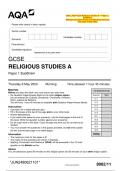
2024_AQA-GCSE Religious Studies A – Paper 1:
Buddhism
(Merged Question Paper and Marking Scheme)
Thursday 9 May 2024
Please write clearly in block capitals.
Centre number
Candidate number
Surname
Forename(s)
Candidate signature
I declare this is my own work .
GCSE
RELIGIOUS STUDIES A
Paper 1 Buddhism
Thursday 9 May 2024 Morning Time allowed: 1 hour 45 minutes
Materials For Examiner’s Use
Before you open this book, you must ensure you also have:
• the Question Paper/Answer Book for the other religion option Question Mark
you are entered for (Catholic Christianity, Christianity, Hinduism,
01.1
Islam, Judaism or Sikhism).
You will have 1 hour 45 minutes to complete both Question Paper/Answer Books. 01.2
01.3
Instructions
• Use black ink or black ball-point pen. 01.4
• Fill in the boxes at the top of this page and on your other book. 01.5
• Answer all questions.
02.1
• If you need extra space for your answer(s), use the lined pages at the end of
this book. Write the question number against your answer(s). 02.2
• Do all rough work in this book. Cross through any work you do not want to be 02.3
marked.
02.4
• You must answer the questions in the spaces provided. Do not write outside
the box around each page or on blank pages. 02.5
Information TOTAL
• The maximum mark for this paper is 51.
• The marks for the questions are shown in brackets.
• Spelling, Punctuation and Grammar (SPaG) will be assessed in the 12-mark
question in the Beliefs section.
Advice
You are advised to spend 50 minutes on this religion option and 50 minutes on your other religion option.
*JUN2480621101*
IB/M/Jun24/G4005/E5 8062/11
,GCSE Religious Studies A: Paper 1 - Buddhism Summary
The GCSE Religious Studies A: Paper 1 - Buddhism, scheduled for May 2025, will assess students'
understanding of Buddhist beliefs, practices, and teachings. This paper will focus on the core aspects of
Buddhism, including its history, key figures, the life of the Buddha, and how Buddhists live out their faith
today. Students will explore Buddhist teachings on suffering, the path to enlightenment, and the importance of
meditation, as well as the role of Buddhist communities in promoting these teachings.
Key Areas Covered:
1. The Life of the Buddha
The Early Life of Siddhartha Gautama: Students will study the life of Siddhartha Gautama, who
became the Buddha. This includes his birth, early life as a prince, his exposure to human suffering, and
his renunciation of royal life.
The Enlightenment: The story of how Siddhartha Gautama meditated under the Bodhi tree and
attained enlightenment, understanding the nature of suffering, its causes, and the way to overcome it.
The Buddha's Teachings: After enlightenment, the Buddha began to teach others about the nature of
suffering (dukkha) and the path to liberation. His key teachings include the Four Noble Truths and the
Eightfold Path.
The Buddha's Death (Parinirvana): Students will learn about the Buddha's passing and how his
death is seen as a final liberation from the cycle of rebirth.
2. The Four Noble Truths
The First Noble Truth – Dukkha (Suffering): The understanding that suffering exists in life. This
includes physical and emotional pain, aging, illness, and death.
The Second Noble Truth – Samudaya (The Cause of Suffering): The cause of suffering is craving
(tanha) and attachment to things that are temporary.
The Third Noble Truth – Nirodha (Cessation of Suffering): The possibility of ending suffering by
letting go of attachment and craving.
The Fourth Noble Truth – Magga (The Path to the End of Suffering): The Eightfold Path, which
provides a way to end suffering and achieve enlightenment.
3. The Eightfold Path
Right View: Understanding the Four Noble Truths and the nature of reality.
Right Intention: Cultivating the right attitudes and motivations, such as kindness and compassion.
Right Speech: Speaking truthfully and kindly, avoiding lies, gossip, and harmful speech.
Right Action: Acting ethically, including following the Five Precepts, which guide moral behavior.
Right Livelihood: Choosing a profession that does not harm others and aligns with Buddhist values.
Right Effort: Putting effort into cultivating good qualities and abandoning harmful ones.
Right Mindfulness: Being aware of the present moment, cultivating mindfulness in all aspects of life.
Right Concentration: Developing deep meditation and concentration to achieve insight and wisdom.
4. The Three Universal Truths
Anicca (Impermanence): The belief that all things are in a constant state of change and nothing is
permanent.
Dukkha (Suffering): The recognition that suffering is an inherent part of life, due to attachment and
desire.
Anatta (Non-Self): The idea that there is no permanent, unchanging self; the self is a collection of
changing experiences and phenomena.
5. Buddhist Practices
, Meditation: The role of meditation in Buddhism, including mindfulness meditation (vipassana) and
concentration meditation (samatha), which help cultivate mental clarity, concentration, and insight.
The Five Precepts: These ethical guidelines are followed by lay Buddhists, including refraining from
killing, stealing, lying, sexual misconduct, and intoxication.
Buddhist Rituals and Worship: The practice of offering food, incense, and chanting in temples, as
well as the importance of festivals such as Vesak (celebrating the Buddha’s birth, enlightenment, and
death).
Monastic Life: The role of monks and nuns in Buddhism, their vows, and their lifestyle dedicated to
meditation, study, and service.
6. Buddhist Sects
Theravada Buddhism: Focuses on the teachings of the historical Buddha and emphasizes personal
meditation and insight. It is most common in Southeast Asia (e.g., Thailand, Sri Lanka).
Mahayana Buddhism: Focuses on the bodhisattva path, where practitioners aspire to become
Buddhas for the benefit of all sentient beings. Mahayana is found in East Asia (e.g., China, Japan).
Vajrayana Buddhism: A form of Mahayana, practiced mainly in Tibet, which includes esoteric
practices such as rituals and the use of mantras.
7. Buddhism in the Modern World
The Role of Buddhism Today: Students will examine how Buddhism is practiced in modern society,
including its influence on global spiritual practices and its role in promoting mindfulness and mental
well-being.
Engaged Buddhism: The movement that applies Buddhist teachings to social, political, and
environmental issues, promoting peace, justice, and environmental sustainability.
8. The Role of Religious Texts in Buddhism
The Tripitaka (Pali Canon): The primary scriptures of Theravada Buddhism, including teachings of
the Buddha, monastic rules, and philosophical discussions.
Mahayana Sutras: The key texts of Mahayana Buddhism, which include teachings on the nature of
reality, bodhisattvas, and the path to enlightenment.
The Dhammapada: A key text in Theravada Buddhism that presents the Buddha’s teachings in verse
form, offering guidance on moral conduct, meditation, and wisdom.
, 2
Do not write
outside the
0 1 Buddhism: Beliefs box
0 1 .1 Which one of the following gives the meaning of anatta?
[1 mark]
Put a tick () in the box next to the correct answer.
A Impermanence
B No fixed self
C Suffering
D Teaching 1
0 1 .2 Give two of the Five Aggregates (skandhas).
[2 marks]
1
2
2
*02*
IB/M/Jun24/8062/11
Buddhism
(Merged Question Paper and Marking Scheme)
Thursday 9 May 2024
Please write clearly in block capitals.
Centre number
Candidate number
Surname
Forename(s)
Candidate signature
I declare this is my own work .
GCSE
RELIGIOUS STUDIES A
Paper 1 Buddhism
Thursday 9 May 2024 Morning Time allowed: 1 hour 45 minutes
Materials For Examiner’s Use
Before you open this book, you must ensure you also have:
• the Question Paper/Answer Book for the other religion option Question Mark
you are entered for (Catholic Christianity, Christianity, Hinduism,
01.1
Islam, Judaism or Sikhism).
You will have 1 hour 45 minutes to complete both Question Paper/Answer Books. 01.2
01.3
Instructions
• Use black ink or black ball-point pen. 01.4
• Fill in the boxes at the top of this page and on your other book. 01.5
• Answer all questions.
02.1
• If you need extra space for your answer(s), use the lined pages at the end of
this book. Write the question number against your answer(s). 02.2
• Do all rough work in this book. Cross through any work you do not want to be 02.3
marked.
02.4
• You must answer the questions in the spaces provided. Do not write outside
the box around each page or on blank pages. 02.5
Information TOTAL
• The maximum mark for this paper is 51.
• The marks for the questions are shown in brackets.
• Spelling, Punctuation and Grammar (SPaG) will be assessed in the 12-mark
question in the Beliefs section.
Advice
You are advised to spend 50 minutes on this religion option and 50 minutes on your other religion option.
*JUN2480621101*
IB/M/Jun24/G4005/E5 8062/11
,GCSE Religious Studies A: Paper 1 - Buddhism Summary
The GCSE Religious Studies A: Paper 1 - Buddhism, scheduled for May 2025, will assess students'
understanding of Buddhist beliefs, practices, and teachings. This paper will focus on the core aspects of
Buddhism, including its history, key figures, the life of the Buddha, and how Buddhists live out their faith
today. Students will explore Buddhist teachings on suffering, the path to enlightenment, and the importance of
meditation, as well as the role of Buddhist communities in promoting these teachings.
Key Areas Covered:
1. The Life of the Buddha
The Early Life of Siddhartha Gautama: Students will study the life of Siddhartha Gautama, who
became the Buddha. This includes his birth, early life as a prince, his exposure to human suffering, and
his renunciation of royal life.
The Enlightenment: The story of how Siddhartha Gautama meditated under the Bodhi tree and
attained enlightenment, understanding the nature of suffering, its causes, and the way to overcome it.
The Buddha's Teachings: After enlightenment, the Buddha began to teach others about the nature of
suffering (dukkha) and the path to liberation. His key teachings include the Four Noble Truths and the
Eightfold Path.
The Buddha's Death (Parinirvana): Students will learn about the Buddha's passing and how his
death is seen as a final liberation from the cycle of rebirth.
2. The Four Noble Truths
The First Noble Truth – Dukkha (Suffering): The understanding that suffering exists in life. This
includes physical and emotional pain, aging, illness, and death.
The Second Noble Truth – Samudaya (The Cause of Suffering): The cause of suffering is craving
(tanha) and attachment to things that are temporary.
The Third Noble Truth – Nirodha (Cessation of Suffering): The possibility of ending suffering by
letting go of attachment and craving.
The Fourth Noble Truth – Magga (The Path to the End of Suffering): The Eightfold Path, which
provides a way to end suffering and achieve enlightenment.
3. The Eightfold Path
Right View: Understanding the Four Noble Truths and the nature of reality.
Right Intention: Cultivating the right attitudes and motivations, such as kindness and compassion.
Right Speech: Speaking truthfully and kindly, avoiding lies, gossip, and harmful speech.
Right Action: Acting ethically, including following the Five Precepts, which guide moral behavior.
Right Livelihood: Choosing a profession that does not harm others and aligns with Buddhist values.
Right Effort: Putting effort into cultivating good qualities and abandoning harmful ones.
Right Mindfulness: Being aware of the present moment, cultivating mindfulness in all aspects of life.
Right Concentration: Developing deep meditation and concentration to achieve insight and wisdom.
4. The Three Universal Truths
Anicca (Impermanence): The belief that all things are in a constant state of change and nothing is
permanent.
Dukkha (Suffering): The recognition that suffering is an inherent part of life, due to attachment and
desire.
Anatta (Non-Self): The idea that there is no permanent, unchanging self; the self is a collection of
changing experiences and phenomena.
5. Buddhist Practices
, Meditation: The role of meditation in Buddhism, including mindfulness meditation (vipassana) and
concentration meditation (samatha), which help cultivate mental clarity, concentration, and insight.
The Five Precepts: These ethical guidelines are followed by lay Buddhists, including refraining from
killing, stealing, lying, sexual misconduct, and intoxication.
Buddhist Rituals and Worship: The practice of offering food, incense, and chanting in temples, as
well as the importance of festivals such as Vesak (celebrating the Buddha’s birth, enlightenment, and
death).
Monastic Life: The role of monks and nuns in Buddhism, their vows, and their lifestyle dedicated to
meditation, study, and service.
6. Buddhist Sects
Theravada Buddhism: Focuses on the teachings of the historical Buddha and emphasizes personal
meditation and insight. It is most common in Southeast Asia (e.g., Thailand, Sri Lanka).
Mahayana Buddhism: Focuses on the bodhisattva path, where practitioners aspire to become
Buddhas for the benefit of all sentient beings. Mahayana is found in East Asia (e.g., China, Japan).
Vajrayana Buddhism: A form of Mahayana, practiced mainly in Tibet, which includes esoteric
practices such as rituals and the use of mantras.
7. Buddhism in the Modern World
The Role of Buddhism Today: Students will examine how Buddhism is practiced in modern society,
including its influence on global spiritual practices and its role in promoting mindfulness and mental
well-being.
Engaged Buddhism: The movement that applies Buddhist teachings to social, political, and
environmental issues, promoting peace, justice, and environmental sustainability.
8. The Role of Religious Texts in Buddhism
The Tripitaka (Pali Canon): The primary scriptures of Theravada Buddhism, including teachings of
the Buddha, monastic rules, and philosophical discussions.
Mahayana Sutras: The key texts of Mahayana Buddhism, which include teachings on the nature of
reality, bodhisattvas, and the path to enlightenment.
The Dhammapada: A key text in Theravada Buddhism that presents the Buddha’s teachings in verse
form, offering guidance on moral conduct, meditation, and wisdom.
, 2
Do not write
outside the
0 1 Buddhism: Beliefs box
0 1 .1 Which one of the following gives the meaning of anatta?
[1 mark]
Put a tick () in the box next to the correct answer.
A Impermanence
B No fixed self
C Suffering
D Teaching 1
0 1 .2 Give two of the Five Aggregates (skandhas).
[2 marks]
1
2
2
*02*
IB/M/Jun24/8062/11