GCSE
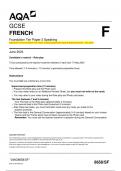
FRENCH
Foundation Tier Paper 2 Speaking
AQA-GCSE French Foundation Tier: Paper 2 Speaking (Question Paper & Marking Scheme) - June 2024.
F
June 2024
Candidate’s material – Role-play
To be conducted by the teacher-examiner between 2 April and 17 May 2024
Time allowed: 7–9 minutes (+ 12 minutes’ supervised preparation time)
Instructions
You must not use a dictionary at any time.
Supervised preparation time (12 minutes)
o Prepare this Role-play and the Photo card.
o You may make notes on an Additional Answer Sheet, but you must not write on the cards.
o You may refer to your notes during the Role-play and Photo card tasks.
The test (between 7 and 9 minutes)
Your first task is the Role-play (approximately 2 minutes).
o Your second task is the Photo card (maximum 2 minutes).
o After these two tasks, you must hand both cards and any notes you made to the
teacher-examiner.
o The final task is the General Conversation (approximately 3–5 minutes) based on your chosen
Theme and the Theme which has not been covered on the Photo card.
Remember: You must ask the teacher-examiner a question during the General Conversation.
Copyright information
For confidentiality purposes, all acknowledgements of third-party copyright material are published in a separate booklet. This booklet is published after
each live examination series and is available for free download from www.aqa.org.uk.
Permission to reproduce all copyright material has been applied for. In some cases, efforts to contact copyright-holders may have been unsuccessful and
AQA will be happy to rectify any omissions of acknowledgements. If you have any queries please contact the Copyright Team.
Copyright © 2024 AQA and its licensors. All rights reserved.
*246G8658/SF*
IB/H/Jun24/G4001/E5 8658/SF
, 2
What is questioned in the exam:
The Paper 2 Speaking exam usually consists of the following components:
1. Role-play (approximately 2-3 minutes):
You will be given a scenario in which you need to act out a conversation with the examiner.
You will be asked to respond to questions related to everyday situations such as ordering
food in a restaurant, asking for directions, or making travel plans. You need to demonstrate
your ability to use appropriate vocabulary and simple sentence structures.
2. Photo card (approximately 2 minutes):
You will be shown a photo card, and you will need to describe the picture and answer some
follow-up questions. The questions will usually relate to the people, actions, and setting in
the picture. You will also need to give an opinion or explain something related to the photo.
3. Conversation (approximately 5-6 minutes):
You will have a conversation with the examiner on a range of familiar topics. These could
include personal information (e.g., hobbies, family, school, holidays) or opinions on certain
subjects (e.g., music, films, technology). The examiner will ask you a series of questions,
and you will be expected to answer using full sentences.
Tips for passing the exam:
1. Practice speaking regularly:
Practice speaking French as much as possible before the exam. You can speak with
classmates, teachers, or even use language apps to improve your fluency. The more you
practice, the more confident you will be during the exam.
2. Review common topics:
Focus on common topics that are likely to come up in the exam. These include topics such
as:
o Family and friends
o Hobbies and leisure activities
o School life
o Travel and holidays
o Shopping and food
o Daily routines
3. Use simple and clear language:
In the Foundation Tier exam, it is better to use simple, clear sentences than to attempt
complex ones that you might get wrong. Make sure your sentences are grammatically
correct and easy to understand.
4. Learn useful vocabulary:
Make sure you know a range of vocabulary for various topics, such as colors, days of the
week, verbs, and adjectives to describe people and situations. Having a solid vocabulary
base will help you respond more easily.
5. Use connectives and opinions:
In the conversation part, aim to give detailed answers. Use words like parce que (because),
mais (but), par exemple (for example), and je pense que (I think that) to help structure your
responses and show that you can provide reasons for your opinions.
6. Listen carefully to the examiner:
When answering questions, make sure you fully understand the question before responding.
If you do not understand, don’t hesitate to ask the examiner to repeat the question.
7. Be confident:
Try not to worry if you make a mistake – just keep speaking and do your best. The
examiner is looking for your ability to communicate in French, not for perfection.
8. Practice with a partner:
If possible, practice mock speaking exams with a partner or teacher. This will help you get
comfortable with the format and timing of the exam.
, 9. Be prepared for follow-up questions:
The examiner may ask additional questions based on your responses, so be prepared to
expand on your answers. Practice answering questions in full sentences.
ROLE-PLAY 1
CANDIDATE’S ROLE
Instructions to candidates
Your teacher will play the part of your Belgian friend and will speak first.
You should address your friend as tu.
When you see this – ! – you will have to respond to something you have not prepared.
When you see this – ? – you will have to ask a question.
Tu parles de toi et de tes copains avec ton ami(e) belge.
Toi – ton âge et un détail personnel.
!
Un(e) de tes ami(e)s – description (deux détails).
Le week-end avec tes ami(e)s – une activité.
? Meilleur(e) ami(e).
, IB/H/Jun24/8658/SF
FRENCH
Foundation Tier Paper 2 Speaking
AQA-GCSE French Foundation Tier: Paper 2 Speaking (Question Paper & Marking Scheme) - June 2024.
F
June 2024
Candidate’s material – Role-play
To be conducted by the teacher-examiner between 2 April and 17 May 2024
Time allowed: 7–9 minutes (+ 12 minutes’ supervised preparation time)
Instructions
You must not use a dictionary at any time.
Supervised preparation time (12 minutes)
o Prepare this Role-play and the Photo card.
o You may make notes on an Additional Answer Sheet, but you must not write on the cards.
o You may refer to your notes during the Role-play and Photo card tasks.
The test (between 7 and 9 minutes)
Your first task is the Role-play (approximately 2 minutes).
o Your second task is the Photo card (maximum 2 minutes).
o After these two tasks, you must hand both cards and any notes you made to the
teacher-examiner.
o The final task is the General Conversation (approximately 3–5 minutes) based on your chosen
Theme and the Theme which has not been covered on the Photo card.
Remember: You must ask the teacher-examiner a question during the General Conversation.
Copyright information
For confidentiality purposes, all acknowledgements of third-party copyright material are published in a separate booklet. This booklet is published after
each live examination series and is available for free download from www.aqa.org.uk.
Permission to reproduce all copyright material has been applied for. In some cases, efforts to contact copyright-holders may have been unsuccessful and
AQA will be happy to rectify any omissions of acknowledgements. If you have any queries please contact the Copyright Team.
Copyright © 2024 AQA and its licensors. All rights reserved.
*246G8658/SF*
IB/H/Jun24/G4001/E5 8658/SF
, 2
What is questioned in the exam:
The Paper 2 Speaking exam usually consists of the following components:
1. Role-play (approximately 2-3 minutes):
You will be given a scenario in which you need to act out a conversation with the examiner.
You will be asked to respond to questions related to everyday situations such as ordering
food in a restaurant, asking for directions, or making travel plans. You need to demonstrate
your ability to use appropriate vocabulary and simple sentence structures.
2. Photo card (approximately 2 minutes):
You will be shown a photo card, and you will need to describe the picture and answer some
follow-up questions. The questions will usually relate to the people, actions, and setting in
the picture. You will also need to give an opinion or explain something related to the photo.
3. Conversation (approximately 5-6 minutes):
You will have a conversation with the examiner on a range of familiar topics. These could
include personal information (e.g., hobbies, family, school, holidays) or opinions on certain
subjects (e.g., music, films, technology). The examiner will ask you a series of questions,
and you will be expected to answer using full sentences.
Tips for passing the exam:
1. Practice speaking regularly:
Practice speaking French as much as possible before the exam. You can speak with
classmates, teachers, or even use language apps to improve your fluency. The more you
practice, the more confident you will be during the exam.
2. Review common topics:
Focus on common topics that are likely to come up in the exam. These include topics such
as:
o Family and friends
o Hobbies and leisure activities
o School life
o Travel and holidays
o Shopping and food
o Daily routines
3. Use simple and clear language:
In the Foundation Tier exam, it is better to use simple, clear sentences than to attempt
complex ones that you might get wrong. Make sure your sentences are grammatically
correct and easy to understand.
4. Learn useful vocabulary:
Make sure you know a range of vocabulary for various topics, such as colors, days of the
week, verbs, and adjectives to describe people and situations. Having a solid vocabulary
base will help you respond more easily.
5. Use connectives and opinions:
In the conversation part, aim to give detailed answers. Use words like parce que (because),
mais (but), par exemple (for example), and je pense que (I think that) to help structure your
responses and show that you can provide reasons for your opinions.
6. Listen carefully to the examiner:
When answering questions, make sure you fully understand the question before responding.
If you do not understand, don’t hesitate to ask the examiner to repeat the question.
7. Be confident:
Try not to worry if you make a mistake – just keep speaking and do your best. The
examiner is looking for your ability to communicate in French, not for perfection.
8. Practice with a partner:
If possible, practice mock speaking exams with a partner or teacher. This will help you get
comfortable with the format and timing of the exam.
, 9. Be prepared for follow-up questions:
The examiner may ask additional questions based on your responses, so be prepared to
expand on your answers. Practice answering questions in full sentences.
ROLE-PLAY 1
CANDIDATE’S ROLE
Instructions to candidates
Your teacher will play the part of your Belgian friend and will speak first.
You should address your friend as tu.
When you see this – ! – you will have to respond to something you have not prepared.
When you see this – ? – you will have to ask a question.
Tu parles de toi et de tes copains avec ton ami(e) belge.
Toi – ton âge et un détail personnel.
!
Un(e) de tes ami(e)s – description (deux détails).
Le week-end avec tes ami(e)s – une activité.
? Meilleur(e) ami(e).
, IB/H/Jun24/8658/SF