
Intro
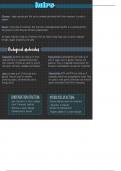
Monomer = single repeating unit that can be combined and bonded with other monomers to create a
polymer
Polymer= A long chain of monomers that have been chemically bonded together in a repeating pattern
The process in which they are formed is polymerisation.
An organic molecule is made up of elements that are found in living things such as carbon, hydrogen,
nitrogen, oxygen, phosphorus and sulfur.
Biological molecules
Polypeptides (proteins) are made up of amino Polysaccharides (carbohydrates) are made up of
acids and there is a peptide bond between units of sugars such as glucose, fructose and
each monomer. Proteins are used for growth galactose. There is a glycosidic bond between the
and repair, hormones, antibodies and enzymes. monomers. Carbohydrates are used for respiration.
Lipids are made up of 3 fatty acids and a Polynucleotides (DNA and RNA) are made up of
glycerol. They are used for insulation, nucleotides which have phosphodiester bonds. They
protecting organs, cell membranes and as are used to store genetic information and transfer
energy stores. genetic information from DNA to ribosomes.
Condensation reaction: Hydrolysis reaction:
Joins monomers to form a polymer Breaks polymers down into monomers
: Joins 2 molecules together
&
-
Separates 2 molecules
↑
Removes a water molecule Breaks the chemical bond
-
Chemical bond is formed : Requires addition of a water molecule
, Carbohydrates
Carbohydrates are made from monosaccharides and all contain the elements C, H and O.
I
Monosaccharides and disaccharides are simple carbohydrates
Monosaccharides Disaccharides
Consist of only one sugar molecule Monosaccharides combined in pairs form
They are soluble and sweet-tasting disaccharides
Have the general formula (CH O) where
n can be a number from 3 to 7 (isomers) Glucose + glucose = maltose
Examples are glucose, galactose and fructose Galactose + glucose = lactose
Fructose + glucose= sucrose
Glucose:
A hexose sugar (6 carbon atoms) Polysaccharides:
CHO -
Examples are glycogen, starch and cellulose
Has 2 isomers: alpha and beta -
They are polymers
Bonding via condensation polymerisation:
HO
so
H Oh
a-glucose
5
H
/ 0 H I
B-glucose OH
·
H
/
& HO H
OH HO
glycosidic bond
Cellulose:
Monomer = single repeating unit that can be combined and bonded with other monomers to create a
polymer
Polymer= A long chain of monomers that have been chemically bonded together in a repeating pattern
The process in which they are formed is polymerisation.
An organic molecule is made up of elements that are found in living things such as carbon, hydrogen,
nitrogen, oxygen, phosphorus and sulfur.
Biological molecules
Polypeptides (proteins) are made up of amino Polysaccharides (carbohydrates) are made up of
acids and there is a peptide bond between units of sugars such as glucose, fructose and
each monomer. Proteins are used for growth galactose. There is a glycosidic bond between the
and repair, hormones, antibodies and enzymes. monomers. Carbohydrates are used for respiration.
Lipids are made up of 3 fatty acids and a Polynucleotides (DNA and RNA) are made up of
glycerol. They are used for insulation, nucleotides which have phosphodiester bonds. They
protecting organs, cell membranes and as are used to store genetic information and transfer
energy stores. genetic information from DNA to ribosomes.
Condensation reaction: Hydrolysis reaction:
Joins monomers to form a polymer Breaks polymers down into monomers
: Joins 2 molecules together
&
-
Separates 2 molecules
↑
Removes a water molecule Breaks the chemical bond
-
Chemical bond is formed : Requires addition of a water molecule
, Carbohydrates
Carbohydrates are made from monosaccharides and all contain the elements C, H and O.
I
Monosaccharides and disaccharides are simple carbohydrates
Monosaccharides Disaccharides
Consist of only one sugar molecule Monosaccharides combined in pairs form
They are soluble and sweet-tasting disaccharides
Have the general formula (CH O) where
n can be a number from 3 to 7 (isomers) Glucose + glucose = maltose
Examples are glucose, galactose and fructose Galactose + glucose = lactose
Fructose + glucose= sucrose
Glucose:
A hexose sugar (6 carbon atoms) Polysaccharides:
CHO -
Examples are glycogen, starch and cellulose
Has 2 isomers: alpha and beta -
They are polymers
Bonding via condensation polymerisation:
HO
so
H Oh
a-glucose
5
H
/ 0 H I
B-glucose OH
·
H
/
& HO H
OH HO
glycosidic bond
Cellulose:


