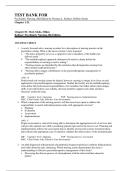
Complete Test Bank For
CHEMISTRY 10TH EDITION
BY KENNETH WHITTEN RAYMOND DAVIS LARRY PECK
(2023)||ALL CHATERS||VERIFIED
,Chapter 1—The Foundations Of Chemistry
Multiple Choice
1. Which Of The Following Statements Is Incorrect?
A. A Body In Motion Possesses Kinetic Energy Because Of Its Motion.
B. An Object Possesses Potential Energy Because Of Its Position Or Composition.
C. Nuclear Energy Is An Important Kind Of Potential Energy.
D. Chemical Reactions And Physical Changes That Release Energy To Their Surroundings Are
Endothermic.
E. The Law Of Conservation Of Matter And Energy States That The Combined Amount Of Matter
And Energy In The Universe Is Fixed.
Ans>>D
Obj: Define The Laws Of Conservation Of Matter And Energy. | Define The Terms Endothermic And
Exothermic. | Classify Energy As Potential Or Kinetic.
Top: Matter And Energy
2. A Braking Automobile Converts Kinetic Energy Into Heat In The Brake Pads. This Is An Example
Of The:
A. Law Of Conservation Of Energy
B. Law Of Constant Composition
C. Law Of Conservation Of Matter
D. Law Of Multiple Proportions
E. Law Of Gravity
Ans>>A
Obj: Apply The Law Of Conservation Of Energy. Top: Matter And Energy
3. When Magnesium Is Burned In Air The Mass Of The Product Is Heavier Than The Original Mass
Of The Magnesium. However, The Product Formed Still Has The Same Exact Mass Of Magnesium With
The Remainder Of The Mass Being Oxygen. This Is An Example Of:
A. Law Of Conservation Of Energy
B. Law Of Definite Proportions
,C. Law Of Conservation Of Matter
D. Law Of Multiple Proportions
E. Law Of Gravity
Ans>>C
Obj: Apply The Law Of Conservation Of Energy. Top: Matter And Energy
4. Which Of The Following Represents Matter That Could Be Described As Macroscale?
A. A Bromine Atom
B. Molecules Of Water
C. Bacteria Observed Under A Microscope
D. A Paperclip
E. None Of These
Ans>>D
Obj: Classify A Description Of Matter As Atomic-, Micro-, Or Macro-Scale. Top: Chemistry – A Molecular
View Of Matter
5. Dalton's Atomic Theory Included All Of The Ideas Listed Below Except:
A. Atoms Cannot Be Created Or Destroyed.
B. An Element Is Composed Of Very Small Particles Called Protons, Neutrons And Electrons.
C. All Atoms Of A Given Element Have Identical Properties.
D. All Atoms Of A Given Element Have Properties That Differ From Those Of Other Elements.
E. Compounds Are Formed When Atoms Of Different Elements Combine With One Another In
Small Whole-Number Ratios.
Ans>>B
Obj: Identify The Tenets Of Dalton's Atomic Theory. Top: Chemistry – A Molecular View Of Matter
6. Atoms Consist Of Three Fundamental Particles. What Are These Particles And Their Charges?
A. Proton (+1), Neutron (Neutral) And Electron (-1)
, B. Proton (-1), Neutron (+1) And Electron (Neutral)
C. Proton (+1), Neutron (-1) And Electron (Neutral)
D. Proton (Neutral), Neutron (+1) And Electron (-1)
E. Proton (-1), Neutron (Neutral) And Electron (+1)
Ans>>A
Obj: Identify The Three Subatomic Particles That Make Up An Atom. Top: Chemistry – A Molecular View
Of Matter
7. One Of The Following Does Not Describe Gases. Which One Is It?
A. Expands Infinitely.
B. Rigid Shape.
C. Easily Compressed.
D. Relatively Low Densities.
E. Particles Far Apart.
Ans>>B
Obj: Classify A Gas. Top: States Of Matter
8. One Of The Following Does Not Describe Solids. Which One Is It?
A. Particles In Definite Positions.
B. Definite Shape.
C. Easily Compressed.
D. Relatively High Densities.
E. Particles Compact.
Ans>>C
Obj: Classify A Solid. Top: States Of Matter
9. Which Response Lists Characteristics Of Liquids?
I. Volume Does Not Vary Much Upon Heating.
CHEMISTRY 10TH EDITION
BY KENNETH WHITTEN RAYMOND DAVIS LARRY PECK
(2023)||ALL CHATERS||VERIFIED
,Chapter 1—The Foundations Of Chemistry
Multiple Choice
1. Which Of The Following Statements Is Incorrect?
A. A Body In Motion Possesses Kinetic Energy Because Of Its Motion.
B. An Object Possesses Potential Energy Because Of Its Position Or Composition.
C. Nuclear Energy Is An Important Kind Of Potential Energy.
D. Chemical Reactions And Physical Changes That Release Energy To Their Surroundings Are
Endothermic.
E. The Law Of Conservation Of Matter And Energy States That The Combined Amount Of Matter
And Energy In The Universe Is Fixed.
Ans>>D
Obj: Define The Laws Of Conservation Of Matter And Energy. | Define The Terms Endothermic And
Exothermic. | Classify Energy As Potential Or Kinetic.
Top: Matter And Energy
2. A Braking Automobile Converts Kinetic Energy Into Heat In The Brake Pads. This Is An Example
Of The:
A. Law Of Conservation Of Energy
B. Law Of Constant Composition
C. Law Of Conservation Of Matter
D. Law Of Multiple Proportions
E. Law Of Gravity
Ans>>A
Obj: Apply The Law Of Conservation Of Energy. Top: Matter And Energy
3. When Magnesium Is Burned In Air The Mass Of The Product Is Heavier Than The Original Mass
Of The Magnesium. However, The Product Formed Still Has The Same Exact Mass Of Magnesium With
The Remainder Of The Mass Being Oxygen. This Is An Example Of:
A. Law Of Conservation Of Energy
B. Law Of Definite Proportions
,C. Law Of Conservation Of Matter
D. Law Of Multiple Proportions
E. Law Of Gravity
Ans>>C
Obj: Apply The Law Of Conservation Of Energy. Top: Matter And Energy
4. Which Of The Following Represents Matter That Could Be Described As Macroscale?
A. A Bromine Atom
B. Molecules Of Water
C. Bacteria Observed Under A Microscope
D. A Paperclip
E. None Of These
Ans>>D
Obj: Classify A Description Of Matter As Atomic-, Micro-, Or Macro-Scale. Top: Chemistry – A Molecular
View Of Matter
5. Dalton's Atomic Theory Included All Of The Ideas Listed Below Except:
A. Atoms Cannot Be Created Or Destroyed.
B. An Element Is Composed Of Very Small Particles Called Protons, Neutrons And Electrons.
C. All Atoms Of A Given Element Have Identical Properties.
D. All Atoms Of A Given Element Have Properties That Differ From Those Of Other Elements.
E. Compounds Are Formed When Atoms Of Different Elements Combine With One Another In
Small Whole-Number Ratios.
Ans>>B
Obj: Identify The Tenets Of Dalton's Atomic Theory. Top: Chemistry – A Molecular View Of Matter
6. Atoms Consist Of Three Fundamental Particles. What Are These Particles And Their Charges?
A. Proton (+1), Neutron (Neutral) And Electron (-1)
, B. Proton (-1), Neutron (+1) And Electron (Neutral)
C. Proton (+1), Neutron (-1) And Electron (Neutral)
D. Proton (Neutral), Neutron (+1) And Electron (-1)
E. Proton (-1), Neutron (Neutral) And Electron (+1)
Ans>>A
Obj: Identify The Three Subatomic Particles That Make Up An Atom. Top: Chemistry – A Molecular View
Of Matter
7. One Of The Following Does Not Describe Gases. Which One Is It?
A. Expands Infinitely.
B. Rigid Shape.
C. Easily Compressed.
D. Relatively Low Densities.
E. Particles Far Apart.
Ans>>B
Obj: Classify A Gas. Top: States Of Matter
8. One Of The Following Does Not Describe Solids. Which One Is It?
A. Particles In Definite Positions.
B. Definite Shape.
C. Easily Compressed.
D. Relatively High Densities.
E. Particles Compact.
Ans>>C
Obj: Classify A Solid. Top: States Of Matter
9. Which Response Lists Characteristics Of Liquids?
I. Volume Does Not Vary Much Upon Heating.