Lecture 1: Introduction
Research strategies: quantitative and qualitative approaches;
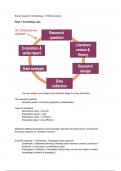
Steps in the research process: the empirical cycle;
Research design issues: experimental, cross- sectional, longitudinal,
case study, comparative design;
Research projects are multidisciplinary: scientists from different
backgrounds need to work together;
“The method is the servant, not the master”: you should FIRST
formulate research questions and aims, and THEN decide which
method is the best given the specific questions and aims;
Why conducting research?
- “Academics conduct research because (...) questions occur to
them.” (...) “at its core, it [research] is done because there is an
aspect of our understanding of what goes on in society that is to
some extent unresolved” (Bryman, p.3)
- “all life is problem solving”- Karl Popper
- “the research scientist is (...) a solver of puzzles”- Thomas Kuhn
What is scientific research?
- Systematic: deliberate planning, following clear research process.
You should have a plan, not only trust your intuition
- Verifiable, controllable, transparent: clarification and reflection
about how one has established certain knowledge.
- Empirical evidence ultimately decides: data that will help about
your conclusion.
- “Attention to these steps is what distinguishes academic social
research from other kinds of social research” (Bryman, p.14)
,Steps in the research process
- “At this point, I am not going to try to sequence the various stages
or elements, as the sequencing varies somewhat according to
different research strategies” (Bryman, p.6)
1. Research question
2. Literature review
3. Concepts and theory
4. Selection of research units (sampling cases)
5. Data collection
6. Data analysis
7. Writing up
,The messiness of social research (p.13):
- “Reconstructed logic”: a clear, step-for-step procedure VS “Logic
in practice”: more chaotic, depends on the project, less strict
rules, more craftsmanship.
- “There are plenty of things that can go wrong” (p.14). Therefore:
need for flexibility and need for perseverance.
Research question: very important
Motivation and relevance
- Scientific puzzle? Or focus on particular implications for society or
particular stakeholders?
Type of questions: they shape your research
- Exploratory study
- Descriptive study
- Explanatory study
- Evaluative study
Q influences all other phases of research process
- Which literature are you going to search for?
, - Research design? (e.g. population and sampling)
- Which analysis?
- Conclusions and recommendations
Formulate research questions
- Explorative = inventory: which kind of issues are defined as
mental health problem? Which concerns exist about students’
wellbeing? Explore the phenomenon (Y).
- Descriptive = How many first year students in the Netherlands
suffer from mental health problems? How do students perceive
their own wellbeing? One step further. Describe the amount or
perception of Y.
- Explanatory (why?) = Which factors have a positive or negative
impact on the mental health of students? To what extent can Y be
explained by X?
- Evaluative (how effective?) = How effective are mindfulness
courses to improve mental health among students? What are the
advantages and disadvantages of different possible interventions?
To what extent an intervention to influence Y has had an effect?
The textbook (Bryman) in addition also lists other types of research
questions:
- Prediction: how large is the group students with mental health
problems expected to be in 2020? How will Y be in the future?
- Develop good practice = what is the best way to reduce stress
among students? How can we most effectively improve the
situation regarding Y?
- Empowerment = how can students themselves improve their
mental wellbeing? How can the research subjects improve their
situation (Y) themselves?
Research strategies: quantitative and qualitative approaches;
Steps in the research process: the empirical cycle;
Research design issues: experimental, cross- sectional, longitudinal,
case study, comparative design;
Research projects are multidisciplinary: scientists from different
backgrounds need to work together;
“The method is the servant, not the master”: you should FIRST
formulate research questions and aims, and THEN decide which
method is the best given the specific questions and aims;
Why conducting research?
- “Academics conduct research because (...) questions occur to
them.” (...) “at its core, it [research] is done because there is an
aspect of our understanding of what goes on in society that is to
some extent unresolved” (Bryman, p.3)
- “all life is problem solving”- Karl Popper
- “the research scientist is (...) a solver of puzzles”- Thomas Kuhn
What is scientific research?
- Systematic: deliberate planning, following clear research process.
You should have a plan, not only trust your intuition
- Verifiable, controllable, transparent: clarification and reflection
about how one has established certain knowledge.
- Empirical evidence ultimately decides: data that will help about
your conclusion.
- “Attention to these steps is what distinguishes academic social
research from other kinds of social research” (Bryman, p.14)
,Steps in the research process
- “At this point, I am not going to try to sequence the various stages
or elements, as the sequencing varies somewhat according to
different research strategies” (Bryman, p.6)
1. Research question
2. Literature review
3. Concepts and theory
4. Selection of research units (sampling cases)
5. Data collection
6. Data analysis
7. Writing up
,The messiness of social research (p.13):
- “Reconstructed logic”: a clear, step-for-step procedure VS “Logic
in practice”: more chaotic, depends on the project, less strict
rules, more craftsmanship.
- “There are plenty of things that can go wrong” (p.14). Therefore:
need for flexibility and need for perseverance.
Research question: very important
Motivation and relevance
- Scientific puzzle? Or focus on particular implications for society or
particular stakeholders?
Type of questions: they shape your research
- Exploratory study
- Descriptive study
- Explanatory study
- Evaluative study
Q influences all other phases of research process
- Which literature are you going to search for?
, - Research design? (e.g. population and sampling)
- Which analysis?
- Conclusions and recommendations
Formulate research questions
- Explorative = inventory: which kind of issues are defined as
mental health problem? Which concerns exist about students’
wellbeing? Explore the phenomenon (Y).
- Descriptive = How many first year students in the Netherlands
suffer from mental health problems? How do students perceive
their own wellbeing? One step further. Describe the amount or
perception of Y.
- Explanatory (why?) = Which factors have a positive or negative
impact on the mental health of students? To what extent can Y be
explained by X?
- Evaluative (how effective?) = How effective are mindfulness
courses to improve mental health among students? What are the
advantages and disadvantages of different possible interventions?
To what extent an intervention to influence Y has had an effect?
The textbook (Bryman) in addition also lists other types of research
questions:
- Prediction: how large is the group students with mental health
problems expected to be in 2020? How will Y be in the future?
- Develop good practice = what is the best way to reduce stress
among students? How can we most effectively improve the
situation regarding Y?
- Empowerment = how can students themselves improve their
mental wellbeing? How can the research subjects improve their
situation (Y) themselves?