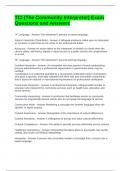
TCI (The Community Interpreter) Exam
Questions and Answers
"A" Language - Answer-The interpreter's primary or native language.
Adjunct Interpreter (Dual Role) - Answer-A bilingual employee called upon to interpreter
on occasion or part-time as one of his or her professional duties.
Advocacy - Answer-An action taken by the interpreter on behalf of a client when the
client's safety, well-being, dignity or equal access to a public service are compromised
or at risk.
"B" Language - Answer-The interpreter's second working language
Certified Interpreter - Answer--An interpreter who has passed a formal credentialing
process administered by a professional organization or government entity may be
certified.
-Certification is a credential awarded by a recognized certification body to interpreters
who pass a rigorous, externally validated skill tests with oral and written components
that is based on national or international requirements for professional certification.
Community Interpreter - Answer-A professional interpreter, bilingual staff member or
volunteer who interprets for community services such as health care, education and
social services
Community Interpreting - Answer-A profession that facilitates access to community
services for linguistically diverse clients who do not speak the language of service.
Consecutive Mode - Answer-Rendering a message into another language when the
speaker or signer pauses.
Cultural Awareness - Answer-Recognition of the importance of cultural differences
Cultural Sensitivity - Answer-A willlingness to accept and value cultural differences
Cultural Competence - Answer-The ability to provide services effectively across cultures
Healthcare Interpreting - Answer-Interpreting that takes place in any health care facility
setting; also known as Medical Interpreting
Interpreter - Answer-A person who accurately renders a message from a source into a
target language
, Interpreting - Answer-The process of interpreting is to facilitate communication between
those who do not share a common language
LEP - Answer-Limited English Proficiency, Individuals who do not speak English as their
first language.
Sight Translation - Answer-The oral or signed translation of a written document (For
example, the reading of a brochure)
Simultaneous Mode - Answer-Rendering a message into an other language while a
person is still speaking or signing the message.
Source Language - Answer-The language from which an interpreter interprets at any
given moment
Summarization - Answer-Rendering the gist of a message into an other language
Target Language - Answer-The language into which an interpreter interprets at any
given moment
Translator - Answer-A person who professionally renders a written text into another
language in writing.
Transparency - Answer-Interpreting everything that is said or signed, including remarks
addressed to the interpreter or any intervention by the interpreter.
Working Languages - Answer-The languages into and from which one interprets
What Is Community Interpreting? - Answer-A profession that facilitates access to
community services for linguistically diverse clients who do not speak the language of
service.
Who Is A Community Interpreter? - Answer-A professional interpreter, bilingual staff
member or volunteer who interprets for health care, education or other community
services.
How Is Community Interpreting Delivered? - Answer-In person, on the phone or by
video.
When Was The Profession First Established? - Answer-In 1927 when simultaneous
interpreting was performed professionally in public in Geneva.
Where And When Was Community Interpreter Born? - Answer-It was born in 1970 in
Australia
Then in the late 80s and 90s came to the US.
Questions and Answers
"A" Language - Answer-The interpreter's primary or native language.
Adjunct Interpreter (Dual Role) - Answer-A bilingual employee called upon to interpreter
on occasion or part-time as one of his or her professional duties.
Advocacy - Answer-An action taken by the interpreter on behalf of a client when the
client's safety, well-being, dignity or equal access to a public service are compromised
or at risk.
"B" Language - Answer-The interpreter's second working language
Certified Interpreter - Answer--An interpreter who has passed a formal credentialing
process administered by a professional organization or government entity may be
certified.
-Certification is a credential awarded by a recognized certification body to interpreters
who pass a rigorous, externally validated skill tests with oral and written components
that is based on national or international requirements for professional certification.
Community Interpreter - Answer-A professional interpreter, bilingual staff member or
volunteer who interprets for community services such as health care, education and
social services
Community Interpreting - Answer-A profession that facilitates access to community
services for linguistically diverse clients who do not speak the language of service.
Consecutive Mode - Answer-Rendering a message into another language when the
speaker or signer pauses.
Cultural Awareness - Answer-Recognition of the importance of cultural differences
Cultural Sensitivity - Answer-A willlingness to accept and value cultural differences
Cultural Competence - Answer-The ability to provide services effectively across cultures
Healthcare Interpreting - Answer-Interpreting that takes place in any health care facility
setting; also known as Medical Interpreting
Interpreter - Answer-A person who accurately renders a message from a source into a
target language
, Interpreting - Answer-The process of interpreting is to facilitate communication between
those who do not share a common language
LEP - Answer-Limited English Proficiency, Individuals who do not speak English as their
first language.
Sight Translation - Answer-The oral or signed translation of a written document (For
example, the reading of a brochure)
Simultaneous Mode - Answer-Rendering a message into an other language while a
person is still speaking or signing the message.
Source Language - Answer-The language from which an interpreter interprets at any
given moment
Summarization - Answer-Rendering the gist of a message into an other language
Target Language - Answer-The language into which an interpreter interprets at any
given moment
Translator - Answer-A person who professionally renders a written text into another
language in writing.
Transparency - Answer-Interpreting everything that is said or signed, including remarks
addressed to the interpreter or any intervention by the interpreter.
Working Languages - Answer-The languages into and from which one interprets
What Is Community Interpreting? - Answer-A profession that facilitates access to
community services for linguistically diverse clients who do not speak the language of
service.
Who Is A Community Interpreter? - Answer-A professional interpreter, bilingual staff
member or volunteer who interprets for health care, education or other community
services.
How Is Community Interpreting Delivered? - Answer-In person, on the phone or by
video.
When Was The Profession First Established? - Answer-In 1927 when simultaneous
interpreting was performed professionally in public in Geneva.
Where And When Was Community Interpreter Born? - Answer-It was born in 1970 in
Australia
Then in the late 80s and 90s came to the US.