100% satisfaction guarantee Immediately available after payment Both online and in PDF No strings attached 4.2 TrustPilot
logo-home
Exam (elaborations)

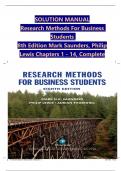
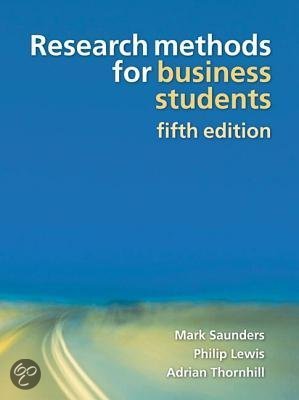
SOLUTION MANUAL Research Methods For Business Students 8th Edition Mark Saunders, Philip Lewis Chapters 1 - 14, Complete

Rating
-
Sold
-
Pages
125
Grade
A+
Uploaded on
13-12-2024
Written in
2024/2025

Contents Chapters Pages Introduction 5 1 Business and management research, reflective diaries and the purpose of this book 15 2 Choosing a research topic and developing your research proposal 19 3 Critically reviewing the literature 23 4 Understanding research philosophy and approaches to theory development27 5 Formulating the research design 32 6 Negotiating access and research ethics 36 7 Selecting samples 40 8 Utilising secondary data 44 9 Collecting data through observation 48 10 Collecting primary data using research interviews and research diaries 54 11 Collecting primary data using questionnaires 59 12 Analysing data quantitatively 63 13 Analysing data qualitatively 68 14 Writing and presenting your project report 72 Appendix 75 1 Research project assignment 75 2 Group poster research project assignment 80 3 Research proposal assignment 84 4 Additional cases on the companion website 89 5 © Pearson Education Limited 2019 INTRODUCTION An overview of the instructors’ manual This instructors’ manual provides commentary for the eighth edition of the textbook Research Methods for Business Students. The commentary is on a chapter by chapter basis and includes: chapter learning outcomes; summary of the content; comments on likely student reactions and possible use of materials; ideas for students’ preparatory work; suggestions for delivery in the classroom; ideas for students’ follow-up work. In addition, we have included a copy of a research project assignment, a group research projectposter assignment and a copy of a dissertation proposal assignment as appendices. Research Methods for Business – an overview of the eighth edition Pedagogic features The over-riding purpose of Research Methods for Business Students is to help undergraduate and postgraduate students and students on professional courses to undertake research. Each chapter deals with a part of the research process and discusses the ideas, techniques and methods using aslittle jargon as is possible. Tables, checklists and diagrams are used to aid this discussion. Wherenew terms are introduced for the first time, they are shown in bold, and a definition or explanation follows shortly afterwards. They are also listed with a brief definition in the glossary. The application of appropriate information technology is considered, in most instances as an integral part of the text. Chapters have been cross￾referenced as appropriate, and an index is provided tohelp students find their way around the book. Focus on student research boxes are included within the text of each chapter. These are basedon actual research projects, undertaken by students, in which points made in the text are illustrated. In many instances, these worked examples illustrate possible pitfalls students may come across while undertaking their research. Where a pitfall has been illustrated, it will, it is hoped, help your students avoid making the same mistake. Further illustrations are provided by focus on management research and research in the news boxes. Focus on management research boxes discuss recent research in business and management. These are normally derived from refereed academic journal articles, and students are likely to beable to download the actual articles from online databases at their university. Focus on research in the news boxes provide topical news articles that illustrate pertinent research-related issues. All these will help students to understand the technique or idea 6 © Pearson Education Limited 2019 and to assess its suitability or appropriateness to their research. Boxed checklists provide students withfurther focussed guidance for their own research. Saunders, Research Methods for Business Students, 8e, Instructor’s Manual 7 © Pearson Education Limited 2019 A summary of key points at the end of each chapter can be used by students before and after reading the chapter to ensure that they have digested the main points. Self-check questions enable students to check they have understood the chapter. These can all be answered without recourse to other (external) resources. Answers are provided to all the self- check questions at the end of each chapter. Review and discuss questions follow the self-check questions. These suggest a variety of activities students can undertake to help them further develop their knowledge and understanding of the material in the chapter, often involving discussion with a friend. Self-test multiple choice questions and true/false questions for each chapter are available on this book’s companion website. All chapters include a section towards the end titled “Progressing your research project” that can be undertaken as part of the student’s research project. These are presented in sufficient detail to enable them to focus on the techniques that are most appropriate to his or her research. By completing all these sections, the student will have also completed his or her project report. Each chapter is also accompanied by references, further reading and a case study. Further reading is included for two distinct reasons: ▪ to direct students to other work on the ideas contained within the chapter; ▪ to direct students to further examples of research where the ideas contained in the chapterhave been used. Case studies at the end of each chapter are all new to the eighth edition. They have been drawn from a variety of business and management research scenarios and have been based on the case study’sauthors’ students’ experiences when undertaking a research project. They have been written to highlight real issues that occur when undertaking business and management research. To help focusstudents’ thoughts or discussion on some of the pertinent issues, each case is followed by evaluativequestions, answers to which are provided on the Instructors’ Companion Web Site. A case study follows every chapter. A further 75 case studies from earlier editions of the book are available onthe Students’ Companion Web Site; answers to these cases are provided on the Instructors’ Companion Web Site. A complete list of these cases is provided in Appendix 4. Contents Chapter 1 outlines the nature of research and, more specifically, of business and management research. The basic versus applied research and relevance debates are considered and advice offered regarding keeping a reflective diary or notebook. The chapter concludes with an overview of the purpose and structure of the book. Chapter 2 is written to assist students in the generation of ideas, which will help them to choosea suitable research topic, and offers advice on what makes a good research topic. If your students have already been given a research topic, perhaps by an organisation or tutor, they will need torefine it into one that is feasible and should still therefore read this chapter. After their idea hasbeen generated and refined, the chapter discusses how to turn this idea into clear research question(s) and objectives. (Research questions and objectives are referred to throughout the book.) Finally, the chapter provides advice on how to write a research proposal. Saunders, Research Methods for Business Students, 8e, Instructor’s Manual 8 © Pearson Education Limited 2019 The importance of the critical literature review to students’ research is discussed in Chapter 3. This chapter outlines what a critical review needs to include and the range of secondary and primary literature sources available. The chapter explains the purpose of reviewing the literature,discusses a range of search strategies and contains advice on how to plan and undertake a search and to write the review. The processes of identifying key words and searching using online databases and the Internet are outlined. It also offers advice on how to record items and to evaluate their relevance as well as discussing plagiarism. Chapter 4 addresses the issue of understanding different research philosophies including positivism, critical realism, interpretivism, post modernism and pragmatism. Within this, the functionalist, interpretive, radical humanist and radical structuralist paradigms are discussed. Deductive, inductive, abductive and retroductive approaches to theory development are also considered. In this chapter, students are challenged to think about their own values and how they view the world and the impact this will have on the way they undertake their research. These ideas are developed further in Chapter 5, which explores the process of research design. As part of this, the methodological choice of quantitative, qualitative or mixed methods is considered. A variety of research strategies are explored and longitudinal and cross￾sectional time horizons discussed. Consideration is given to the implications of design choice for the credibility of students’ research findings and conclusions. Chapter 6 explores issues related to gaining access and to research ethics. It offers advice on howto gain physical and cognitive access both to organisations and to individuals using both traditional and Internet-mediated strategies. Potential ethical issues are discussed in relation to each stage of the research process and different data collection methods. Issues of data protectionand data management are also introduced. A range of the probability and non-probability sampling techniques available for use by studentsin their research is explained in Chapter 7. The chapter considers why sampling is necessary andlooks at issues of sample size and likely response rates for both probability and non-probabilitysamples. Advice on how to relate the choice of sampling techniques to the research topic is given, and the techniques for assessing the representativeness of those who respond are discussed. Chapters 8, 9, 10 and 11 are concerned with different methods of obtaining data. The use of secondary data is discussed in Chapter 8, which introduces the variety of data that are likely to be available and suggests ways in which they can be used. The advantages and disadvantages of secondary data are discussed, and a range of techniques for locating these data is suggested. Chapter 8 provides an indication of the myriad of sources available via the Internet and also offers advice to students on how to evaluate the suitability of secondary data for their research. Chapter 9 is concerned with collecting data through observation. Three observation methods are presented and discussed in this chapter: participant observation, structured observation and Internet-mediated observation. This chapter also discusses the use of videography, audio- recording and static visual images in the collection of observational data. These approaches areconsidered in turn to allow practical advice on each to be offered and their respective data quality issues to be discussed. Saunders, Research Methods for Business Students, 8e, Instructor’s Manual 9 © Pearson Education Limited 2019 Chapter 10 is concerned with collecting primary data using research interviews and research diaries. Types of research interview are outlined and their appropriateness discussed. Advice onhow to conduct in-depth and semi-structured research interviews is offered, including group interviews and focus groups, telephone interviews, Internet￾mediated interviews and visual interviews. Attention is given to the respective advantages and disadvantages of these types of research interview. This chapter also introduces research diaries and discusses advantages and issues associated with their use. Chapter 11 is the final chapter concerned with collecting data. It introduces students to the use of both self-completed and interviewer-completed questionnaires and explores their advantages and disadvantages. Practical advice is offered on the process of designing, piloting and delivering Internet; SMS, postal, delivery and collection and telephone and face-to-face questionnaires to enhance their response rates. Particular attention is again given to ensuring that the data collected are both reliable and valid. Analysis of data is covered in Chapters 12 and 13. Chapter 12 outlines and illustrates the main issues that students need to consider when preparing data for quantitative analysis and when analysing these data by computer. Different types of data are defined, and advice is given on howto categorise and code text and visual data and create a data matrix and to code data. Practical advice is also offered on the analysis of these data using computerised analysis software. The most appropriate diagrams to explore and illustrate data are discussed, and suggestions are made about the most appropriate statistics to use, to describe data, to explore relationships and to examine trends. Chapter 13 outlines and discusses the main approaches available to students to analyse data qualitatively both manually and using Computer-Aided Qualitative Analysis Software (CAQDAS). The nature of qualitative data and analysis, and issues associated with transcription, are discussed. A number of aids that will help students to analyse these data and record their ideas about progressing their research are also discussed. The chapter then outlines and briefly evaluatesa number of techniques to analyse data qualitatively. Chapter 14 helps students with the structure, content and style of their final project report (dissertation) and any associated oral and poster presentations. Differences between consultancy(management) reports and project reports (dissertations) are outlined. Above all, the chapter encourages students to see writing as an intrinsic part of the research process that should not beleft until everything else is completed. This chapter also includes sections on writing a reflectiveessay and making presentations. In addition, there are four appendices including guidance on author-date (Harvard, American Psychological Association) and numeric (Vancouver) styles of referencing and guidelines for non-discriminatory language. The eighth edition also includes an extensive glossary of over 700research methods terms. Using Research Methods for Business Students This book is written with a progressive logic, which means that the terms and concepts are defined when they are first introduced. One implication of this is that it is sensible for students to start at the beginning and to work their way through the text and focus on student research boxes, focuson management research boxes, focus on research in the news boxes, self-check questions, review and discuss questions, case studies and case study questions. They can do this in a variety of ways depending on the reasons for using this book. However, this approach may not necessarily be suitable, and you may wish to use the chapters in a different order or just dip into particular Saunders, Research Methods for Business Students, 8e, Instructor’s Manual 10 © Pearson Education Limited 2019 sections of the book. If this is true, then the students will probably need to use the glossary to check that they understand some of the terms and concepts used in the chapters they read. Suggestions for three of the more common ways in which the book might be used are given below.

Show more Read less
Institution
Research Methods For Business Students
Module
Research Methods For Business Students


Whoops! We can’t load your doc right now. Try again or contact support.

Written for

Institution
Research Methods For Business Students
Module
Research Methods For Business Students

Document information

Uploaded on
December 13, 2024
Number of pages
125
Written in
2024/2025
Type
Exam (elaborations)
Contains
Questions & answers

Subjects

Content preview

SOLUTION MANUAL
Research Methods For Business Students
8th Edition Mark Saunders, Philip Lewis
Chapters 1 - 14, Complete


3
© Pearson Education Limited 2019

, Contents

Chapters Pages

Introduction 5
1 Business and management research, reflective diaries and the purpose
of this book 15
2 Choosing a research topic and developing your research proposal 19
3 Critically reviewing the literature 23
4 Understanding research philosophy and approaches to theory development27
5 Formulating the research design 32
6 Negotiating access and research ethics 36
7 Selecting samples 40
8 Utilising secondary data 44
9 Collecting data through observation 48
10 Collecting primary data using research interviews and research diaries 54
11 Collecting primary data using questionnaires 59
12 Analysing data quantitatively 63
13 Analysing data qualitatively 68
14 Writing and presenting your project report 72

Appendix 75
1 Research project assignment 75
2 Group poster research project assignment 80
3 Research proposal assignment 84
4 Additional cases on the companion website 89


4
© Pearson Education Limited 2019

, INTRODUCTION

An overview of the instructors’ manual

This instructors’ manual provides commentary for the eighth edition of the textbook
Research Methods for Business Students. The commentary is on a chapter by chapter basis and
includes:

chapter learning outcomes;

summary of the content;

comments on likely student reactions and possible use of materials;

ideas for students’ preparatory work;

suggestions for delivery in the classroom;

ideas for students’ follow-up work.

In addition, we have included a copy of a research project assignment, a group research
projectposter assignment and a copy of a dissertation proposal assignment as appendices.

Research Methods for Business – an overview of the eighth edition

Pedagogic features

The over-riding purpose of Research Methods for Business Students is to help undergraduate and
postgraduate students and students on professional courses to undertake research. Each
chapter deals with a part of the research process and discusses the ideas, techniques and
methods using as little jargon as is possible. Tables, checklists and diagrams are used to aid
this discussion. Wherenew terms are introduced for the first time, they are shown in bold, and
a definition or explanation follows shortly afterwards. They are also listed with a brief
definition in the glossary. The application of appropriate information technology is
considered, in most instances as an integral part of the text. Chapters have been cross-
referenced as appropriate, and an index is provided to help students find their way around
the book.

Focus on student research boxes are included within the text of each chapter. These are
basedon actual research projects, undertaken by students, in which points made in the text
are illustrated. In many instances, these worked examples illustrate possible pitfalls
students may come across while undertaking their research. Where a pitfall has been
illustrated, it will, it is hoped, help your students avoid making the same mistake. Further
illustrations are provided by focus on management research and research in the news
boxes.

Focus on management research boxes discuss recent research in business and management.
These are normally derived from refereed academic journal articles, and students are likely
to beable to download the actual articles from online databases at their university.

Focus on research in the news boxes provide topical news articles that illustrate pertinent
research-related issues. All these will help students to understand the technique or idea
5
© Pearson Education Limited 2019

, and to assess its suitability or appropriateness to their research. Boxed checklists provide
students withfurther focussed guidance for their own research.


6
© Pearson Education Limited 2019

Get to know the seller

Seller avatar
Reputation scores are based on the amount of documents a seller has sold for a fee and the reviews they have received for those documents. There are three levels: Bronze, Silver and Gold. The better the reputation, the more your can rely on the quality of the sellers work.
StuviaSource Teachme2-tutor
View profile
Follow You need to be logged in order to follow users or courses
Sold
20
Member since
1 year
Number of followers
2
Documents
672
Last sold
2 weeks ago
test bank tutors

Ace Your Exams with Our Top-Quality Test Banks! Unlock your academic potential with our expertly curated test banks, available now on Stuvia. Get access to comprehensive and reliable study materials to boost your grades and confidence. Why Choose Us? Extensive range of subjects and courses Accurate and up-to-date content Guaranteed to enhance your study sessions Act Now! Visit my Stuvia profile and get the test banks you need to succeed. Don’t miss out—start preparing smarter today!

Read more Read less
4.9

104 reviews

5
98
4
4
3
0
2
0
1
2

Recently viewed by you

Why students choose Stuvia

Created by fellow students, verified by reviews

Quality you can trust: written by students who passed their exams and reviewed by others who've used these revision notes.

Didn't get what you expected? Choose another document

No problem! You can straightaway pick a different document that better suits what you're after.

Pay as you like, start learning straight away

No subscription, no commitments. Pay the way you're used to via credit card and download your PDF document instantly.

Student with book image

“Bought, downloaded, and smashed it. It really can be that simple.”

Alisha Student

Frequently asked questions