NURS 3366 PATHOPHYS ASSIGNMENT WITH ACCURATE SOLUTIONS
100% VERIFIED
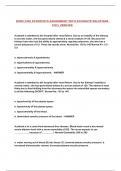
A patient is admitted to the hospital after renal failure. Due to an inability of the kidneys
to excrete water, she has generalized edema & a serum sodium of 129. Because the
kidneys have also lost the ability to appropriately regulate potassium, she also has a
serum potassium of 5.9. These lab results show: Normal Na: 135 to 145 Normal K+: 3.5 -
5.0
a. hypernatremia & hypokalemia.
b. hyperkalemia & hyponatremia.
c. hyperosmolality & hypernatremia.
d. hypoosmolality & hypocalcemia. - ANSWER
A patient is admitted to the hospital after renal failure. Due to her kidneys' inability to
excrete water, she has generalized edema & a serum sodium of 129. The edema is most
likely due to fluid shifting from the intravascular space into interstitial spaces secondary
to all the following EXCEPT: Normal Na: 135 to 145
a. hypertonicity of the plasma space.
b. hypotonicity of the plasma space.
c. hypoosmolality of the blood.
d. diminished osmotic pressure of the blood. - ANSWER
A patient is in a coma from advanced liver disease. Blood tests reveal a decreased
serum albumin level with a serum osmolality of 265. The nurse expects to see
_____________ because of __________? Normal Osmolality: 280 to 295
a. water moving out of blood (B) into tissue (T); lowered plasma oncotic pressure. b.
increased intravascular volume; increased plasma oncotic pressure.
, c. dehydrated brain cells; fluid moving from T into B.
d. water moving from T into B; increased osmolality of the vascular space. - ANSWER
A client is diagnosed with cancer and has a very poor appetite, resulting in an 80-pound
weight loss. On review (examination), the nurse finds generalized edema and a low
serum protein level. Which mini-concept map best relates the relationship between the
patient's serum protein level and the presence of edema?
a. hypoproteinemia→ concentration in blood is now lower than the normal concentration
of fluids inside cells→ fluid goes from B to T.
b. hypoproteinemia→ concentration in blood is now higher than the normal
concentration of fluids inside cells→ fluid goes from B to T.
c. hypoproteinemia→ blood is now hyperosmolar compared to the cells → fluid goes
from T to B.
d. hyperproteinemia→blood now has lower oncotic pressure than normal→ fluid goes
from T to B. - ANSWER
A patient is in a coma from advanced liver disease. Blood tests reveal a blood pH of
7.30, and serum HCO3 of 18. The patient's acid/base imbalance is called metabolic
__________.
a. alkalosis, as manifested by the low pH & HCO3.
b. alkalosis, most likely due to accumulation of "alkali guy" substances such as HCO3.
c. acidosis, most likely due to accumulation of "acid gang" substances such as H+.
d. acidosis, as manifested by the high pH & low HCO3. - ANSWER
A patient who just came out of general anesthesia has lab work done. The serum
osmolality is 240. The nurse taking care of this patient suspects that the _____ is due
_______. Normal Osmolality: 280 to 295
a. hyperosmolality: dehydration.
100% VERIFIED
A patient is admitted to the hospital after renal failure. Due to an inability of the kidneys
to excrete water, she has generalized edema & a serum sodium of 129. Because the
kidneys have also lost the ability to appropriately regulate potassium, she also has a
serum potassium of 5.9. These lab results show: Normal Na: 135 to 145 Normal K+: 3.5 -
5.0
a. hypernatremia & hypokalemia.
b. hyperkalemia & hyponatremia.
c. hyperosmolality & hypernatremia.
d. hypoosmolality & hypocalcemia. - ANSWER
A patient is admitted to the hospital after renal failure. Due to her kidneys' inability to
excrete water, she has generalized edema & a serum sodium of 129. The edema is most
likely due to fluid shifting from the intravascular space into interstitial spaces secondary
to all the following EXCEPT: Normal Na: 135 to 145
a. hypertonicity of the plasma space.
b. hypotonicity of the plasma space.
c. hypoosmolality of the blood.
d. diminished osmotic pressure of the blood. - ANSWER
A patient is in a coma from advanced liver disease. Blood tests reveal a decreased
serum albumin level with a serum osmolality of 265. The nurse expects to see
_____________ because of __________? Normal Osmolality: 280 to 295
a. water moving out of blood (B) into tissue (T); lowered plasma oncotic pressure. b.
increased intravascular volume; increased plasma oncotic pressure.
, c. dehydrated brain cells; fluid moving from T into B.
d. water moving from T into B; increased osmolality of the vascular space. - ANSWER
A client is diagnosed with cancer and has a very poor appetite, resulting in an 80-pound
weight loss. On review (examination), the nurse finds generalized edema and a low
serum protein level. Which mini-concept map best relates the relationship between the
patient's serum protein level and the presence of edema?
a. hypoproteinemia→ concentration in blood is now lower than the normal concentration
of fluids inside cells→ fluid goes from B to T.
b. hypoproteinemia→ concentration in blood is now higher than the normal
concentration of fluids inside cells→ fluid goes from B to T.
c. hypoproteinemia→ blood is now hyperosmolar compared to the cells → fluid goes
from T to B.
d. hyperproteinemia→blood now has lower oncotic pressure than normal→ fluid goes
from T to B. - ANSWER
A patient is in a coma from advanced liver disease. Blood tests reveal a blood pH of
7.30, and serum HCO3 of 18. The patient's acid/base imbalance is called metabolic
__________.
a. alkalosis, as manifested by the low pH & HCO3.
b. alkalosis, most likely due to accumulation of "alkali guy" substances such as HCO3.
c. acidosis, most likely due to accumulation of "acid gang" substances such as H+.
d. acidosis, as manifested by the high pH & low HCO3. - ANSWER
A patient who just came out of general anesthesia has lab work done. The serum
osmolality is 240. The nurse taking care of this patient suspects that the _____ is due
_______. Normal Osmolality: 280 to 295
a. hyperosmolality: dehydration.