
INLEIDING
DIZZINESS
• High prevalence
- High cost (direct & indirect)
• Increases falls -> more trauma
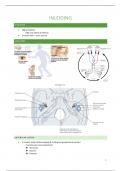
ANATOMY
VESTIBULAR SYSTEM
• 5 receptor organs (elke beweging & richting kan geregistreerd worden)
- 3 semicircular canals (rotational)
➔ Horizontal
➔ Anterior
➔ Posterior
1
, - 2 otolith organs (translational)
➔ Utricle
➔ Saccule
• Bony labyrinth – membranous labyrinth
• Endolymph (< membranous labyrinth)
- Na poor
- K rich
• Perilymph (between bony and membranous labyrinth)
(rechstreekse verbinding met CSV)
- Na rich
- K poor
- ~cerebrospinal fluid
HAIRCELLS
• Contains stereocilia
- Linked by tiplinks
- Kinocilium
• Transducer of motion into vestibular signals
- Deflection toward the kinocilium à depolarization à increased rate of firing in the afferent nerve
fiber
- Bending away from the kinocilium à hyperpolarization à decreased rate of firing in the afferent
nerve fiber
SEMICIRCULAR CANALS
• Rotational movements
• Cupula
• Based on inertia of the endolymph versus the the membranous labyrinth à bending of the cupul
- bending of the stereocilia
- altering membrane potential
- altering firing rate nerve
• function
- Detection of acceleration/deceleration
- No difference between standing still and constant velocity
- Each semicircular canal is maximally sensitive to rotations in its plane
➔ 3 dimensions
OTOLITH ORGANS (SACCULUS/UTRICULUS)
• 2 organs
- Utricle: horizontal
- Saccule: vertical
• Function
- Gravity
- Linear acceleration
• Based on inertia principle: statoconia versus membranous labyrinth
LIMITATION PERIPHERAL VESTIBULAR SYSTEM
• Only changes in velocity can be detected
2
, - No detection of constant velocity or rest
• Otolith: no discrimination between translation and tilt possible
• Brain integrates information from vestibular system, visual and somatosensory system to interpret
head and body motions
VESTIBULO-OCULAR REFLEX
• Function -> gaze stability during head movements
• Principle: detection of head movement -> eye move in opposite direction at same speed
• The vestibulo-ocular reflex (VOR)
- functions to maintain steady image on retina when head is moving
• Effective for high frequency head movements
- Example: you can still read street signs while walking or jogging
• Test 1 – the visual system
- Track your finger while moving it faster and faster > blurs
- Smooth pursuit capabilities exceeded
- 75 millisec
• Test 2 – the vestibular system:
- Hold your finger and turn your head quickly from side to side > clear
- Compensatory eye movements (opposite direction)
- 7-15 millisec
ROTATIONAL VESTIBULO -OCULAR REFLEX
• Head rotation sensed by horizontal SCC
• Eye movement in opposite direction of head movement, at the same speed
• Slow phase = compensatory eye rotation
• Quick phase = saccade-like movement to a new point of fixation
! nystagmus wordt vernoemd naar de snelle beweging (er is een snelle & trage fase) !
CENTRAL VESTIBULAR PATHWAY
• Head at rest:
- spontaneous tonic discharge in the VIII nerve: equal on both sides
• rotating to the left
- Horizontal canal left excited, horizontal canal right inhibited
- N VIII left: increase in firing
- N VIII right: decrease in firing
- Brain interprets this as moving to the left
• Vestibulo-ocular reflex is 3 neuron arc
- Connect each semicircular canal to appropriate eye muscle
- Can be suppressed by flocculus & cerebellum
ROTATIONAL VESTIBULO-OCULAR REFLEX
• Nystagmus: direction defined by the quick phase
• Rightward rotation à nystagmus to the right (slow phase to the left for a compensated eye
movement)
• Leftward rotation à nystagmus to the left (slow phase to the right for a compensated eye movement)
3
, TESTING VESTIBULAR SYSTEM
• Video head impulse testing
• Electronystagmography – videonystagmography
• Vestibular-evoked myogenic potentials
HEAD IMPULSE TEST
• normal eye
movement
response will
compensate for
head turn
• Gaze will stay fixed
on target
! patient moet kunnen fixeren op een punt & er mogen geen nekklachten
aanwezig zijn !
CVEMP
• Testen van saccule
• cVEMP is believed to assess saccular vestibular signals carried via the
vestibulospinal tract
• cVEMP is performed by applying sound stimulation to 1 ear while
recording surface EMG over the ipsilateral sternocleidomastoid muscle.
• Soundresponsive vestibular cells, mainly within the inner ear saccule,
momentarily inhibit ipsilateral muscle tone via the cervical vestibulocollic
pathway
• Surface EMG responses from the tonically contracted ipsilateral
sternocleidomastoid muscle are averaged to yield a biphasic waveform
response
4
DIZZINESS
• High prevalence
- High cost (direct & indirect)
• Increases falls -> more trauma
ANATOMY
VESTIBULAR SYSTEM
• 5 receptor organs (elke beweging & richting kan geregistreerd worden)
- 3 semicircular canals (rotational)
➔ Horizontal
➔ Anterior
➔ Posterior
1
, - 2 otolith organs (translational)
➔ Utricle
➔ Saccule
• Bony labyrinth – membranous labyrinth
• Endolymph (< membranous labyrinth)
- Na poor
- K rich
• Perilymph (between bony and membranous labyrinth)
(rechstreekse verbinding met CSV)
- Na rich
- K poor
- ~cerebrospinal fluid
HAIRCELLS
• Contains stereocilia
- Linked by tiplinks
- Kinocilium
• Transducer of motion into vestibular signals
- Deflection toward the kinocilium à depolarization à increased rate of firing in the afferent nerve
fiber
- Bending away from the kinocilium à hyperpolarization à decreased rate of firing in the afferent
nerve fiber
SEMICIRCULAR CANALS
• Rotational movements
• Cupula
• Based on inertia of the endolymph versus the the membranous labyrinth à bending of the cupul
- bending of the stereocilia
- altering membrane potential
- altering firing rate nerve
• function
- Detection of acceleration/deceleration
- No difference between standing still and constant velocity
- Each semicircular canal is maximally sensitive to rotations in its plane
➔ 3 dimensions
OTOLITH ORGANS (SACCULUS/UTRICULUS)
• 2 organs
- Utricle: horizontal
- Saccule: vertical
• Function
- Gravity
- Linear acceleration
• Based on inertia principle: statoconia versus membranous labyrinth
LIMITATION PERIPHERAL VESTIBULAR SYSTEM
• Only changes in velocity can be detected
2
, - No detection of constant velocity or rest
• Otolith: no discrimination between translation and tilt possible
• Brain integrates information from vestibular system, visual and somatosensory system to interpret
head and body motions
VESTIBULO-OCULAR REFLEX
• Function -> gaze stability during head movements
• Principle: detection of head movement -> eye move in opposite direction at same speed
• The vestibulo-ocular reflex (VOR)
- functions to maintain steady image on retina when head is moving
• Effective for high frequency head movements
- Example: you can still read street signs while walking or jogging
• Test 1 – the visual system
- Track your finger while moving it faster and faster > blurs
- Smooth pursuit capabilities exceeded
- 75 millisec
• Test 2 – the vestibular system:
- Hold your finger and turn your head quickly from side to side > clear
- Compensatory eye movements (opposite direction)
- 7-15 millisec
ROTATIONAL VESTIBULO -OCULAR REFLEX
• Head rotation sensed by horizontal SCC
• Eye movement in opposite direction of head movement, at the same speed
• Slow phase = compensatory eye rotation
• Quick phase = saccade-like movement to a new point of fixation
! nystagmus wordt vernoemd naar de snelle beweging (er is een snelle & trage fase) !
CENTRAL VESTIBULAR PATHWAY
• Head at rest:
- spontaneous tonic discharge in the VIII nerve: equal on both sides
• rotating to the left
- Horizontal canal left excited, horizontal canal right inhibited
- N VIII left: increase in firing
- N VIII right: decrease in firing
- Brain interprets this as moving to the left
• Vestibulo-ocular reflex is 3 neuron arc
- Connect each semicircular canal to appropriate eye muscle
- Can be suppressed by flocculus & cerebellum
ROTATIONAL VESTIBULO-OCULAR REFLEX
• Nystagmus: direction defined by the quick phase
• Rightward rotation à nystagmus to the right (slow phase to the left for a compensated eye
movement)
• Leftward rotation à nystagmus to the left (slow phase to the right for a compensated eye movement)
3
, TESTING VESTIBULAR SYSTEM
• Video head impulse testing
• Electronystagmography – videonystagmography
• Vestibular-evoked myogenic potentials
HEAD IMPULSE TEST
• normal eye
movement
response will
compensate for
head turn
• Gaze will stay fixed
on target
! patient moet kunnen fixeren op een punt & er mogen geen nekklachten
aanwezig zijn !
CVEMP
• Testen van saccule
• cVEMP is believed to assess saccular vestibular signals carried via the
vestibulospinal tract
• cVEMP is performed by applying sound stimulation to 1 ear while
recording surface EMG over the ipsilateral sternocleidomastoid muscle.
• Soundresponsive vestibular cells, mainly within the inner ear saccule,
momentarily inhibit ipsilateral muscle tone via the cervical vestibulocollic
pathway
• Surface EMG responses from the tonically contracted ipsilateral
sternocleidomastoid muscle are averaged to yield a biphasic waveform
response
4


