GEOMORPHOLOGY
CHAPTER 1 : DRAINAGE SYSTEMS IN SOUTH AFRICA
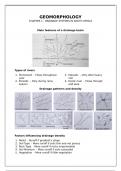
Main features of a drainage basin
Types of rivers
1. Permanent - Flows throughout 3. Episodic - Only after heavy
year rain
2. Periodic - Only during rainy 4. Exotic river - Flows through
season arid area
Drainage patterns and density
Factors influencing drainage density
1. Relief - Runoff if gradient’s steep
2. Soil Type - More runoff if soils thin and not porous
3. Rock Type - More runoff if rocks impermeable
4. Soil Moisture - More runoff if soils saturated
5. Vegetation - More runoff if little vegetation
, Determining stream order
When two streams of equal order join a higher stream order is made -
2x1st orders = 2nd order
Discharge of a river
Laminar flow - River beds level
Turbulent flow - River beds uneven
CHAPTER 2 : FLUVIAL PROCESSES
River profiles determined by the
1. Amount of energy available for erosion
2. Transportation and deposition of sediment
3. Landforms shaped during this process
Steeper the gradient, more rapid the stream flow, greater erosion
Deposition when flow of river decreases
Transverse profile
Cross section of river from one side to the other
Young stage - Steep, more downward erosion
Mature stage - Less steep, lateral erosion
Old stage - Gentle gradient, deposition
Longitudinal profile
Profile along length of river from source to mouth
Indicates gradient of river
Steep upper course and gradual lower course
River grading
Graded - Balance between erosion and deposition, creates sufficient
energy flow
Ungraded - Many temporary bases of erosion
Overgraded - Erodes the channel, has lots of energy
Undergraded - Deposits some of its load, no energy to flow
Temporary base levels along river course
CHAPTER 1 : DRAINAGE SYSTEMS IN SOUTH AFRICA
Main features of a drainage basin
Types of rivers
1. Permanent - Flows throughout 3. Episodic - Only after heavy
year rain
2. Periodic - Only during rainy 4. Exotic river - Flows through
season arid area
Drainage patterns and density
Factors influencing drainage density
1. Relief - Runoff if gradient’s steep
2. Soil Type - More runoff if soils thin and not porous
3. Rock Type - More runoff if rocks impermeable
4. Soil Moisture - More runoff if soils saturated
5. Vegetation - More runoff if little vegetation
, Determining stream order
When two streams of equal order join a higher stream order is made -
2x1st orders = 2nd order
Discharge of a river
Laminar flow - River beds level
Turbulent flow - River beds uneven
CHAPTER 2 : FLUVIAL PROCESSES
River profiles determined by the
1. Amount of energy available for erosion
2. Transportation and deposition of sediment
3. Landforms shaped during this process
Steeper the gradient, more rapid the stream flow, greater erosion
Deposition when flow of river decreases
Transverse profile
Cross section of river from one side to the other
Young stage - Steep, more downward erosion
Mature stage - Less steep, lateral erosion
Old stage - Gentle gradient, deposition
Longitudinal profile
Profile along length of river from source to mouth
Indicates gradient of river
Steep upper course and gradual lower course
River grading
Graded - Balance between erosion and deposition, creates sufficient
energy flow
Ungraded - Many temporary bases of erosion
Overgraded - Erodes the channel, has lots of energy
Undergraded - Deposits some of its load, no energy to flow
Temporary base levels along river course