

SUMMARY NATURAL PROCESSES MIDTERM
HC 1 introduction, energy in the atmosphere
Energy in the atmosphere
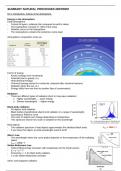
Earth atmosphere
- Consist of layers, relatively thin compared to earth’s radius
- The troposphere consists of ~90% of the mass
- Weather occurs in the troposphere
- The stratosphere contains the protective ozone layer
Atmospheric composition of dry air
Forms of energy
- Kinetic (energy from movement)
- Potential (due to gravity i.e.)
- Heat (thermal energy)
- Chemical (energy stored in a molecule, released after chemical reaction)
- Radiation (from the sun i.e.)
- Energy shifts from one form to another (law of conservation)
Radiation
- There are different types of radiation (short or long wave radiation)
o Higher wavelengths → lower energy
o Shorter wavelengths → higher energy
Black-body radiation
- All objects emit radiation
- Black bodies (hypothetical object) emit radiation in a range of wavelengths
according to Planck’s curve
- The color of objects can change depending on temperature
- This spectrum shows how much is radiated on this wavelength
Real objects
- The radiation spectrum of real objects approximates the idealized black body
- If you have this object, at what wavelength would it emit?
Wien’s Law
- The wavelength where the curve peaks depends on the temperature of the radiating
object
- λmax = 2898 / T
Stefan-Boltzmann Law
- Total emitted energy increases with temperature (to the fourth power)
- E = ε * σ * T4
- Emissivity ε = 1 for black body radiation
- σ is the Stefan-Boltzmann constant
Short- and longwave radiation
,- Sun emits shorter wavelengths than the earth
- we get more energy from the sun, therefore the sun emits shorter wavelengths (inversed relation)
Radiation from the sun’s perspective
- Radiation from the sun (solar radiation) can be reflected by clouds
- Sun is radiating into the ozone layer and ozone shift this radiation into thermal energy
- Some of the radiation ends up at the earth surface, partially reflected again, partially absorbed
Radiation from the earth’s perspective
- Greenhouse effect (receiving energy from the atmosphere)
- Earth is also emitting radiation back into the atmosphere
Short wave radiation
- Reflection
- Scattering (something is being hit and effected without being
absorbed)
- Absorption
- Re-emission
Albedo
If the surface is darker, it has a lower albedo
Energy fluxes
- Ingoing and outgoing fluxes are (almost) equal
→ because of the law of energy conservation
Spatial variability in absorbed shortwave radiation
- Most absorption over tropical areas (they receive radiation more efficient, NL more at an angle and ice
reflects more than ocean)
- More absorption over oceans than over land (oceans are darker than land, so more absorption)
Net radiation
Red → incoming > outgoing
Blue → outgoing > incoming
,Tropics heating up and poles cooling down? → Lateral energy transport from tropics to the poles
Lateral energy transfer
→ transfer through sensible heat, latent heat and oceans (circulation)
Diurnal variations
- During the day, the temperature increases because of incoming solar radiation
- Desert heats and cools more quickly than ocean → heating up desert easier because less evaporation
of water than when you heat up an ocean (evaporation costs a lot of energy)
CO2 in the atmosphere
- Important greenhouse gas, leading to increased temperatures on Earth
- Pre-industrial values of ~280 ppm (from ice cores) and currently ~415 ppm
CO2 at Mauna Loa
- Measurement station on Hawaii
- Atmospheric CO2 measurements started here by Charles D. Keeling in 1958
- On top of volcano negligible local CO2 emissions: ideal background site for Northern Hemisphere
→ long term increase of atmospheric CO2
→ fluctuations because of the seasons of the Northern Hemisphere driven by the vegetation
→ when CO2 is high, O2 is low
HC 2 energy and circulation in the atmosphere
Forces
- Forces can lead to acceleration, deceleration or deflection according to Newton’s Law → F = m * a
- Forces are vectors (having magnitude and direction) and can be
added
Vertical forces on air parcels
→ two forces working in opposite vertical direction (gravity and
buoyancy/opwaartse kracht)
→ if these two cancel each other out, the air parcel isn’t moving
Isopleths (or contour lines)
→ are curves along which a specific variable is constant
→ for mountains, lines of equal height are often used (if there are a lot of lines, there is a lot of
height difference)
Isobars
→ are frequently used for studying atmospheric flows, lines across weather map for example
4 important forces
- The low gradient force → points from high to low pressure
- Coriolis force
- Friction
, Coriolis effect
- Because of earth’s rotation, air parcels moving in the atmosphere appear to be deflected by the Coriolis
force
- Not a ‘real force’, used to describe air flows in the atmosphere
- Flows on the Northern Hemisphere are deflected to the right and flows on the southern Hemisphere to
the left
Coriolis force can be expressed as:
F = 2 * Ω * V * sin (ᵠ)
Ω → rotational speed of the earth (=constant)
V → wind speed
ᵠ → degree latitude
The Coriolis force depends on latitude
Coriolis force is larger for polar regions, at the equator there is no Coriolis force
Turning to the right, relative to the motion turning to the left relative to the motion
Pressure gradient and Coriolis force
- Pressure flows from high pressure areas to low pressure areas
- The Coriolis force acts perpendicular to the flow/motion
- Pressure gradient > wind speed > Coriolis force
- In balance: pressure gradient force equals Coriolis force
→ If an air parcel is not moving, the Coriolis force is zero
Coriolis in depression
- Air moves towards a low-pressure zone and is being deflected by the Coriolis force
HC 1 introduction, energy in the atmosphere
Energy in the atmosphere
Earth atmosphere
- Consist of layers, relatively thin compared to earth’s radius
- The troposphere consists of ~90% of the mass
- Weather occurs in the troposphere
- The stratosphere contains the protective ozone layer
Atmospheric composition of dry air
Forms of energy
- Kinetic (energy from movement)
- Potential (due to gravity i.e.)
- Heat (thermal energy)
- Chemical (energy stored in a molecule, released after chemical reaction)
- Radiation (from the sun i.e.)
- Energy shifts from one form to another (law of conservation)
Radiation
- There are different types of radiation (short or long wave radiation)
o Higher wavelengths → lower energy
o Shorter wavelengths → higher energy
Black-body radiation
- All objects emit radiation
- Black bodies (hypothetical object) emit radiation in a range of wavelengths
according to Planck’s curve
- The color of objects can change depending on temperature
- This spectrum shows how much is radiated on this wavelength
Real objects
- The radiation spectrum of real objects approximates the idealized black body
- If you have this object, at what wavelength would it emit?
Wien’s Law
- The wavelength where the curve peaks depends on the temperature of the radiating
object
- λmax = 2898 / T
Stefan-Boltzmann Law
- Total emitted energy increases with temperature (to the fourth power)
- E = ε * σ * T4
- Emissivity ε = 1 for black body radiation
- σ is the Stefan-Boltzmann constant
Short- and longwave radiation
,- Sun emits shorter wavelengths than the earth
- we get more energy from the sun, therefore the sun emits shorter wavelengths (inversed relation)
Radiation from the sun’s perspective
- Radiation from the sun (solar radiation) can be reflected by clouds
- Sun is radiating into the ozone layer and ozone shift this radiation into thermal energy
- Some of the radiation ends up at the earth surface, partially reflected again, partially absorbed
Radiation from the earth’s perspective
- Greenhouse effect (receiving energy from the atmosphere)
- Earth is also emitting radiation back into the atmosphere
Short wave radiation
- Reflection
- Scattering (something is being hit and effected without being
absorbed)
- Absorption
- Re-emission
Albedo
If the surface is darker, it has a lower albedo
Energy fluxes
- Ingoing and outgoing fluxes are (almost) equal
→ because of the law of energy conservation
Spatial variability in absorbed shortwave radiation
- Most absorption over tropical areas (they receive radiation more efficient, NL more at an angle and ice
reflects more than ocean)
- More absorption over oceans than over land (oceans are darker than land, so more absorption)
Net radiation
Red → incoming > outgoing
Blue → outgoing > incoming
,Tropics heating up and poles cooling down? → Lateral energy transport from tropics to the poles
Lateral energy transfer
→ transfer through sensible heat, latent heat and oceans (circulation)
Diurnal variations
- During the day, the temperature increases because of incoming solar radiation
- Desert heats and cools more quickly than ocean → heating up desert easier because less evaporation
of water than when you heat up an ocean (evaporation costs a lot of energy)
CO2 in the atmosphere
- Important greenhouse gas, leading to increased temperatures on Earth
- Pre-industrial values of ~280 ppm (from ice cores) and currently ~415 ppm
CO2 at Mauna Loa
- Measurement station on Hawaii
- Atmospheric CO2 measurements started here by Charles D. Keeling in 1958
- On top of volcano negligible local CO2 emissions: ideal background site for Northern Hemisphere
→ long term increase of atmospheric CO2
→ fluctuations because of the seasons of the Northern Hemisphere driven by the vegetation
→ when CO2 is high, O2 is low
HC 2 energy and circulation in the atmosphere
Forces
- Forces can lead to acceleration, deceleration or deflection according to Newton’s Law → F = m * a
- Forces are vectors (having magnitude and direction) and can be
added
Vertical forces on air parcels
→ two forces working in opposite vertical direction (gravity and
buoyancy/opwaartse kracht)
→ if these two cancel each other out, the air parcel isn’t moving
Isopleths (or contour lines)
→ are curves along which a specific variable is constant
→ for mountains, lines of equal height are often used (if there are a lot of lines, there is a lot of
height difference)
Isobars
→ are frequently used for studying atmospheric flows, lines across weather map for example
4 important forces
- The low gradient force → points from high to low pressure
- Coriolis force
- Friction
, Coriolis effect
- Because of earth’s rotation, air parcels moving in the atmosphere appear to be deflected by the Coriolis
force
- Not a ‘real force’, used to describe air flows in the atmosphere
- Flows on the Northern Hemisphere are deflected to the right and flows on the southern Hemisphere to
the left
Coriolis force can be expressed as:
F = 2 * Ω * V * sin (ᵠ)
Ω → rotational speed of the earth (=constant)
V → wind speed
ᵠ → degree latitude
The Coriolis force depends on latitude
Coriolis force is larger for polar regions, at the equator there is no Coriolis force
Turning to the right, relative to the motion turning to the left relative to the motion
Pressure gradient and Coriolis force
- Pressure flows from high pressure areas to low pressure areas
- The Coriolis force acts perpendicular to the flow/motion
- Pressure gradient > wind speed > Coriolis force
- In balance: pressure gradient force equals Coriolis force
→ If an air parcel is not moving, the Coriolis force is zero
Coriolis in depression
- Air moves towards a low-pressure zone and is being deflected by the Coriolis force


