MAN 3025 EXAM 2 UCF QUESTIONS
WITH COMPLETE SOLUTIONS
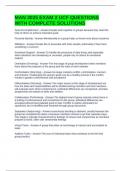
Goal Accomplishment - Answer-People work together in groups because they need the
help of others to achieve important goals
Personal Identity - Answer-Membership in a group helps us know more about ourselves
Affiliation - Answer-People like to associate with other people, particularly if they have
something in common
Emotional Support - Answer-To handle the pressures of daily living, and especially
when situations are threatening or uncertain, people rely on others for emotional
support
Orientation (Forming) - Answer-The first stage of group development when members
learn about the purposes of the group and the roles of each member
Confrontation (Storming) - Answer-his stage contains conflict, confrontation, concern,
and criticism. Challenging the group's goals can be a healthy process if the conflict
results in greater cohesiveness and acceptance
Differentiation (Norming) - Answer-The major issues at this stage of development are
how the tasks and responsibilities will be divided among members and how members
will evaluate each other's performance. Individual differences are recognized, and task
assignments are based on skills and abilities.
Collaboration (Performing) - Answer-The highest level of group maturity where there is
a feeling of cohesiveness and commitment to the group. Individual differences are
accepted without being labeled good or bad. Conflict is neither eliminated nor
squelched, but is identified and resolved through group discussion.
Separation (Adjourning) - Answer-consciously deciding to disband, usually because the
group has completed its tasks or because members choose to go their separate ways.
This stage is typically characterized by feelings of closure and compromise as members
prepare to leave, often with sentimental feelings.
Virtual Team - Answer-A group that relies on technology to interact and accomplish its
tasks
Additive Tasks - Answer-The sum of individual tasks that contribute to the the final
group product
, Conjunctive Tasks - Answer-Tasks that can be divided into interdependent subtasks
and then assigned to various group members through a "division of labor"
Disjunctive Tasks - Answer-Decision-making tasks that require the group to select the
best solution
Process Losses - Answer-The inefficiencies that arise from having to organize and
coordinate larger groups
Social Density - Answer-The concentration of people within an area
Assigned Roles - Answer-Tasks that are prescribed by the organization as a means of
dividing the labor and assigning responsibility
Emergent Roles - Answer-Roles that develop naturally to meet the needs of group
members or assist in achieving formal goals
Work Roles - Answer-Task-oriented activities involved in accomplishing the work and
achieving the group objective
Maintenance Roles - Answer-The social-emotional activities of group members that
maintain their involvement and personal commitment to the group
Blocking Roles - Answer-Activities that disrupt or destroy the group
Role Episode - Answer-The interaction between role senders and the person receiving
the role
Focal Person - Answer-the person the role sender is trying to change the behavior of
Role Readiness - Answer-The focal person's ability and willingness to accept the
responsibility associated with a new role
Intersender Role Conflict - Answer-When two or more role senders communicate
incompatible expectations to the focal person
Person-role Conflict - Answer-When people are asked to behave in ways that are
inconsistent with their personal values
Role Overload - Answer-The conflicting demands of too many roles (also called inter-
role conflict)
Group Norms - Answer-General expectations about how members ought to behave
Injunctive Norms - Answer-The shared attitudes and beliefs that group members bring
to the group that are enforced through peer pressure
WITH COMPLETE SOLUTIONS
Goal Accomplishment - Answer-People work together in groups because they need the
help of others to achieve important goals
Personal Identity - Answer-Membership in a group helps us know more about ourselves
Affiliation - Answer-People like to associate with other people, particularly if they have
something in common
Emotional Support - Answer-To handle the pressures of daily living, and especially
when situations are threatening or uncertain, people rely on others for emotional
support
Orientation (Forming) - Answer-The first stage of group development when members
learn about the purposes of the group and the roles of each member
Confrontation (Storming) - Answer-his stage contains conflict, confrontation, concern,
and criticism. Challenging the group's goals can be a healthy process if the conflict
results in greater cohesiveness and acceptance
Differentiation (Norming) - Answer-The major issues at this stage of development are
how the tasks and responsibilities will be divided among members and how members
will evaluate each other's performance. Individual differences are recognized, and task
assignments are based on skills and abilities.
Collaboration (Performing) - Answer-The highest level of group maturity where there is
a feeling of cohesiveness and commitment to the group. Individual differences are
accepted without being labeled good or bad. Conflict is neither eliminated nor
squelched, but is identified and resolved through group discussion.
Separation (Adjourning) - Answer-consciously deciding to disband, usually because the
group has completed its tasks or because members choose to go their separate ways.
This stage is typically characterized by feelings of closure and compromise as members
prepare to leave, often with sentimental feelings.
Virtual Team - Answer-A group that relies on technology to interact and accomplish its
tasks
Additive Tasks - Answer-The sum of individual tasks that contribute to the the final
group product
, Conjunctive Tasks - Answer-Tasks that can be divided into interdependent subtasks
and then assigned to various group members through a "division of labor"
Disjunctive Tasks - Answer-Decision-making tasks that require the group to select the
best solution
Process Losses - Answer-The inefficiencies that arise from having to organize and
coordinate larger groups
Social Density - Answer-The concentration of people within an area
Assigned Roles - Answer-Tasks that are prescribed by the organization as a means of
dividing the labor and assigning responsibility
Emergent Roles - Answer-Roles that develop naturally to meet the needs of group
members or assist in achieving formal goals
Work Roles - Answer-Task-oriented activities involved in accomplishing the work and
achieving the group objective
Maintenance Roles - Answer-The social-emotional activities of group members that
maintain their involvement and personal commitment to the group
Blocking Roles - Answer-Activities that disrupt or destroy the group
Role Episode - Answer-The interaction between role senders and the person receiving
the role
Focal Person - Answer-the person the role sender is trying to change the behavior of
Role Readiness - Answer-The focal person's ability and willingness to accept the
responsibility associated with a new role
Intersender Role Conflict - Answer-When two or more role senders communicate
incompatible expectations to the focal person
Person-role Conflict - Answer-When people are asked to behave in ways that are
inconsistent with their personal values
Role Overload - Answer-The conflicting demands of too many roles (also called inter-
role conflict)
Group Norms - Answer-General expectations about how members ought to behave
Injunctive Norms - Answer-The shared attitudes and beliefs that group members bring
to the group that are enforced through peer pressure