1. Process Concept:
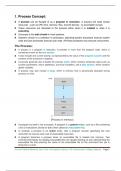
A process can be thought of as a program in execution. A process will need certain
resources - such as CPU time, memory, files, and I/O devices - to accomplish its task.
These resources are allocated to the process either when it is created or while it is
executing.
A process is the unit of work in most systems.
Systems consist of a collection of processes: operating-system processes execute system
code and user processes execute user code. All these processes may execute concurrently.
The Process:
A process is a program in execution. A process is more than the program code, which is
sometimes known as the text section.
It also includes the current activity, as represented by the value of the program counter and the
contents of the processor’s registers.
A process generally also includes the process stack, which contains temporary data (such as
function parameters, return addresses, and local variables), and a data section, which contains
global variables.
A process may also include a heap, which is memory that is dynamically allocated during
process run time.
[Process in memory]
A program by itself is not a process. A program is a passive entity, such as a file containing
a list of instructions stored on disk (often called an executable file).
In contrast, a process is an active entity, with a program counter specifying the next
instruction to execute and a set of associated resources.
A program becomes a process when an executable file is loaded into memory. Two
common techniques for loading executable files are double-clicking an icon representing the
executable file and entering the name of the executable file on the command line (as in
prog.exe or a.out).
Sri Jyoti Prakash Mohanta, Asst. Prof. of Computer Science, F.M. Autonomous College, Balasore. Page 1
, Process State:
As a process executes, it changes state. The state of a process is defined in part by the
current activity of that process.
A process may be in one of the following states:
New. The process is being created.
Running. Instructions are being executed.
Waiting. The process is waiting for some event to occur (such as an I/O completion or
reception of a signal).
Ready. The process is waiting to be assigned to a processor.
Terminated. The process has finished execution.
It is important to realize that only one process can be running on any processor at any
instant. Many processes may be ready and waiting, however.
The state diagram corresponding to these states is presented in Figure:
[Diagram of process state]
Process Control Block:
Each process is represented in the operating system by a process control block (PCB)—
also called a task control block.
PCB contains many pieces of information associated with a specific process, including
these:
Process state. The state may be new, ready, running, waiting, halted, and so on.
Program counter. The counter indicates the address of the next instruction to be
executed for this process.
CPU registers. The registers vary in number and type, depending on the computer
architecture. They include accumulators, index registers, stack pointers, and general-
purpose registers, plus any condition-code information.
Sri Jyoti Prakash Mohanta, Asst. Prof. of Computer Science, F.M. Autonomous College, Balasore. Page 2
A process can be thought of as a program in execution. A process will need certain
resources - such as CPU time, memory, files, and I/O devices - to accomplish its task.
These resources are allocated to the process either when it is created or while it is
executing.
A process is the unit of work in most systems.
Systems consist of a collection of processes: operating-system processes execute system
code and user processes execute user code. All these processes may execute concurrently.
The Process:
A process is a program in execution. A process is more than the program code, which is
sometimes known as the text section.
It also includes the current activity, as represented by the value of the program counter and the
contents of the processor’s registers.
A process generally also includes the process stack, which contains temporary data (such as
function parameters, return addresses, and local variables), and a data section, which contains
global variables.
A process may also include a heap, which is memory that is dynamically allocated during
process run time.
[Process in memory]
A program by itself is not a process. A program is a passive entity, such as a file containing
a list of instructions stored on disk (often called an executable file).
In contrast, a process is an active entity, with a program counter specifying the next
instruction to execute and a set of associated resources.
A program becomes a process when an executable file is loaded into memory. Two
common techniques for loading executable files are double-clicking an icon representing the
executable file and entering the name of the executable file on the command line (as in
prog.exe or a.out).
Sri Jyoti Prakash Mohanta, Asst. Prof. of Computer Science, F.M. Autonomous College, Balasore. Page 1
, Process State:
As a process executes, it changes state. The state of a process is defined in part by the
current activity of that process.
A process may be in one of the following states:
New. The process is being created.
Running. Instructions are being executed.
Waiting. The process is waiting for some event to occur (such as an I/O completion or
reception of a signal).
Ready. The process is waiting to be assigned to a processor.
Terminated. The process has finished execution.
It is important to realize that only one process can be running on any processor at any
instant. Many processes may be ready and waiting, however.
The state diagram corresponding to these states is presented in Figure:
[Diagram of process state]
Process Control Block:
Each process is represented in the operating system by a process control block (PCB)—
also called a task control block.
PCB contains many pieces of information associated with a specific process, including
these:
Process state. The state may be new, ready, running, waiting, halted, and so on.
Program counter. The counter indicates the address of the next instruction to be
executed for this process.
CPU registers. The registers vary in number and type, depending on the computer
architecture. They include accumulators, index registers, stack pointers, and general-
purpose registers, plus any condition-code information.
Sri Jyoti Prakash Mohanta, Asst. Prof. of Computer Science, F.M. Autonomous College, Balasore. Page 2