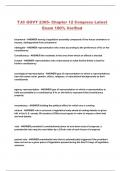
TJC GOVT 2305- Chapter 12 Congress Latest
Exam 100% Verified
bicameral - ANSWER having a legislative assembly composed of two house chambers or
houses, distinguished from unicameral
ndelegate - ANSWER representative who votes according to the preference of his or her
constituency
Constituency - ANSWER the residents in the area from which an official is elected
trustee - ANSWER representative who votes based on what he/she thinks is best for
his/her constituency
sociological representation - ANSWER type of representation in which a representatives
have the same racial, gender, ethics, religious, or educational backgrounds as their
constituents
agency representation - ANSWER type of representation in which a representative is
held accountable to a constituency if he or she fails to represent that constituency
properly
incumbency - ANSWER holding the political office for which one is running
cloture - ANSWER rule or process in legislative body aimed at ending debate on given
bill; in the U.S. senate, 60 senators (3/5ths) must agree in order to impose a time limit
and end debate.
veto - ANSWER president's constitutional power to turn down acts of congress; a
presidential veto may be overridden by a 2/3rds vote of each house of congress
pocket veto - ANSWER presidential veto that is automatically triggered if the president
does not act on a given piece of legislation passed during the final 10 days of legislative
sessions.
, What factors influence which laws congress passes? - ANSWER -Constituents are most
important
-interest groups also play a role
- party leadership might care if it is a partisan vote ["Part Discipline"]
party unity vote A roll-call vote in the House or Senate in which at least 50 percent of the
members of one party take a particular position and are opposed by at least 50 percent
of the members of the other party.
roll-call vote A vote in which each legislator's yes or no vote is recorded as the clerk
calls the names of the members alphabetically
logrolling - ANSWER a legislative practice whereby agreements are made between
legislators in voting for or against a bill; vote trading
how does congress influence other branches of the government? - ANSWER -Oversight
-advice and consent (appointments: ambassadors and federal judges and approves
treates)
-impeachment
oversight - ANSWER the effort by Congress, through hearings, investigations, and other
techniques, to exercise control over the activities of executive agencies
appropriation - ANSWER The amounts of money approved by Congress in statutes (bills)
that each unit or agency of government can spend
executive agreement - ANSWER an agreement, made between the president and
another country, that has the force of a treaty but does not require the Senate's "advice
and consent"
Exam 100% Verified
bicameral - ANSWER having a legislative assembly composed of two house chambers or
houses, distinguished from unicameral
ndelegate - ANSWER representative who votes according to the preference of his or her
constituency
Constituency - ANSWER the residents in the area from which an official is elected
trustee - ANSWER representative who votes based on what he/she thinks is best for
his/her constituency
sociological representation - ANSWER type of representation in which a representatives
have the same racial, gender, ethics, religious, or educational backgrounds as their
constituents
agency representation - ANSWER type of representation in which a representative is
held accountable to a constituency if he or she fails to represent that constituency
properly
incumbency - ANSWER holding the political office for which one is running
cloture - ANSWER rule or process in legislative body aimed at ending debate on given
bill; in the U.S. senate, 60 senators (3/5ths) must agree in order to impose a time limit
and end debate.
veto - ANSWER president's constitutional power to turn down acts of congress; a
presidential veto may be overridden by a 2/3rds vote of each house of congress
pocket veto - ANSWER presidential veto that is automatically triggered if the president
does not act on a given piece of legislation passed during the final 10 days of legislative
sessions.
, What factors influence which laws congress passes? - ANSWER -Constituents are most
important
-interest groups also play a role
- party leadership might care if it is a partisan vote ["Part Discipline"]
party unity vote A roll-call vote in the House or Senate in which at least 50 percent of the
members of one party take a particular position and are opposed by at least 50 percent
of the members of the other party.
roll-call vote A vote in which each legislator's yes or no vote is recorded as the clerk
calls the names of the members alphabetically
logrolling - ANSWER a legislative practice whereby agreements are made between
legislators in voting for or against a bill; vote trading
how does congress influence other branches of the government? - ANSWER -Oversight
-advice and consent (appointments: ambassadors and federal judges and approves
treates)
-impeachment
oversight - ANSWER the effort by Congress, through hearings, investigations, and other
techniques, to exercise control over the activities of executive agencies
appropriation - ANSWER The amounts of money approved by Congress in statutes (bills)
that each unit or agency of government can spend
executive agreement - ANSWER an agreement, made between the president and
another country, that has the force of a treaty but does not require the Senate's "advice
and consent"