
Multiple Choice
1. An oil supplier has received several customer complaints about the smell of canola oil. The oil
supplier therefore wants to implement analytical controls to assess the oil quality. Which
combination of methods would you recommend to assess the lipid oxidation level in bulk canola oil
(contains a-linolenic acid C18:3 w 3, and linoleic acid C18:2 w 6)?
Measure conjugated dienes and total aldehydes.
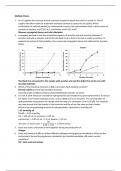
2. A company decided to test the antioxidant capacity of ascorbic acid and ascorbyl palmitate (=
ascorbic acid with a palmitic acid (16:0) esterified on it) in bulk oil and oil-in-water emulsions. To
evaluate the extent of lipid oxidation, they measured conjugated dienes and obtained the 2 graphs
below.
The black line correspond to the sample with ascorbic acid and the dotted line to the one with
ascorbyl palmitate
3. Which of the following molecules is not a secondary lipid oxidation product?
Peroxyl radical (primary lipid oxidation product)
Secondary lipid oxidation products (malondialdehyde, epoxide, nonanal)
4. A 10 wt.% O/W emulsion is tested for hydroperoxide concentration by spectrophotometry. To extract
the lipids, 2 mL hexane:isopropanol (3:1, v/v) is added to 0.5 mL emulsion. The concentration of
hydroperoxides measured in the sample with the help of a calibration curve is 50 µM. For simplicity
you may assume that the density of the emulsion and the oil are the same as that of water.
Which is the corresponding amount of hydroperoxides, expressed in mmol/kg oil?
1.55 mmol/kg oil
50 µM -> 0.05 mmol/kg
Oil -> 10% of 0.5 mL emulsion = 0.05 mL
Lipid extract -> 0.05 mL oil + 1.5 mL hexane = 1.55 mL
50
𝐴𝑚𝑜𝑢𝑛𝑡 𝑜𝑓 ℎ𝑦𝑑𝑟𝑜𝑥𝑖𝑑𝑒 = = 1.55𝑚𝑚𝑜𝑙/𝑘𝑔
0.05 × 1.55
5. Yeast and acetic acid bacteria work together during the production of:
Vinegar
6. Lactic acid bacteria (LAB) can follow different pathways during glucose metabolism. What are the
end products formed during glucose metabolism by heterofermentative LAB under aerobic
conditions?
CO2, lactic acid and acetate
1. An oil supplier has received several customer complaints about the smell of canola oil. The oil
supplier therefore wants to implement analytical controls to assess the oil quality. Which
combination of methods would you recommend to assess the lipid oxidation level in bulk canola oil
(contains a-linolenic acid C18:3 w 3, and linoleic acid C18:2 w 6)?
Measure conjugated dienes and total aldehydes.
2. A company decided to test the antioxidant capacity of ascorbic acid and ascorbyl palmitate (=
ascorbic acid with a palmitic acid (16:0) esterified on it) in bulk oil and oil-in-water emulsions. To
evaluate the extent of lipid oxidation, they measured conjugated dienes and obtained the 2 graphs
below.
The black line correspond to the sample with ascorbic acid and the dotted line to the one with
ascorbyl palmitate
3. Which of the following molecules is not a secondary lipid oxidation product?
Peroxyl radical (primary lipid oxidation product)
Secondary lipid oxidation products (malondialdehyde, epoxide, nonanal)
4. A 10 wt.% O/W emulsion is tested for hydroperoxide concentration by spectrophotometry. To extract
the lipids, 2 mL hexane:isopropanol (3:1, v/v) is added to 0.5 mL emulsion. The concentration of
hydroperoxides measured in the sample with the help of a calibration curve is 50 µM. For simplicity
you may assume that the density of the emulsion and the oil are the same as that of water.
Which is the corresponding amount of hydroperoxides, expressed in mmol/kg oil?
1.55 mmol/kg oil
50 µM -> 0.05 mmol/kg
Oil -> 10% of 0.5 mL emulsion = 0.05 mL
Lipid extract -> 0.05 mL oil + 1.5 mL hexane = 1.55 mL
50
𝐴𝑚𝑜𝑢𝑛𝑡 𝑜𝑓 ℎ𝑦𝑑𝑟𝑜𝑥𝑖𝑑𝑒 = = 1.55𝑚𝑚𝑜𝑙/𝑘𝑔
0.05 × 1.55
5. Yeast and acetic acid bacteria work together during the production of:
Vinegar
6. Lactic acid bacteria (LAB) can follow different pathways during glucose metabolism. What are the
end products formed during glucose metabolism by heterofermentative LAB under aerobic
conditions?
CO2, lactic acid and acetate


