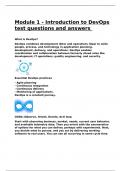
Module 1 - Introduction to DevOps
test questions and answers
What is DevOps?
DevOps combines development (Dev) and operations (Ops) to unite
people, process, and technology in application planning,
development, delivery, and operations. DevOps enables
coordination and collaboration between formerly siloed roles like
development, IT operations, quality engineering, and security.
Essential DevOps practices
- Agile planning
- Continuous integration
- Continuous delivery
- Monitoring of applications.
DevOps is a constant journey.
OODA (Observe, Orient, Decide, Act) loop
Start with observing business, market, needs, current user behavior,
and available telemetry data. Then you orient with the enumeration
of options for what you can deliver, perhaps with experiments. Next,
you decide what to pursue, and you act by delivering working
software to real users. You can see all occurring in some cycle time.
, Pivot or Persevere Approach
Roughly one-third of the deployments will have negative business
results. Approximately one-third will have positive results, and one-
third will make no difference. Fail fast on effects that do not
advance the business and double down on outcomes that support
the business.
Validated learning
Your cycle time determines how quickly you can gather feedback to
determine what happens in the next loop. The feedback that you
collect with each cycle should be factual, actionable data.
Adopt DevOps practices
- You shorten your cycle time by working in smaller batches.
- Using more automation.
- Hardening your release pipeline.
- Improving your telemetry.
- Deploying more frequently.
Optimize validated learning
The more frequently you deploy, the more you can experiment. The
more opportunity you have to pivot or persevere and gain validated
test questions and answers
What is DevOps?
DevOps combines development (Dev) and operations (Ops) to unite
people, process, and technology in application planning,
development, delivery, and operations. DevOps enables
coordination and collaboration between formerly siloed roles like
development, IT operations, quality engineering, and security.
Essential DevOps practices
- Agile planning
- Continuous integration
- Continuous delivery
- Monitoring of applications.
DevOps is a constant journey.
OODA (Observe, Orient, Decide, Act) loop
Start with observing business, market, needs, current user behavior,
and available telemetry data. Then you orient with the enumeration
of options for what you can deliver, perhaps with experiments. Next,
you decide what to pursue, and you act by delivering working
software to real users. You can see all occurring in some cycle time.
, Pivot or Persevere Approach
Roughly one-third of the deployments will have negative business
results. Approximately one-third will have positive results, and one-
third will make no difference. Fail fast on effects that do not
advance the business and double down on outcomes that support
the business.
Validated learning
Your cycle time determines how quickly you can gather feedback to
determine what happens in the next loop. The feedback that you
collect with each cycle should be factual, actionable data.
Adopt DevOps practices
- You shorten your cycle time by working in smaller batches.
- Using more automation.
- Hardening your release pipeline.
- Improving your telemetry.
- Deploying more frequently.
Optimize validated learning
The more frequently you deploy, the more you can experiment. The
more opportunity you have to pivot or persevere and gain validated