CONCEPT 8.4: Enzymes speed up metabolic reactions by lowering energy barriers
• Spontaneous reactions do not need added energy, but they can be slow enough to be
imperceptible
– For example, the hydrolysis of sucrose to glucose and fructose is spontaneous
– At room temperature, a solution of sucrose in sterile water would sit for years
without appreciable hydrolysis
• A catalyst is a chemical agent that speeds up a reaction without being consumed by the
reaction
• An enzyme is a macromolecule (typically protein) that acts as a catalyst to speed up a
specific reaction
– For example, adding the enzyme sucrase to a sucrose solution at room
temperature will catalyze the complete hydrolysis of sucrose within seconds
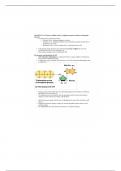
The Activation Energy Barrier
• Every chemical reaction between molecules involves bond breaking and bond forming
• A molecule must be contorted into a highly unstable state before bonds can break to start
the reaction
• To reach this state, the molecule must absorb energy from its surroundings
• The initial energy needed to break the bonds of the reactants is called the activation
energy (EA)
• Heat in the form of thermal energy absorbed from the surroundings often supplies
activation energy
• Molecules become unstable when enough energy is absorbed to break bonds; this is the
transition state
• As atoms settle into new, more stable bonds, energy is released to the surroundings
• In an exergonic reaction, the formation of new bonds releases more energy than was
invested in breaking the old bonds
, • The activation energy provides a barrier that determines the rate of spontaneous reactions
• For some reactions, EA is low enough that thermal energy at room temperature is
sufficient to overcome the activation barrier
• Most reactions have high EA, and need additional energy (usually heat) to reach the
transition state
How Enzymes Speed Up Reactions
• Adding heat is not a useful way to speed reactions in cells because it can cause proteins
to denature
• Heat is also impractical because it would speed up all reactions, not just those that are
needed
• Instead, organisms carry out catalysis, the process by which a catalyst selectively speeds
up a reaction without itself being consumed
• An enzyme catalyzes a reaction by lowering the EA barrier enough for the reaction to
occur at moderate temperatures
• An enzyme cannot change ΔG; it only speeds up a reaction that would eventually occur
anyway
• Spontaneous reactions do not need added energy, but they can be slow enough to be
imperceptible
– For example, the hydrolysis of sucrose to glucose and fructose is spontaneous
– At room temperature, a solution of sucrose in sterile water would sit for years
without appreciable hydrolysis
• A catalyst is a chemical agent that speeds up a reaction without being consumed by the
reaction
• An enzyme is a macromolecule (typically protein) that acts as a catalyst to speed up a
specific reaction
– For example, adding the enzyme sucrase to a sucrose solution at room
temperature will catalyze the complete hydrolysis of sucrose within seconds
The Activation Energy Barrier
• Every chemical reaction between molecules involves bond breaking and bond forming
• A molecule must be contorted into a highly unstable state before bonds can break to start
the reaction
• To reach this state, the molecule must absorb energy from its surroundings
• The initial energy needed to break the bonds of the reactants is called the activation
energy (EA)
• Heat in the form of thermal energy absorbed from the surroundings often supplies
activation energy
• Molecules become unstable when enough energy is absorbed to break bonds; this is the
transition state
• As atoms settle into new, more stable bonds, energy is released to the surroundings
• In an exergonic reaction, the formation of new bonds releases more energy than was
invested in breaking the old bonds
, • The activation energy provides a barrier that determines the rate of spontaneous reactions
• For some reactions, EA is low enough that thermal energy at room temperature is
sufficient to overcome the activation barrier
• Most reactions have high EA, and need additional energy (usually heat) to reach the
transition state
How Enzymes Speed Up Reactions
• Adding heat is not a useful way to speed reactions in cells because it can cause proteins
to denature
• Heat is also impractical because it would speed up all reactions, not just those that are
needed
• Instead, organisms carry out catalysis, the process by which a catalyst selectively speeds
up a reaction without itself being consumed
• An enzyme catalyzes a reaction by lowering the EA barrier enough for the reaction to
occur at moderate temperatures
• An enzyme cannot change ΔG; it only speeds up a reaction that would eventually occur
anyway