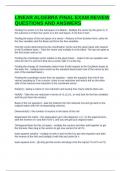
LINEAR ALGEBRA FINAL EXAM REVIEW
QUESTIONS AND ANSWERS
Finding If a vector is in the null space of a Matrix - Multiply the vector by the given A. If
the outcome is 0 then the vector is in the null Space, if not then it isn't.
Finding the basis of the null space of a vector - Reduce to Row Echelon form, solve for
the free variables and the Basis and from the free variables
Find the vector determined by the coordination Vector and the given basis with respect
to the Euclidean basis - Take the vector and multiply it to the basis. The top one goes to
the first vector and so on.
Finding the coordinate vector relative to the given basis. - make it into an equation and
solve for the C's and form that into a vector with C1 at the top
Finding the change of coordinates matrix from B with respect to the Euclidean bases to
the basic Rn - multiply each vector by the standard basis (each row of the vector by the
part of the standard basis.)
Finding the coordinate vector from an equation - make the equation from the B into
vectors equaling to P as a vector, solve to row reduction and what's left on the other
side of the reduced row reduction is the coordinate vector.
Rank(A) - taking a matrix to row reduction and seeing how many indents there are.
Null(A) - Take the row reduction in terms of x1,x2,x3,..xn and look for the free variables
and the put them into vectors.
Basis of the col space(A) - take the indents from the reduced row and go back to the
original matrix with the corresponding columns.
Dimension(A) - the number of vectors in the basis of the null
diagonalize the matrix - the eigenvalues go in the diagonal, v is = to the eigenvectors,
take the inverse of v and then VDV-1 and you will get your original matrix
Orthogonal Basis for the col space - multiply the vectors and then add together to get
the formula, then plug in the vectors to get new vectors for all V's.
least squares solution - multiply At with A and At with b to get new equation and take
the inverse of the AtA and multiply it with Atb and solve for x
least squares error - ||b-Ax|| get that vector and plug it into the sqrt(x1^2+x2^2+xn^2)
QUESTIONS AND ANSWERS
Finding If a vector is in the null space of a Matrix - Multiply the vector by the given A. If
the outcome is 0 then the vector is in the null Space, if not then it isn't.
Finding the basis of the null space of a vector - Reduce to Row Echelon form, solve for
the free variables and the Basis and from the free variables
Find the vector determined by the coordination Vector and the given basis with respect
to the Euclidean basis - Take the vector and multiply it to the basis. The top one goes to
the first vector and so on.
Finding the coordinate vector relative to the given basis. - make it into an equation and
solve for the C's and form that into a vector with C1 at the top
Finding the change of coordinates matrix from B with respect to the Euclidean bases to
the basic Rn - multiply each vector by the standard basis (each row of the vector by the
part of the standard basis.)
Finding the coordinate vector from an equation - make the equation from the B into
vectors equaling to P as a vector, solve to row reduction and what's left on the other
side of the reduced row reduction is the coordinate vector.
Rank(A) - taking a matrix to row reduction and seeing how many indents there are.
Null(A) - Take the row reduction in terms of x1,x2,x3,..xn and look for the free variables
and the put them into vectors.
Basis of the col space(A) - take the indents from the reduced row and go back to the
original matrix with the corresponding columns.
Dimension(A) - the number of vectors in the basis of the null
diagonalize the matrix - the eigenvalues go in the diagonal, v is = to the eigenvectors,
take the inverse of v and then VDV-1 and you will get your original matrix
Orthogonal Basis for the col space - multiply the vectors and then add together to get
the formula, then plug in the vectors to get new vectors for all V's.
least squares solution - multiply At with A and At with b to get new equation and take
the inverse of the AtA and multiply it with Atb and solve for x
least squares error - ||b-Ax|| get that vector and plug it into the sqrt(x1^2+x2^2+xn^2)