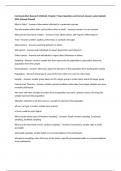
Communication Research Methods- Chapter 7 Exam Questions and Correct Answers Latest Update
2024 (Already Passed)
What Is Data? - Answers Information collected in a systematic manner
The information within Data can be either what or what? - Answers numeric or non-numeric
What are the four kinds of Data? - Answers Texts, Observations, Self-reports, Other Reports
Texts - Answers written, spoken, performed, or symbolic messages
Observations: - Answers watching behavior in action
Self-reports - Answers ask individuals to report about their own behaviors
Other reports - Answers ask individuals to report about behaviors of others
Sampling - Answers create a sample that best represents the population to generalize about the
population from the sample
Generalization - Answers inferences about the behavior of the population from studying the sample
Population: - Answers the group of cases/units from which you want to collect data
Sample: - Answers smaller group taken out of a larger group to make claims about the larger group
Central Limit Theorem - Answers •Under normal conditions data taken from larger samples are more
normally distributed
•As more and more samples are taken from a population you have a greater chance of having the
sample represent the population
•Random selection is the best way for a sample to represent the population
•If you can't get a random sample your amount
of error could be much higher
What are the three types of Random Sampling? - Answers Simple random sampling, Systematic
sampling, Stratified sampling
What are the four kinds of non- random sampling? - Answers Convenience sample: data is easily
accessible
•Snowball sampling: sample builds on recommendations from participants
•Purposive sampling: when the focus of the study is specific grousample builds on recommendations
from participants
2024 (Already Passed)
What Is Data? - Answers Information collected in a systematic manner
The information within Data can be either what or what? - Answers numeric or non-numeric
What are the four kinds of Data? - Answers Texts, Observations, Self-reports, Other Reports
Texts - Answers written, spoken, performed, or symbolic messages
Observations: - Answers watching behavior in action
Self-reports - Answers ask individuals to report about their own behaviors
Other reports - Answers ask individuals to report about behaviors of others
Sampling - Answers create a sample that best represents the population to generalize about the
population from the sample
Generalization - Answers inferences about the behavior of the population from studying the sample
Population: - Answers the group of cases/units from which you want to collect data
Sample: - Answers smaller group taken out of a larger group to make claims about the larger group
Central Limit Theorem - Answers •Under normal conditions data taken from larger samples are more
normally distributed
•As more and more samples are taken from a population you have a greater chance of having the
sample represent the population
•Random selection is the best way for a sample to represent the population
•If you can't get a random sample your amount
of error could be much higher
What are the three types of Random Sampling? - Answers Simple random sampling, Systematic
sampling, Stratified sampling
What are the four kinds of non- random sampling? - Answers Convenience sample: data is easily
accessible
•Snowball sampling: sample builds on recommendations from participants
•Purposive sampling: when the focus of the study is specific grousample builds on recommendations
from participants