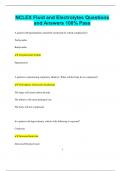
NCLEX Fluid and Electrolytes Questions
and Answers 100% Pass
A patient with hyperkalemia should be monitored for which complication?
Tachycardia
Bradycardia
✔✔ Irregular heart rhythm
Hypertension
A patient is experiencing respiratory alkalosis. What will the body do to compensate?
✔✔ The kidneys will excrete bicarbonate
The lungs will retain carbon dioxide
The kidneys will retain hydrogen ions
The body will not compensate
In a patient with hypovolemia, which of the following is expected?
Confusion
✔✔ Increased heart rate
Decreased blood pressure
1
,Normal urine output
A nurse is caring for a patient with hypernatremia. Which symptom would be most concerning?
Dry mouth
✔✔ Confusion
Muscle weakness
Edema
Which of the following is the most common cause of hyponatremia in hospitalized patients?
Heart failure
Kidney disease
✔✔ Excessive water intake
Use of diuretics
A patient with hypomagnesemia is likely to experience which of the following?
Severe thirst
✔✔ Muscle twitching
Nausea
2
,Tachycardia
A patient presents with dry skin, confusion, and increased thirst. The nurse suspects
hypernatremia. Which of the following would be a priority intervention?
Encouraging increased sodium intake
✔✔ Administering IV fluids with a lower sodium concentration
Administering potassium supplements
Increasing the patient's oral intake of water
In a patient with metabolic acidosis, what compensatory action is the body likely to take?
✔✔ Increased respiratory rate to expel carbon dioxide
Increased urine excretion of sodium
Decreased respiratory rate to retain carbon dioxide
Retention of sodium in the kidneys
Which electrolyte imbalance is most commonly associated with muscle weakness and fatigue?
✔✔ Hypokalemia
Hypercalcemia
3
, Hyperkalemia
Hyponatremia
A nurse is caring for a patient with hypercalcemia. What clinical finding would the nurse most
likely observe?
✔✔ Decreased deep tendon reflexes
Muscle twitching
Increased heart rate
Tetany
For a patient with hypokalemia, which of the following ECG changes is likely to be seen?
Tall T waves
✔✔ Flattened T waves
Widened QRS complex
Increased P wave amplitude
In which of the following conditions would you most likely see a positive Chvostek's sign?
Hyperkalemia
4
and Answers 100% Pass
A patient with hyperkalemia should be monitored for which complication?
Tachycardia
Bradycardia
✔✔ Irregular heart rhythm
Hypertension
A patient is experiencing respiratory alkalosis. What will the body do to compensate?
✔✔ The kidneys will excrete bicarbonate
The lungs will retain carbon dioxide
The kidneys will retain hydrogen ions
The body will not compensate
In a patient with hypovolemia, which of the following is expected?
Confusion
✔✔ Increased heart rate
Decreased blood pressure
1
,Normal urine output
A nurse is caring for a patient with hypernatremia. Which symptom would be most concerning?
Dry mouth
✔✔ Confusion
Muscle weakness
Edema
Which of the following is the most common cause of hyponatremia in hospitalized patients?
Heart failure
Kidney disease
✔✔ Excessive water intake
Use of diuretics
A patient with hypomagnesemia is likely to experience which of the following?
Severe thirst
✔✔ Muscle twitching
Nausea
2
,Tachycardia
A patient presents with dry skin, confusion, and increased thirst. The nurse suspects
hypernatremia. Which of the following would be a priority intervention?
Encouraging increased sodium intake
✔✔ Administering IV fluids with a lower sodium concentration
Administering potassium supplements
Increasing the patient's oral intake of water
In a patient with metabolic acidosis, what compensatory action is the body likely to take?
✔✔ Increased respiratory rate to expel carbon dioxide
Increased urine excretion of sodium
Decreased respiratory rate to retain carbon dioxide
Retention of sodium in the kidneys
Which electrolyte imbalance is most commonly associated with muscle weakness and fatigue?
✔✔ Hypokalemia
Hypercalcemia
3
, Hyperkalemia
Hyponatremia
A nurse is caring for a patient with hypercalcemia. What clinical finding would the nurse most
likely observe?
✔✔ Decreased deep tendon reflexes
Muscle twitching
Increased heart rate
Tetany
For a patient with hypokalemia, which of the following ECG changes is likely to be seen?
Tall T waves
✔✔ Flattened T waves
Widened QRS complex
Increased P wave amplitude
In which of the following conditions would you most likely see a positive Chvostek's sign?
Hyperkalemia
4