100% satisfaction guarantee Immediately available after payment Both online and in PDF No strings attached 4.2 TrustPilot
logo-home
Exam (elaborations)

NR283 Patho Exam 1 Questions and Answers

Rating
-
Sold
-
Pages
118
Grade
A+
Uploaded on
26-11-2024
Written in
2024/2025

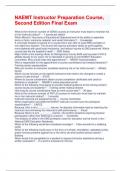
NR283 Patho Exam 1 Questions and Answers 1. Which of the following would be the most likely cause of an iatrogenic disease? a. An inherited disorder b. A combination of specific etiological factors c. An unwanted effect of a prescribed drug d. Prolonged exposure to toxic chemicals in the environment - Answersc. An unwanted effect of a prescribed drug 2. The manifestations of a disease are best defined as the: a. subjective feelings of discomfort during a chronic illness. b. signs and symptoms of a disease. c. factors that precipitate an acute episode of a chronic illness. d. early indicators of the prodromal stage of infection. - Answersb. signs and symptoms of a disease 3. The best definition of the term prognosis is the: a. precipitating factors causing an acute episode. b. number of remissions to be expected during the course of a chronic illness. c. predicted outcome or likelihood of recovery from a specific disease. d. exacerbations occurring during chronic illness. - Answersc. predicted outcome or likelihood of recovery from a specific disease. 4. Which of the following is considered a systemic sign of disease? a. Swelling of the knee b. Fever c. Pain in the neck d. Red rash on the face - Answersb. Fever 5. Etiology is defined as the study of the: a. causes of a disease. b. course of a disease. c. expected complications of a disease. d. manifestations of a disease. - Answersa. causes of a disease. 6. A type of cellular adaptation in which there is a decrease in cell size is referred to as: a. hypertrophy. b. metaplasia. c. anaplasia. d. atrophy. - Answersd. atrophy. 7. A change in a tissue marked by cells that vary in size and shape and show increased mitotic figures would be called: a. metaplasia. b. atrophy. c. dysplasia. d. hypertrophy. - Answersc. dysplasia. 8. A deficit of oxygen in the cells usually due to respiratory or circulatory problems is called: a. apoptosis. b. ischemia. c. hypertrophy. d. necrosis. - Answersb. ischemia 9. When a group of cells in the body dies, the change is called: a. ischemia. b. gangrene. c. hypoxia. d. necrosis. - Answersd. necrosis 10. Rigorous weight lifting/body building regimens may result in the skeletal muscle cells undergoing: a. hypertrophy. b. dysplasia. c. atrophy. d. regeneration. - Answersa. hypertrophy 11. The term cancer refers to: a. dysplasia. b. hyperplasia. c. metaplasia. d. malignant neoplasm. - Answersd. malignant neoplasm. 12. To which of the following does the term apoptosis refer? a. Increased rate of mitosis by certain cells b. Ischemic damage to cells c. Liquefaction of necrotic tissue d. Preprogrammed cell self-destruction - Answersd. Preprogrammed cell self-destruction 13. Which of the following statements is TRUE? a. Alteration of DNA does not change cell function. b. Damaged cells may be able to repair themselves. c. All types of cells die at the same rate. d. Mild ischemia causes immediate cell death. - Answersb. Damaged cells may be able to repair themselves. 14. Caseation necrosis refers to an area where: a. cell proteins have been denatured. b. cell are liquefied by enzymes. c. dead cells form a thick cheesy substance. d. bacterial invasion has occurred. - Answersc. dead cells form a thick cheesy substance 15. Routine application of sun block to skin would be an example of: a. an iatrogenic cause of cancer. b. a preventive measure. c. a precipitating factor. d. a predisposing condition. - Answersb. a preventive measure. 16. A circumstance that causes a sudden acute episode of a chronic disease to occur is termed: a. latent stage. b. predisposing factor. c. incidence. d. precipitating factor. - Answersd. precipitating factor. 17. The term homeostasis refers to: a. the causative factors in a particular disease. b. maintenance of a stable internal environment. c. a condition that triggers an acute episode. d. a collection of signs and symptoms. - Answersb. maintenance of a stable internal environment. 18. Which term is used to describe a new and secondary or additional problem that arises after the original disease has been established? a. Symptoms b. Occurrence c. Manifestations d. Complication - Answersd. Complication 19. Pathophysiology involves the study of: a. the structure of the human body. b. the functions of various organs in the body. c. functional or structural changes resulting from disease processes. d. various cell structures and related functions. - Answersc. functional or structural changes resulting from disease processes. 20. Which of the following is the best definition of epidemiology? a. The science of tracking the occurrence and distribution of diseases b. The relative number of deaths resulting from a particular disease c. Identification of a specific disease through evaluation of signs and symptoms d. The global search for emerging diseases - Answersa. The science of tracking the occurrence and distribution of diseases 21. Which of the following can cause cell injury or death? 1. Hypoxia 2. Exposure to excessive cold 3. Excessive pressure on a tissue 4. Chemical toxins a. 1, 2 b. 2, 4 c. 1, 3, 4 d. 1, 2, 3, 4 - Answersd. 1, 2, 3, 4 22. All of the following are part of the Seven Steps to Health EXCEPT: a. follow cancer screening guidelines. b. use sun block agents whenever exposed. c. participate in strenuous exercise on a regular daily basis. d. choose high fiber, lower fat foods. - Answersc. participate in strenuous exercise on a regular daily basis. 23. The term disease refers to: a. the period of recovery and return to a normal healthy state. b. a deviation from the normal state of health and function. c. the treatment measures used to promote recovery. d. a basic collection of signs and symptoms. - Answersb. a deviation from the normal state of health and function. 24. A collection of signs and symptoms, often affecting more than one organ or system, that usually occur together in response to a certain condition is referred to as a (an): a. acute disease. b. multiorgan disorder. c. syndrome. d. manifestation. - Answersc. syndrome. 25. All of the following statements are correct about cell damage EXCEPT: a. the initial stage of cell damage often causes an alteration in metabolic reactions. b. If the factor causing the damage is removed quickly, the cell may be able to recover and return to its normal state. c. If the noxious factor remains for an extended period of time, the damage becomes irreversible and the cell dies. d. Initially, cell damage does not change cell metabolism, structure, or function. - Answersd. Initially, cell damage does not change cell metabolism, structure, or function. 26. Which of the following conditions distinguishes double blind studies used in health research? a. Neither the members of the control group or the experimental group nor the person administering the treatment knows who is receiving the experimental therapy. b. Both groups of research subjects and the person administering the treatment know who is receiving the experimental therapy. c. The research subjects do not know, but the person administering the treatment knows who is receiving placebo or standard therapy. d. Only members of the control group know they are receiving standard therapy. - Answersa. Neither the members of the control group or the experimental group nor the person administering the treatment knows who is receiving the experimental therapy. 27. If the data collected from the research process confirm that the new treatment has increased effectiveness and is safe, this is called: a. the placebo effect. b. evidence-based research. c. blind research studies. d. approval for immediate distribution. - Answersb. evidence-based research.

Show more Read less
Institution
NR283 Patho 1
Course
NR283 Patho 1


Whoops! We can’t load your doc right now. Try again or contact support.

Written for

Institution
NR283 Patho 1
Course
NR283 Patho 1

Document information

Uploaded on
November 26, 2024
Number of pages
118
Written in
2024/2025
Type
Exam (elaborations)
Contains
Questions & answers

Subjects

Content preview

©Themoon EXAM SOLUTIONS
26/11/2024 10:59AM

NR283 Patho Exam 1 Questions and
Answers


1. Which of the following would be the most likely cause of an iatrogenic disease?


a. An inherited disorder


b. A combination of specific etiological factors


c. An unwanted effect of a prescribed drug


d. Prolonged exposure to toxic chemicals in the environment - Answers✓✓c. An unwanted
effect of a prescribed drug


2. The manifestations of a disease are best defined as the:


a. subjective feelings of discomfort during a chronic illness.


b. signs and symptoms of a disease.


c. factors that precipitate an acute episode of a chronic illness.


d. early indicators of the prodromal stage of infection. - Answers✓✓b. signs and symptoms of a
disease

, ©Themoon EXAM SOLUTIONS
26/11/2024 10:59AM


3. The best definition of the term prognosis is the:


a. precipitating factors causing an acute episode.


b. number of remissions to be expected during the course of a chronic illness.


c. predicted outcome or likelihood of recovery from a specific disease.


d. exacerbations occurring during chronic illness. - Answers✓✓c. predicted outcome or
likelihood of recovery from a specific disease.


4. Which of the following is considered a systemic sign of disease?


a. Swelling of the knee


b. Fever


c. Pain in the neck


d. Red rash on the face - Answers✓✓b. Fever


5. Etiology is defined as the study of the:


a. causes of a disease.

, ©Themoon EXAM SOLUTIONS
26/11/2024 10:59AM


b. course of a disease.


c. expected complications of a disease.


d. manifestations of a disease. - Answers✓✓a. causes of a disease.


6. A type of cellular adaptation in which there is a decrease in cell size is referred to as:


a. hypertrophy.


b. metaplasia.


c. anaplasia.


d. atrophy. - Answers✓✓d. atrophy.


7. A change in a tissue marked by cells that vary in size and shape and show increased mitotic
figures would be called:


a. metaplasia.


b. atrophy.


c. dysplasia.

, ©Themoon EXAM SOLUTIONS
26/11/2024 10:59AM


d. hypertrophy. - Answers✓✓c. dysplasia.


8. A deficit of oxygen in the cells usually due to respiratory or circulatory problems is called:


a. apoptosis.


b. ischemia.


c. hypertrophy.


d. necrosis. - Answers✓✓b. ischemia


9. When a group of cells in the body dies, the change is called:


a. ischemia.


b. gangrene.


c. hypoxia.


d. necrosis. - Answers✓✓d. necrosis


10. Rigorous weight lifting/body building regimens may result in the skeletal muscle cells
undergoing:

$15.49
Get access to the full document:

100% satisfaction guarantee
Immediately available after payment
Both online and in PDF
No strings attached

Get to know the seller
Seller avatar
Themoon

Get to know the seller

Seller avatar
Themoon Liberty University
View profile
Follow You need to be logged in order to follow users or courses
Sold
1
Member since
1 year
Number of followers
0
Documents
511
Last sold
7 months ago

Timely Exams Questions With Verified Answers And Package Deals.

0.0

0 reviews

5
0
4
0
3
0
2
0
1
0

Recently viewed by you

Why students choose Stuvia

Created by fellow students, verified by reviews

Quality you can trust: written by students who passed their exams and reviewed by others who've used these notes.

Didn't get what you expected? Choose another document

No worries! You can immediately select a different document that better matches what you need.

Pay how you prefer, start learning right away

No subscription, no commitments. Pay the way you're used to via credit card or EFT and download your PDF document instantly.

Student with book image

“Bought, downloaded, and aced it. It really can be that simple.”

Alisha Student

Frequently asked questions