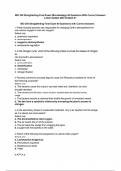
BIO 250 Straighterling Final Exam (Microbiology) 60 Questions With Correct Answers Latest Update 2024 Graded A+
BIO 250 Straighterling Final Exam 60 Questions with Correct Answers 1 - What microbial process was responsible for changing Earth’s atmosphere from one without oxygen to one with oxygen? Select one: a. anaerobic respiration b. decomposition c. oxygenic photosynthesis d. temperature regulation 2 - In the nitrogen cycle, which of the following phases involves the release of nitrogen as into the Earth’s atmosphere? Select one: a. ammonification b. denitrification c. nitrification d. nitrogen fixation 3 - Farmers commonly inoculate legume crops with Rhizobium bacteria for which of the following purposes? Select one: a. The bacteria cause the crops to use less water and, therefore, be more drought-resistant. b. The bacteria kill off other, more virulent, bacteria that are harmful to the crops c. The bacteria secrete a chemical that inhibits the growth of unwanted weeds. d. The two form a symbiotic relationship increasing the plant’s access to nitrogen. 4 - In the secondary phase of wastewater treatment, why is air injected into the sludge as it is stirred and recirculated? Select one: a. The bioremediators need oxygen. b. The air lowers the pH of the solution. c. The air keeps the sludge from clogging the pipes. d. Oxygen kills the bacteria in the water. 5 - Which of the following microorganisms is used to make yogurt? Select one: a. Lactobacillus bulgaricus b. Pennicillium roqueforti c. Streptococcus lactis d. Yeast 6 - ATP is a Select one: a. by-product of ADP that breaks down phosphates for photosynthesis. b. catalyst for all chemical reactions that occur in the cell. c. long chain of nucleotides responsible for protein synthesis. d. nucleotide that releases and stores energy in the cell. 7 - A viral capsid is composed of Select one: a. carbohydrates. b. lipids. c. enzymes. d. proteins. 8 - Which of these are NOT considered living organisms? Select one: a. monera b. plants c. protists d. viruses 9 - Which of the following describes the order in which different types of RNA are involved in translation? Select one: a. messenger RNA (mRNA), ribosomal RNA (rRNA), transfer RNA ( tRNA) b. messenger RNA (mRNA), transfer RNA (tRNA), ribosomal RNA (rRNA) c. ribosomal RNA (rRNA), messenger RNA (mRNA), transfer RNA (tRNA) d. ribosomal RNA (rRNA), transfer RNA (tRNA), messenger RNA (mRNA) 10 - What is the bacterial identi□cation technique that, when positive, results in the bacterium staining two contrasting colors? Select one: a. acid-fast staining b. fagella staining c. Gram staining d. monochrome staining 11 - Which of the following is found in some, but not all groups of eukaryotic microorganisms? Select one: a. cell wall b. cytoplasmic membrane c. glycocalyx d. mitochondrion 12 - In which instance would a researcher need to use Bergey’s Manual of Systematic Bacteriology instead of Bergey’s Manual of Determinative Bacteriology? Select one: a. to determine the generation time of a species of bacteria b. to determine the morphology of a bacterium c. to FInd out whether a bacterium is Gram-positive or Gram-negative d. to investigate the genetic history of a bacterial species 13 - Which of the following structures is found in gram-negative bacteria but is absent from gram-positive bacteria? Select one: a. glycocalyx b. outer lipid membrane c. ribosome d. specialized appendage 14 - Which type of archaea is able to survive in extremely high concentrations of salt? Select one: a. acidophiles b. alkaliphiles c. halophiles d. psychrophiles 15 - Which of the following is true of prokaryotes, but not true of eukaryotes? Select one: a. Their DNA is wound around histones. b. They have cell walls made of peptidoglycan. c. They have a nucleus. d. They possess membrane-bound organelles. 16 - Which of the following is the role of ribosomes? Select one: a. facilitate photosynthesis b. process nutrients c. provide a site for protein synthesis d. transfer energy from cell stores 17 - Which of the following are theorized to be the ancestors of chloroplasts? Select one: a. cyanobacteria b. mitochondria c. multiple nuclei d. Viruses 18 - Which eukaryotic microorganisms are photoautotrophs? Select one: a. algae b. fungi c. helminths d. Protozoa 19 - Describe the genetic material that is contained within a virus. Select one: a. DNA but no RNA b. neither DNA nor RNA c. RNA but no DNA d. RNA or DNA, but not both 20 - In the life cycle of an animal virus, what occurs during adsorption? Select one: a. The virus attaches to receptor sites outside the host cell. b. The host cell surrounds the virus. c. The virus directs the host to assemble a new virus. d. The new virus is released from the host cell. 21 - Which of the following viral enzymes converts viral RNA into DNA? Select one: a. integrase b. protease c. reverse transcriptase d. ribonuclease 22 - A bacteriophage is what type of microorganism? Select one: a. bacterium b. fungus c. protozoan d. virus 23 - What is the key function of a microbe’s cell membrane, also known as the cytoplasmic membrane? Select one: a. It acts as a sieve to filter water flowing into the cell. b. It gives the cell a distinctive shape. c. It allows the cell to adhere to its environment. d. It transports nutrients in and wastes out. 24 - The outer covering of a virus is called the Select one: a. capsid. b. core. c. matrix. d. nucleic acid. 25 - Which bacterial cell structure helps in locomotion? Select one: a. capsule b. cell wall llum d. plasmid 26 - What organism relies only on inorganic minerals without sun for its nutrition? Select one: a. chemoautotroph b. photoautotroph c. lithoautotroph d. chemoheterotroph 27 - What must a microbe do in active transport to absorb nutrients? Select one: a. expend energy b. expel wastes c. diffuse water d. raise temperature 28 - Why is phosphorous an important nutrient for bacteria? Select one: a. It helps maintain pH. b. It is a component of nucleic acids. c. It is necessary for the formation of disulfide bonds. d. It serves as a source of free energy in oxidation-reduction reactions. 29 - During which cycle of batch culturing are growing cells most vulnerable to a change in heat? Select one: a. rapid growth b. new growth c. downward growth d. stabilizing growth 30 - What is the main process by which bacterial cells reproduce? Select one: a. Binary fussion b. budding c. meiosis d. Mitosis 31 - Appendages possessed by some bacteria that aid in conjugation are called which of the following? Select one: a. axial laments iae lla d. pili 32 - Which of the following processes results in the synthesis of cell molecules and structures? Select one: a. anabolism b. catabolism c. oxidative phosphorylation d. glycolysis 33 - How is it possible for green sulfur bacteria that live on the ocean floor—where no sunlight can reach—to carry on photosynthesis? Select one: a. They get light from fish that glow. b. They get light from geothermal radiation. c. They get light from photoluminescent plants. d. They have developed process for photosynthesis that does not require light. 34 - Which of these bacteria perform photosynthesis? Select one: a. clostridia b. cyanobacteria c. mycobacteria d. spirochetes 35 - Which type of RNA transports the DNA master code to ribosomes? Select one: a. messenger (mRNA) b. transfer (tRNA) c. ribosomal (rRNA) d. single-stranded (ssRNA) 36 - Pieces of genetic material that are contained within bacteria but replicate independently of the cell’s chromosomes are called which of the following? Select one: a. genomes b. plasmids c. RNA d. Viruses 37 - Which of the following types of RNA is clover shaped and brings amino acids to the ribosome during translation? Select one: a. messenger RNA b. transfer RNA c. ribosomal RNA d. micro RNA 38 - Which of the following is a characteristic of RNA, but not of DNA? Select one: a. It is a double-stranded, helical molecule. b. It is copied during transcription. c. The complementary based paired with adenine is thymine. d. The sugar that is a component of the molecular backbone is ribose. 39 - A nucleotide is composed of Select one: a. nitrogen, sulfur, and a 6-carbon sugar. b. calcium, phosphate, and a 5-carbon sugar. c. phosphate, nitrogen, and a 5-carbon sugar. d. sulfur, calcium, and a 6-carbon sugar. 40 - Which of the following is a random change in the DNA arising from errors in replication? Select one: a. crossing over b. induced mutation c. spontaneous mutation d. transmutation 41 - Which of these is a genetic mutation that alters a base but does not change the amino acid? Select one: a. frameshift b. missense c. nonsense d. Silent mutation 42 - What type of information is often transferred directly through conjugation between bacterial cells? Select one: a. sugar fermentation enzymes b. cloning techniques c. drug resistance d. polysaccharide capsules 43 - What is the process that occurs when a recipient eukaryote cell accepts DNA fragments indirectly from the surrounding environment? Select one: a. transfection b. transduction c. transformation d. transferral 44 - Which type of genetic transfer requires that donor and recipient cells come into contact with each other? Select one: a. cloning b. conjugation c. transformation d. Transduction 45 - Which process occurs when a DNA strand is heated? Select one: a. annealing b. denaturing c. restricting d. splicing 46 - In genetic engineering, the enzyme that is used to rejoin DNA phosphate-sugar bonds that have previously been cut is a(n) Select one: a. endonuclease. b. ligase. c. polymerase. d. transcriptase. 47 - Which of the following are the self-replicating bacterial DNA molecules used in genetic engineering? Select one: a. clones b. linkers c. plasmids d. Transformants 48 - How do opportunistic pathogens differ from primary or true pathogens? Select one: a. They must remain in a natural habitat in the body to live. b. They require a weakened defense in the host. c. They activate in the presence of other intruders. d. They develop stronger virulence. 49 - What type of toxin is secreted by a bacterial cell into infected tissues? Select one: a. nephrotoxin b. endotoxin c. hemotoxin d. Exotoxin 50 - Under which circumstances could a fetus be at risk of hemolytic disease? Select one: a. Both parents of the fetus are Rh-. b. The mother has received RhoGAM immunization. c. The Rh+ fetus is the first pregnancy for the Rh- mother. d. The Rh- mother has previously given birth to an Rh+ child. 51 - Which system is critical for communication between body compartments in an immune response of a host? Select one: a. vascular b. respiratory c. lymphatic d. gastrointestinal 52 - Which of the following is the sequence of events that occurs during the body’s response to an injury? Select one: a. dolor, rubor, tumor b. rubor, tumor, dolor c. tumor, dolor, rubor d. tumor, rubor, dolor 53 - What is the process by which microorganisms are coated with specific antibodies? Select one: a. complement activation b. immunization c. opsonization d. Sterilization 54 - What microbial synthesis does penicillin target? Select one: a. protein b. folic acid c. cell wall d. nucleic acid 55 - Why are narrow-spectrum antimicrobials valuable? Select one: a. less costly to produce b. readily available on the market c. low incidence of allergies d. target specific bacteria 56 - How do probiotics help control infections? Select one: a. They encourage healthier nutrition. b. They improve intestinal biota. c. They serve as organic antimicrobials. d. They inhibit drug resistance. 57 - Drinking breast milk provides which of the following kinds of protection from disease for the baby? Select one: a. artificial, active immunity b. artificial, passive immunity c. natural, active immunity d. natural, passive immunity 58 - Which of the following is found in high concentrations in colostrum and is an important factor in protecting nursing infants from enteric pathogens? Select one: a. IgA b. IgD c. IgE d. IgG 59 - Which of the following antimicrobial proteins is produced by T cells? Select one: a. interferon alpha b. interferon beta c. interferon gamma d. interferon delta 60 - Which enzymes in human secretions damage bacterial cell walls? Select one: a. kinases b. lipases c. lysozymes d. proteases
Geschreven voor
Documentinformatie
- Geüpload op
- 26 november 2024
- Aantal pagina's
- 11
- Geschreven in
- 2024/2025
- Type
- Tentamen (uitwerkingen)
- Bevat
- Vragen en antwoorden
Onderwerpen
- bio 250
- bio 250 straighterling
-
bio 250 straighterling final exam microbiology

Ook beschikbaar in voordeelbundel