STATISTICS FINAL SUMMARY
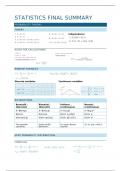
PROBABILITY THEORY
THEORY
Independence
RULES FOR CALCULATIONS
RANDOM VARIABLES
Discrete variables Continuous variables
DISTRIBUTIONS
Bernoulli… Binomial… Uniform… Normal…
(discrete) (discrete) (continuous) (continuous)
X~Bern(p) X~Bin(n,p) X~U(,β) X~N(µ,σ2)
E(x)=p E(x)=np E(x)= (+β)/2 E(x)= µ
V(x)=p(1-p) V(x)= np(1-p) V(x)= (β-) /12
2
V(x)= σ2
Two possible Series of IDD P= equal, Bound Z= (x- µ)/σ ~N(0,1)
outcomes Bernoulli’s interval
JOINT PROBABILITY DISTRIBUTIONS
FORMULAS
, TABLE
LINEAR COMBINATIONS
If we have a random variable W as combination of the random variables X and Y:
W =a+bX+cY then,
µw =a+bµx+cµy
σ2w = b2*σ2x + c2*σ2y +2bcσ(xy)
RANDOM SAMPLING
FORMULAS
MEAN
WHEN SIGMAIS KNOWN
1. H0: 0 against H1: >0 Confidence interval
2. Test statistic:
3. Rejection area: zz
4. Val
5. Conclusion
WHEN S IS KNOWN (SIGMA IS UNKNOWN)
1. H0: 0 against H1: < 0 Confidence interval
2. Test statistic:
3. Rejection area: t:n-1
4. Val
5. Conclusion
PROPORTION
1. H0: p = p0 against H1: p ≠ p0 Confidence interval
2. Test statistic:
3. Rejection area: z-z/2 or zz/2
4. Val
5. Conclusion
VARIANCE
PROBABILITY THEORY
THEORY
Independence
RULES FOR CALCULATIONS
RANDOM VARIABLES
Discrete variables Continuous variables
DISTRIBUTIONS
Bernoulli… Binomial… Uniform… Normal…
(discrete) (discrete) (continuous) (continuous)
X~Bern(p) X~Bin(n,p) X~U(,β) X~N(µ,σ2)
E(x)=p E(x)=np E(x)= (+β)/2 E(x)= µ
V(x)=p(1-p) V(x)= np(1-p) V(x)= (β-) /12
2
V(x)= σ2
Two possible Series of IDD P= equal, Bound Z= (x- µ)/σ ~N(0,1)
outcomes Bernoulli’s interval
JOINT PROBABILITY DISTRIBUTIONS
FORMULAS
, TABLE
LINEAR COMBINATIONS
If we have a random variable W as combination of the random variables X and Y:
W =a+bX+cY then,
µw =a+bµx+cµy
σ2w = b2*σ2x + c2*σ2y +2bcσ(xy)
RANDOM SAMPLING
FORMULAS
MEAN
WHEN SIGMAIS KNOWN
1. H0: 0 against H1: >0 Confidence interval
2. Test statistic:
3. Rejection area: zz
4. Val
5. Conclusion
WHEN S IS KNOWN (SIGMA IS UNKNOWN)
1. H0: 0 against H1: < 0 Confidence interval
2. Test statistic:
3. Rejection area: t:n-1
4. Val
5. Conclusion
PROPORTION
1. H0: p = p0 against H1: p ≠ p0 Confidence interval
2. Test statistic:
3. Rejection area: z-z/2 or zz/2
4. Val
5. Conclusion
VARIANCE