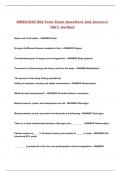
DMSG1820 Mid-Term Exam Questions And Answers
100% Verified
Basic unit of all matter - ANSWER Atom
Groups of different tissues combine to form - ANSWER Organs
Coordinated group of organs are arranged into - ANSWER Body systems
Conversion of food energy into forms useful to the body - ANSWER Metabolism
The process of the body finding equilibrium
Ability to maintain a steady and stable enviornment - ANSWER Homeostasis
What disrupts homeostasis? - ANSWER Stressful stimuli or stressors
Blood pressure, pulse, and temperature are all - ANSWER Vital signs
Measurements used to ascertain how the body is functioning - ANSWER Vital signs
There is a close relationship between vital signs and __________ - ANSWER Homeostasis
Plasma makes up _____% of blood volume and consists of ______% water - ANSWER 55%
blood and 92% water
__________ is produced in the liver and participates in blood coagulation - ANSWER
, Prothrombin
__________ is essential for prothrombin production - ANSWER Vitamin K
Functions of the blood include - ANSWER Transport oxygen and nutrients
Defense against infection
Maintenance of pH
Hemopoiesis
What is hemopoiesis? - ANSWER The formation of new blood cells
The body's primary defense against infection - ANSWER White blood cells (leukocytes)
Includes the pharynx, esophagus, stomach, small intestine, and large intestine -
ANSWER Gastrointestinal system
Major functions of the GI system include _______ and ________ of food and elimination of
waste products - ANSWER Ingestions and digestion
Is the passage of bloody stools and may be a sign of GI bleeding - ANSWER
Hematochezia
The genitourinary system includes - ANSWER Kidneys, ureters, bladder, and urethra
The primary function of the genitourinary system is - ANSWER The formation of urine
and maintenance of homeostasis
The right kidney lies slightly _______ to the left kidney - ANSWER Inferior
100% Verified
Basic unit of all matter - ANSWER Atom
Groups of different tissues combine to form - ANSWER Organs
Coordinated group of organs are arranged into - ANSWER Body systems
Conversion of food energy into forms useful to the body - ANSWER Metabolism
The process of the body finding equilibrium
Ability to maintain a steady and stable enviornment - ANSWER Homeostasis
What disrupts homeostasis? - ANSWER Stressful stimuli or stressors
Blood pressure, pulse, and temperature are all - ANSWER Vital signs
Measurements used to ascertain how the body is functioning - ANSWER Vital signs
There is a close relationship between vital signs and __________ - ANSWER Homeostasis
Plasma makes up _____% of blood volume and consists of ______% water - ANSWER 55%
blood and 92% water
__________ is produced in the liver and participates in blood coagulation - ANSWER
, Prothrombin
__________ is essential for prothrombin production - ANSWER Vitamin K
Functions of the blood include - ANSWER Transport oxygen and nutrients
Defense against infection
Maintenance of pH
Hemopoiesis
What is hemopoiesis? - ANSWER The formation of new blood cells
The body's primary defense against infection - ANSWER White blood cells (leukocytes)
Includes the pharynx, esophagus, stomach, small intestine, and large intestine -
ANSWER Gastrointestinal system
Major functions of the GI system include _______ and ________ of food and elimination of
waste products - ANSWER Ingestions and digestion
Is the passage of bloody stools and may be a sign of GI bleeding - ANSWER
Hematochezia
The genitourinary system includes - ANSWER Kidneys, ureters, bladder, and urethra
The primary function of the genitourinary system is - ANSWER The formation of urine
and maintenance of homeostasis
The right kidney lies slightly _______ to the left kidney - ANSWER Inferior