Med Surg 1 Exam Questions & Answers 2024/2025
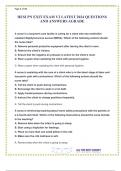
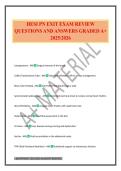
Med Surg 1 Exam Questions & Answers 2024/2025 1. A patient is being admitted to the hospital on the day before a scheduled surgery. What is the most appropriate initial question for the nurse to ask this preoperative patient? a) "What did your surgeon say to you about the type of surgery you are having?" b) "What questions do you have about your surgery?" c) "What type of surgery are you having and why are you having it done?" d) "What do you know about what will be done to you?" - ANSWER-c) "What type of surgery are you having and why are you having it done?" 2. A benzodiazepine has been administered to a patient preoperatively. After the drug has been administered, the nurse plans to monitor the patient for which side effects? Select all that apply. a) Anxiety b) Hypotension c) Hypocalcemia d) Level of Consciousness e) Sedation - ANSWER-a) Anxiety d) Level of Consciousness e) Sedation 3. A preoperative patient has an elevated hemoglobin and hematocrit. What would the nurse suspect regarding the significance of this increased value? a) Immune deficiency b) Kidney dysfunction c) Malignancy d) Dehydration - ANSWER-d) Dehydration 4. Which activities should the nurse carry out in the preoperative period for a client scheduled for surgery? Select all that apply. a) Identify potential or actual health problems. b) Verify the presence of a signed consent form. c) Assess patient's response to interventions. d) Intervene to prevent complications. e) Assess effectiveness of teaching related to postoperative recovery. - ANSWER-a) Identify potential or actual health problems. b) Verify the presence of a signed consent form. e) Assess effectiveness of teaching related to postoperative recovery. 5. A patient having surgery has a degree of risk associated with the surgery. The nurse would evaluate which patient-related factors as contributing to a high degree of risk associated with surgery? Select all that apply. a) Type of institution where surgery is performed b) Involvement of vital organs c) Average nutritional status d) Low likelihood of procedure complications e) A history of respiratory disease and diabetes - ANSWER-b) Involvement of vital organs e) A history of respiratory disease and diabetes 6. A patient has just entered the postanesthesia care unit (PACU) from surgery. For which priority needs should the nurse immediately assess the postoperative patient? a) Vital signs, level of consciousness, presence of pain b) Skin coloring, surgical incision, limb movements c) Skin temperature, blood pressure, mental status d) Temperature, emotional status, wound drainage - ANSWER-a) Vital signs, level of consciousness, presence of pain 7. The nurse in the postanesthesia care unit (PACU) is assessing a postoperative patient. Which indicators suggest to the nurse an alteration in tissue perfusion? Select all that apply. a) Pallor or cyanosis b) Difficulty with mobility c) Pain in the incision area d) Fluid loss e) Decreased urinary output - ANSWER-a) Pallor or cyanosis d) Fluid loss e) Decreased urinary output 8. After surgery, the nurse encourages the patient to move from side to side at least every 2 hours. The patient questions this activity. How does the nurse explain the purpose of this intervention? a) Assist peristalsis to return more quickly b) Lessen muscle weakness c) Increase patient's ability to sleep d) Let the lungs alternatively achieve maximum expansion - ANSWER-d) Let the lungs alternatively achieve maximum expansion 9. The nurse is creating a plan of care for a postoperative patient. The nursing diagnosis in acute pain. What would be appropriate outcomes for this patient? Select all that apply. a) Balanced fluid intake and output b) Seeks help as needed c) Absence of nonverbal signs of pain d) Performs leg exercises as instructed e) Verbally rates pain as 3 on a 1 to 10 scale - ANSWER-c) Absence of nonverbal signs of pain e) Verbally rates pain as 3 on a 1 to 10 scale 10. The patient has been in the post anesthesia care unit (PACU) for one hour. The patient is now groggy but able to respond to voice commands. While assessing the patient, for what reason would the nurse check the bedclothes underneath the patient? a) Determine drainage from tubes or drains b) Assess for fluid balance c) Detect for possible hemorrhage d) Monitor perspiration - ANSWER-c) Detect for possible hemorrhage 11. A 65-year-old was diagnosed and treated for right lower lobe pneumonia 4 days ago. Today, the patient came to the ED reporting abrupt onset of chest pain that is worse with inspiration. The nurse knows that the symptoms are consistent with: a) Pleurisy b) Stable angina c) Bacteremia d) Meningitis - ANSWER-a) Pleurisy 12. The ED nurse is caring for Ginny, a 45-year-old female with a recent history of sexual assault. Ginny came to the ED crying and shaking and stated that she had dyspnea, feeling like she was choking and couldn't breathe, chest pain, and sweating. Ginny reports that the symptoms started about 15 minutes before she came to the ED. Ginny's symptoms are consistent with: a) Myocardial Infarction b) Pneumonia c) Panic Attack d) Influenza - ANSWER-c) Panic Attack 13. A 86-year-old female has recent changes in her mental status, reports having no appetite, and is running a low grade fever. The nurse suspects: a) Delirium b) Dementia c) Urinary tract infection d) Hypokalemia - ANSWER-c) Urinary tract infection 14. Ted is a 76-year-old male who fell at home and sustained a fracture of his right hip. He is being admitted to your unit and will have surgery in the morning. Ted has a past medical history of urinary calculi, benign prostatic hypertrophy, and hypertension. When he arrived to the medical-surgical unit, he has a strong body odor and visible dirt on his body. An indwelling urinary catheter was placed in the ED. Ted is at greatest risk for a UTI is related to: a) History of benign prostatic hypertrophy (BPH) b) Poor hygiene c) Indwelling urinary catheter d) History of urinary calculi e) His age - ANSWER-c) Indwelling urinary catheter 15. A nurse knows that the patient teaching on the pneumococcal vaccine to a 65-year-old patient has been effective when the patient states: continues...
Written for
- Institution
- Med Surg
- Course
- Med Surg
Document information
- Uploaded on
- November 22, 2024
- Number of pages
- 46
- Written in
- 2024/2025
- Type
- Exam (elaborations)
- Contains
- Questions & answers
Subjects
- med surg
- 2024
- 2025
- benzodiazepine
- postanesthesia care unit
- pallor or cyanosis
- hemorrhage
-
pleurisy
-
urinary tract infection
-
pneumococcal vaccine
-
med surg 1 exam questions answers