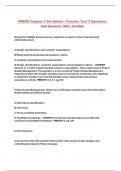
PMBOK Chapter 5 5th Edition - Practice Test 3 Questions
And Answers 100% Verified
During the Validate Scope process, inspection is used to ensure that work and
deliverables meet:
A Design specifications and customer expectations
B Requirements and product acceptance criteria
C Customer expectations and requirements.
D Design specifications, customer expectations and acceptance criteria. - ANSWER
Choices A, C and D include meeting customer expectations. This is addressed in Project
Quality Management. The question is in the context of Project Scope Management.
Inspection (Choice B) includes activities such as measuring, examining, and validating
to determine whether work and deliverables meet requirements and product
acceptance criteria. PMBOK® 5.5.2.1, pg 135
Project Scope Management, which tool or technique could be used with both Collect
Requirements and Define Scope?
A Alternatives identification
B Interviews
C Group creativity techniques
D Facilitated workshops - ANSWER The only tool and technique used with both
processes is facilitated workshops. PMBOK® 5, pg 106
Control Scope is:
A Concerned with enforcing the factors that create project scope changes and
controlling the impact of those changes.
,B Concerned with monitoring the status of the project and product scope and managing
changes to the scope baseline.
C Concerned with making sure that extra work is not billed to your project.
D Concerned with keeping all stakeholders happy. - ANSWER By definition, Control
Scope is the process of monitoring the status of the project and product scope and
managing changes to the scope baseline. Choice B is the correct answer. PMBOK® 5.6,
pg 136
Which of the following is NOT true about a work package?
A Can be subdivided into lower level WBS components
B Can be cost estimated
C Can be scheduled
D Can be measured and controlled - ANSWER The scope of the planned work is
captured within the lowest level WBS components which are called work packages. A
work package can be scheduled, cost estimated, monitored and controlled. PMBOK®
5.4, pg 126
All the following are considered to be requirements classifications EXCEPT:
A Quality requirements
B Performance requirements.
C Business requirements.
D Transition requirements - ANSWER The framework of this question is Project Scope
Management, and more specifically, Collect Requirements. Performance requirements,
Choice B would be part of Project Quality Management and is the odd one out, therefore
the correct answer choice. PMBOK® 5.2, pg 112
A configuration management system is a subsystem of the overall project management
system that does NOT include:
, A Procedures documented to provide technical and administrative direction and
surveillance.
B Principles of DIKW (Data, Information, Knowledge, Wisdom) model on which the basis
of Data Management is applied.
C Documentation, tracking systems and defined approval levels for authorizing and
controlling change
D Procedures for identifying and documenting the functional and physical
characteristics of a product, result, service or component. - ANSWER Choices A, C and
D are all related to a configuration management system which is a subsystem of the
overall project management system. It is a set of formal documented procedures used
to apply technical and administrative direction and surveillance to: identify and
document the functional and physical characteristics of a product, result, service, or
component; control any changes to such characteristics; record and report each
change and its implementation status; and support the audit of the products, results, or
components to verify conformance to requirements. It includes the documentation,
tracking systems, and defined approval levels necessary for authorizing and controlling
changes (PMBOK® Glossary, pg 532). The DIKW (Choice B) is associated with the field
of Knowledge Management, not Data Management, and its FUNDAMENTALS wouldn't be
in the configuration management system anyway. PMBOK® X1.5, pg 466
All of the following are NOT examples of a project requirement classification EXCEPT:
A Pareto chart.
B Relationship with the seller.
C Business needs, transition needs, project needs.
D Funding limitation. - ANSWER A Pareto chart (Choice A) is used to identify the
frequency of outcomes generated by each identified cause. Although the relationship
with the seller (Choice B) may be important to maintain, it would not typically be
considered a project requirement classification. A funding limitation (Choice D) is a
constraint. Each of the items listed in Choice C are examples of project requirements
classifications. PMBOK® 5.2, pg 112
An input to Define Scope is:
A Expert judgment.
And Answers 100% Verified
During the Validate Scope process, inspection is used to ensure that work and
deliverables meet:
A Design specifications and customer expectations
B Requirements and product acceptance criteria
C Customer expectations and requirements.
D Design specifications, customer expectations and acceptance criteria. - ANSWER
Choices A, C and D include meeting customer expectations. This is addressed in Project
Quality Management. The question is in the context of Project Scope Management.
Inspection (Choice B) includes activities such as measuring, examining, and validating
to determine whether work and deliverables meet requirements and product
acceptance criteria. PMBOK® 5.5.2.1, pg 135
Project Scope Management, which tool or technique could be used with both Collect
Requirements and Define Scope?
A Alternatives identification
B Interviews
C Group creativity techniques
D Facilitated workshops - ANSWER The only tool and technique used with both
processes is facilitated workshops. PMBOK® 5, pg 106
Control Scope is:
A Concerned with enforcing the factors that create project scope changes and
controlling the impact of those changes.
,B Concerned with monitoring the status of the project and product scope and managing
changes to the scope baseline.
C Concerned with making sure that extra work is not billed to your project.
D Concerned with keeping all stakeholders happy. - ANSWER By definition, Control
Scope is the process of monitoring the status of the project and product scope and
managing changes to the scope baseline. Choice B is the correct answer. PMBOK® 5.6,
pg 136
Which of the following is NOT true about a work package?
A Can be subdivided into lower level WBS components
B Can be cost estimated
C Can be scheduled
D Can be measured and controlled - ANSWER The scope of the planned work is
captured within the lowest level WBS components which are called work packages. A
work package can be scheduled, cost estimated, monitored and controlled. PMBOK®
5.4, pg 126
All the following are considered to be requirements classifications EXCEPT:
A Quality requirements
B Performance requirements.
C Business requirements.
D Transition requirements - ANSWER The framework of this question is Project Scope
Management, and more specifically, Collect Requirements. Performance requirements,
Choice B would be part of Project Quality Management and is the odd one out, therefore
the correct answer choice. PMBOK® 5.2, pg 112
A configuration management system is a subsystem of the overall project management
system that does NOT include:
, A Procedures documented to provide technical and administrative direction and
surveillance.
B Principles of DIKW (Data, Information, Knowledge, Wisdom) model on which the basis
of Data Management is applied.
C Documentation, tracking systems and defined approval levels for authorizing and
controlling change
D Procedures for identifying and documenting the functional and physical
characteristics of a product, result, service or component. - ANSWER Choices A, C and
D are all related to a configuration management system which is a subsystem of the
overall project management system. It is a set of formal documented procedures used
to apply technical and administrative direction and surveillance to: identify and
document the functional and physical characteristics of a product, result, service, or
component; control any changes to such characteristics; record and report each
change and its implementation status; and support the audit of the products, results, or
components to verify conformance to requirements. It includes the documentation,
tracking systems, and defined approval levels necessary for authorizing and controlling
changes (PMBOK® Glossary, pg 532). The DIKW (Choice B) is associated with the field
of Knowledge Management, not Data Management, and its FUNDAMENTALS wouldn't be
in the configuration management system anyway. PMBOK® X1.5, pg 466
All of the following are NOT examples of a project requirement classification EXCEPT:
A Pareto chart.
B Relationship with the seller.
C Business needs, transition needs, project needs.
D Funding limitation. - ANSWER A Pareto chart (Choice A) is used to identify the
frequency of outcomes generated by each identified cause. Although the relationship
with the seller (Choice B) may be important to maintain, it would not typically be
considered a project requirement classification. A funding limitation (Choice D) is a
constraint. Each of the items listed in Choice C are examples of project requirements
classifications. PMBOK® 5.2, pg 112
An input to Define Scope is:
A Expert judgment.