KUBY IMMUNOLOGY- CHAPTER 2
Study online at https://quizlet.com/_f767i4
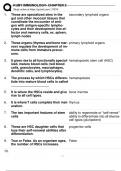
1. These are specialized sites in the secondary lymphoid organs
gut and other mucosal tissues that
coordinate the encounter of anti-
gen with antigen-specific lympho-
cytes and their development into ef-
fector and memory cells. ex. spleen,
lymph nodes
2. These organs (thymus and bone mar- primary lymphoid organs
row) regulate the development of im-
mune cells from immature precur-
sors.
3. It gives rise to all functionally special- hematopoietic stem cell (HSC)
ized, mature blood cells (red blood
cells, granulocytes, macrophages,
dendritic cells, and lymphocytes).
4. The process by which HSCs differen- hematopoiesis
tiate into mature blood cells is called
_____________________
5. It is where the HSCs reside and give bone marrow
rise to all cell types.
6. It is where T cells complete their mat- thymus
uration.
7. The two important features of stem ability to regenerate or "self-renew"
cells ability to differentiate into all diverse
cell types (pluripotent)
8. These are HSC daughter cells that progenitor cells
lose their self-renewal abilities after
differentiation.
9. True or False. As an organism ages, False
the number of HSCs increases.
10.
, KUBY IMMUNOLOGY- CHAPTER 2
Study online at https://quizlet.com/_f767i4
The _____________________ gives common myeloid-erythroid progen-
rise to all red blood cells (the ery- itor (CMP)
throid lineage), granulocytes, mono- common lymphoid progenitor (CLP)
cytes, and macrophages (the myeloid
lineage), while the _______________
which gives rise to B lymphocytes, T
lymphocytes, and NK cells.
11. Cells that originate from the common red blood cells
myeloid-erythroid progenitor (CMP) granulocytes
monocytes
macrophages
12. Cells that originate from the common B lymphocytes
lymphoid progenitor (CLP) T lymphocytes
NK cells
13. They are the first cells to respond to Myeloid cells (monocytes, granulo-
infection. cytes, macrophages)
NK cells
14. It is the cell that arises from both dendritic cells
myeloid and lymphoid lineages.
15. This transcription factor is required GATA-2
for the development of all hematopoi-
etic lineages; in its absence animals
die during embryogenesis.
16. This transcriptional regulator is re- Bmi-1
quired for the self-renewal capacity of
HSCs, and in its absence animals die
within 2 months of birth because of
the failure to repopulate their red and
white blood cells.
17. This family of transcriptional regula- Ikaros
tor is required for lymphoid but not
myeloid development; animals sur-
, KUBY IMMUNOLOGY- CHAPTER 2
Study online at https://quizlet.com/_f767i4
vive in its absence but cannot mount
a full immune response.
18. It is one of four Notch family members Notch1
that regulates the choice between T
and B lymphocyte lineages.
19. Which among the basophils and eosinophils
eosinophils are acidic?
20. These are white blood cells that are granulocytes
considered part of the innate im-
mune system, which has round mul-
ti-lobed nuclei. It contains a compart-
ment filled with a variety of proteins
with distinct functions Some dam-
age pathogens directly; some regu-
late trafficking and activity of other
white blood cells, including lympho-
cytes; and some contribute to the re-
modeling of tissues at the site of in-
fection.
21. It contains the majority of circulat- Neutrophils
ing leukocytes and the main com-
ponent of pus. After differentiation
in the bone marrow, it is released
to the blood and circulates for 7 to
10 hours before migrating to tissues.
These cells significantly increase due
to inflammatory chemokines during
an infection. PHAGOCYTIC; GRANU-
LOCYTE
22. These are nonphagocytic granulo- Basophils
cytes that contain large granules
filled with basic proteins, includ-
ing histamine, which increases blood
vessel permeability and smooth mus-
cle activity. Acts on parasites, includ-
Study online at https://quizlet.com/_f767i4
1. These are specialized sites in the secondary lymphoid organs
gut and other mucosal tissues that
coordinate the encounter of anti-
gen with antigen-specific lympho-
cytes and their development into ef-
fector and memory cells. ex. spleen,
lymph nodes
2. These organs (thymus and bone mar- primary lymphoid organs
row) regulate the development of im-
mune cells from immature precur-
sors.
3. It gives rise to all functionally special- hematopoietic stem cell (HSC)
ized, mature blood cells (red blood
cells, granulocytes, macrophages,
dendritic cells, and lymphocytes).
4. The process by which HSCs differen- hematopoiesis
tiate into mature blood cells is called
_____________________
5. It is where the HSCs reside and give bone marrow
rise to all cell types.
6. It is where T cells complete their mat- thymus
uration.
7. The two important features of stem ability to regenerate or "self-renew"
cells ability to differentiate into all diverse
cell types (pluripotent)
8. These are HSC daughter cells that progenitor cells
lose their self-renewal abilities after
differentiation.
9. True or False. As an organism ages, False
the number of HSCs increases.
10.
, KUBY IMMUNOLOGY- CHAPTER 2
Study online at https://quizlet.com/_f767i4
The _____________________ gives common myeloid-erythroid progen-
rise to all red blood cells (the ery- itor (CMP)
throid lineage), granulocytes, mono- common lymphoid progenitor (CLP)
cytes, and macrophages (the myeloid
lineage), while the _______________
which gives rise to B lymphocytes, T
lymphocytes, and NK cells.
11. Cells that originate from the common red blood cells
myeloid-erythroid progenitor (CMP) granulocytes
monocytes
macrophages
12. Cells that originate from the common B lymphocytes
lymphoid progenitor (CLP) T lymphocytes
NK cells
13. They are the first cells to respond to Myeloid cells (monocytes, granulo-
infection. cytes, macrophages)
NK cells
14. It is the cell that arises from both dendritic cells
myeloid and lymphoid lineages.
15. This transcription factor is required GATA-2
for the development of all hematopoi-
etic lineages; in its absence animals
die during embryogenesis.
16. This transcriptional regulator is re- Bmi-1
quired for the self-renewal capacity of
HSCs, and in its absence animals die
within 2 months of birth because of
the failure to repopulate their red and
white blood cells.
17. This family of transcriptional regula- Ikaros
tor is required for lymphoid but not
myeloid development; animals sur-
, KUBY IMMUNOLOGY- CHAPTER 2
Study online at https://quizlet.com/_f767i4
vive in its absence but cannot mount
a full immune response.
18. It is one of four Notch family members Notch1
that regulates the choice between T
and B lymphocyte lineages.
19. Which among the basophils and eosinophils
eosinophils are acidic?
20. These are white blood cells that are granulocytes
considered part of the innate im-
mune system, which has round mul-
ti-lobed nuclei. It contains a compart-
ment filled with a variety of proteins
with distinct functions Some dam-
age pathogens directly; some regu-
late trafficking and activity of other
white blood cells, including lympho-
cytes; and some contribute to the re-
modeling of tissues at the site of in-
fection.
21. It contains the majority of circulat- Neutrophils
ing leukocytes and the main com-
ponent of pus. After differentiation
in the bone marrow, it is released
to the blood and circulates for 7 to
10 hours before migrating to tissues.
These cells significantly increase due
to inflammatory chemokines during
an infection. PHAGOCYTIC; GRANU-
LOCYTE
22. These are nonphagocytic granulo- Basophils
cytes that contain large granules
filled with basic proteins, includ-
ing histamine, which increases blood
vessel permeability and smooth mus-
cle activity. Acts on parasites, includ-