100% satisfaction guarantee Immediately available after payment Both online and in PDF No strings attached 4.6 TrustPilot
logo-home
Exam (elaborations)

FDNY EMS FINAL EXAM Part 1

Rating
-
Sold
-
Pages
5
Grade
A+
Uploaded on
14-11-2024
Written in
2024/2025

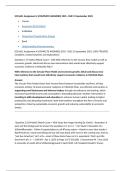
7, 12, 5, 5, 4 - answer-Cervical, Thoracic, Lumbar, Sacral, and coccygeal ( Coccyx) Agonists - answer-Drugs that increase the action of a neurotransmitter Airborne transmission - answer-Involves spreading an infectious agent through mechanisms such as droplets or dust Bloodborne pathogens - answer-Microorganisms found in human blood that can cause infection and disease Cardiac muscle - answer-Involuntary muscle, only in the heart. Certification - answer-Exam is used to ensure all health care providers have at least the same basic level of knowledge and skill Closed-ended questions - answer-questions a person must answer by choosing from a limited, predetermined set of responses Conjunctiva - answer-Delicate membrane lining the eyelids and covering the eyeball Consent - answer-To give permission Crepitus - answer-A crackling or grating sound usually of bones Decision making capacity - answer-Ability to understand the information and to make a choice regarding appropriate medical care. Diaphragm - answer-When the diaphragm contracts, it moves down, enlarging the thoracic cage from top to bottom. Also moves the ribs up and out. During exhalation, the diaphragm and intercostal muscles relax. Diffusion - answer-Passive process in which molecules move from a high concentration to a lower concentration. Direct contact - answer-Occurs when an organism is moved from one person to another through touching without any intermediary Dose - answer-The amount of medication given on the basis of the patient's size and age. Expressed Consent (actual consent) - answer-Type of consent given when patient verbally or otherwise acknowledge that he or she wants you to provide care or transport. May also be nonverbal Foraman magnum - answer-The opening at the base of the skull through which the spinal cord passes from the brain General impression - answer-impression of the patient's condition that is formed on first approaching the patient, based on the patient's environment, chief complaint, and appearance. Golden hour - answer-The time from injury to definitive care, during which treatment of shock and traumatic injuries should occur because survival potential is best; also called the Golden Period. Head tilt chin lift - answer-Opening the airway to relive an obstruction can often be done quickly and easily by this maneuver. Implied consent - answer-A patient who is unconscious or otherwise incapable to make a rational decision. A serious medical condition exists and should never be used unless there is a threat to life or a limb. Indirect contact - answer-Involves the spread of infection between the patient with an infection to another person through an inanimate object. Example: ambulance stretcher (if uncleaned), or needlesticks. Informed consent - answer-Permission for treatment given by a competent patient after the potential risks, benefits, and alternatives to treatment have been explained. Involuntary muscle - answer-A muscle that is not under conscious control. Left and right lungs - answer-Left lung has 2 lobes. Right lung has 3 lobes. Licensure - answer-The process by which states ensure applicant competency in an examination setting. Lower Airway - answer-Consists of the trachea, bronchi, bronchioles, alveoli Mediastinum - answer-Space between the lungs. Surrounded by tough connective tissue Medical control - answer-provided either off-line (indirect) or online (direct), as authorized by the medical director. Online = Directions given over the phone or radio Offline = standing orders Medical director - answer-A physician who assumes ultimate responsibility for the patient-care aspects of the EMS system Medication - answer-A substance that is used to treat or prevent disease or relieve pain. Open-ended questions - answer-questions a person is to answer in his or her own words Parietal

Show more Read less
Institution
FDNY EMS
Course
FDNY EMS


Whoops! We can’t load your doc right now. Try again or contact support.

Written for

Institution
FDNY EMS
Course
FDNY EMS

Document information

Uploaded on
November 14, 2024
Number of pages
5
Written in
2024/2025
Type
Exam (elaborations)
Contains
Questions & answers

Subjects

Content preview

FDNY EMS FINAL EXAM PART 1


Jilk Naivasha

, FDNY EMS FINAL EXAM Part 1

7, 12, 5, 5, 4 - answer-Cervical, Thoracic, Lumbar, Sacral, and coccygeal ( Coccyx)

Agonists - answer-Drugs that increase the action of a neurotransmitter

Airborne transmission - answer-Involves spreading an infectious agent through
mechanisms such as droplets or dust

Bloodborne pathogens - answer-Microorganisms found in human blood that can
cause infection and disease

Cardiac muscle - answer-Involuntary muscle, only in the heart.

Certification - answer-Exam is used to ensure all health care providers have at least
the same basic level of knowledge and skill

Closed-ended questions - answer-questions a person must answer by choosing from
a limited, predetermined set of responses

Conjunctiva - answer-Delicate membrane lining the eyelids and covering the eyeball

Consent - answer-To give permission

Crepitus - answer-A crackling or grating sound usually of bones

Decision making capacity - answer-Ability to understand the information and to
make a choice regarding appropriate medical care.

Diaphragm - answer-When the diaphragm contracts, it moves down, enlarging the
thoracic cage from top to bottom. Also moves the ribs up and out. During
exhalation, the diaphragm and intercostal muscles relax.

Diffusion - answer-Passive process in which molecules move from a high
concentration to a lower concentration.

Direct contact - answer-Occurs when an organism is moved from one person to
another through touching without any intermediary

Dose - answer-The amount of medication given on the basis of the patient's size
and age.

Expressed Consent (actual consent) - answer-Type of consent given when patient
verbally or otherwise acknowledge that he or she wants you to provide care or
transport. May also be nonverbal

Foraman magnum - answer-The opening at the base of the skull through which the
spinal cord passes from the brain


Get to know the seller

Seller avatar
Reputation scores are based on the amount of documents a seller has sold for a fee and the reviews they have received for those documents. There are three levels: Bronze, Silver and Gold. The better the reputation, the more your can rely on the quality of the sellers work.
TOPDOCTOR Abacus College, Oxford
View profile
Follow You need to be logged in order to follow users or courses
Sold
10
Member since
2 year
Number of followers
5
Documents
3396
Last sold
3 months ago
TOPGRADER!!

Looking for relevant and updated study material to help you ace your exams? TOPTIERGRADES has your back!!! I have essential exams, test-banks, study bites, assignments all graded A+, Have Complete solutions, and are updated regularly. Please feel free to message me if you are looking for a specific test bank that is not listed on my profile or want a test bank or exam sent to you directly as google doc link. In the event that any of the materials have an issue, please let me know and I\'ll do my best to resolve it or provide an alternative. Thank You & All The Very BEST!!!!!

Read more Read less
5.0

1 reviews

5
1
4
0
3
0
2
0
1
0

Recently viewed by you

Why students choose Stuvia

Created by fellow students, verified by reviews

Quality you can trust: written by students who passed their tests and reviewed by others who've used these notes.

Didn't get what you expected? Choose another document

No worries! You can instantly pick a different document that better fits what you're looking for.

Pay as you like, start learning right away

No subscription, no commitments. Pay the way you're used to via credit card and download your PDF document instantly.

Student with book image

“Bought, downloaded, and aced it. It really can be that simple.”

Alisha Student

Frequently asked questions