ZEN251
NOTE!
It is recommended that you use the tables that you use in your practical
to study for the theory semester tests and exams as well. This will help
you a lot with grouping.
Good luck with your semester!
Invertebrate origins and diversity
Invertebrates
- Lack a backbone.
- Nerve cord not protected by vertebrae.
- Diverse (96% of all animals)
Biological classification
- E.g., Honeybee
→ Kingdom: Animalia
→ Phylum: Arthropoda
→ Subphylum: Hexapoda
→ Class: Insecta
→ Order: Hymenoptera
→ Family: Apidae
→ Genus: Apis
→ Species: Apis mellifera
- King Phillip Came Over from Great Spain
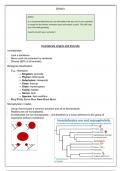
Monophyletic (=clade)
- Group that includes a common ancestor and all its descendants
- Reptiles are not monophyletic.
- Invertebrates are not monophyletic – and therefore is a loose reference to the group of
organisms without a backbone.
,Taxon
- Pl. = taxa
- A group of organisms at any taxonomic level.
- Mammals (class Mammalia) is a taxon.
- The family Elephantidae (which contains all the species of elephant that is described) is a
taxon.
- The species Loxodonta Africana (African bush elephant) is a taxon.
Radiation/Adaptive radiation
- Evolution from an ancestral taxon into a variety of new taxa
- Burst in speciation.
Geological timescale
Scientists study geological strata (layers):
→ Fossils
→ Age of the layer
Geological timescale
- System that relates time in history of earth, with events in history of earth.
- Organize events of Earth history into units (classification)
- Earth is approximately 4.6 billion years old.
Precambrian- - 88% of geological time
Ediacaran Environment
Biota - Calm. Shallow seas
Ediacaran Biota (c. 635-542
Ma)
- Earliest multicellular
organisms
- Sessile
Cambrian - 541-485 Ma
Environment
- Seas
Changes in environment
- Rise in oxygen levels
- Increase in calcium
concentration in
Cambrian seawater.
• Cambrian age rocks on all
- Rise of carnivorous
continents
predators (new defence
• Burgess Shale = (rock formation) strategies)
in north Canada: Exceptional Event
preservation of soft parts of fossils - Eruption of life on Earth
• Similar well-preserved fossils since (Cambrian Explosion)
found in China. - 3 basic body plans
• Lagerstätten: sedimentary already present
deposits that preserve fossils, even
soft tissue, very well.
, -All major animal phyla
appear seemingly rapid in
fossil record.
- Weird forms
(Hallucigenia)
- Weird fossils do not
represent dead-end
lineages but are stem
members of extant phyla.
- Crown taxon: Velvet
worms
- Hallucigenia is a stem
group velvet worm
Devonian - 419-360 Ma
Period Environment
- Extensive colonization by
plants (“forests”)
Event
- Terrestrial invertebrates
became established.
- 1st adaptive radiation of
life on dry land
- 1st insect developed flight
(trees)
- 2nd Mass extinction
Devonian Mass
extinctions (lasted up to
20 my) – Greening
created a sink for CO2
Carboniferous 360-298 Ma
Period Environment
- Uniform, humid, tropical;
Large Forest trees (Coal,
oil) – High O2 levels
Event
- Important period for
insect evolution; high
insect diversity attributed
• High O2 levels, flight & Gigantism to Carboniferous Period.
o Highest atmospheric O2 levels in
- Radiation of winged
geological history
insects: 95% of today’s
o 35% then, 21% today
insects originate from
o Insects’ passive reproductive
insects that could fly.
system: high oxygen infuses into
- Gigantism common
insect body; however, size that
can be reached limited
Permian 298-252 Ma
Period Environment
- Supercontinent Pangea,
surrounded by global
ocean; conditions
become drier (deserts)
Events
- Radiation of
holometabolous insects
, (most successful of all
insects)
- Holometabolous insects:
Pupal stage can survive
unfavourable conditions.
- Most extant insect orders
developing during
Permian, Cockroach-like
insects were dominant.
- 3rd Mass extinction:
Permian Mass extinction.
- Largest mass extinction
ever (“Great Dying”)
- Intense volcanic activity –
Large amounts of CO2 –
global warming, ocean
acidification
Mesozoic and 252Ma- Present
Cenozoic Era Environment
- Hot, dry, Pangea started
to rift mid-Triassic
(Triassic, bound by 2
extinction events); Warm,
humid climates (Jurassic);
Flowering plants appear
(Cretaceous)
Radiation of flowering plants Event
(Cretaceous) and mammals (Cenozoic) - Triassic: Survivors of 3rd
• Coevolution: Flowering plants ME (Great dying) evolve
(angiosperms) and insects Plants further in Triassic –
waxy leaves as defence – insects Modern Insects
developed large mandibles. - Jurassic: Most modern
of pollinators (age of bees) insect families appear.
• Radiation of insects – radiation of - Cretaceous: co-evolution
bats, birds, and predatory insects with flowering plants
• Mammal evolution – dung – dung- - Cenozoic: Modern insect
feeding insects genera; amber
- 4th Mass Extinction:
Triassic-Jurassic Mass
extinction; volcanic
activity and
consequences thereof
- 5th Mass extinction and
the K-T boundary: (or K-
Pa boundary)
- Thin clay layer: Separates
Cretaceous and
Paleogene rock.
- Found around the world.
- Associated with K-T mass
extinction (65Ma)
- Non-bord dinosaurs
extinct
NOTE!
It is recommended that you use the tables that you use in your practical
to study for the theory semester tests and exams as well. This will help
you a lot with grouping.
Good luck with your semester!
Invertebrate origins and diversity
Invertebrates
- Lack a backbone.
- Nerve cord not protected by vertebrae.
- Diverse (96% of all animals)
Biological classification
- E.g., Honeybee
→ Kingdom: Animalia
→ Phylum: Arthropoda
→ Subphylum: Hexapoda
→ Class: Insecta
→ Order: Hymenoptera
→ Family: Apidae
→ Genus: Apis
→ Species: Apis mellifera
- King Phillip Came Over from Great Spain
Monophyletic (=clade)
- Group that includes a common ancestor and all its descendants
- Reptiles are not monophyletic.
- Invertebrates are not monophyletic – and therefore is a loose reference to the group of
organisms without a backbone.
,Taxon
- Pl. = taxa
- A group of organisms at any taxonomic level.
- Mammals (class Mammalia) is a taxon.
- The family Elephantidae (which contains all the species of elephant that is described) is a
taxon.
- The species Loxodonta Africana (African bush elephant) is a taxon.
Radiation/Adaptive radiation
- Evolution from an ancestral taxon into a variety of new taxa
- Burst in speciation.
Geological timescale
Scientists study geological strata (layers):
→ Fossils
→ Age of the layer
Geological timescale
- System that relates time in history of earth, with events in history of earth.
- Organize events of Earth history into units (classification)
- Earth is approximately 4.6 billion years old.
Precambrian- - 88% of geological time
Ediacaran Environment
Biota - Calm. Shallow seas
Ediacaran Biota (c. 635-542
Ma)
- Earliest multicellular
organisms
- Sessile
Cambrian - 541-485 Ma
Environment
- Seas
Changes in environment
- Rise in oxygen levels
- Increase in calcium
concentration in
Cambrian seawater.
• Cambrian age rocks on all
- Rise of carnivorous
continents
predators (new defence
• Burgess Shale = (rock formation) strategies)
in north Canada: Exceptional Event
preservation of soft parts of fossils - Eruption of life on Earth
• Similar well-preserved fossils since (Cambrian Explosion)
found in China. - 3 basic body plans
• Lagerstätten: sedimentary already present
deposits that preserve fossils, even
soft tissue, very well.
, -All major animal phyla
appear seemingly rapid in
fossil record.
- Weird forms
(Hallucigenia)
- Weird fossils do not
represent dead-end
lineages but are stem
members of extant phyla.
- Crown taxon: Velvet
worms
- Hallucigenia is a stem
group velvet worm
Devonian - 419-360 Ma
Period Environment
- Extensive colonization by
plants (“forests”)
Event
- Terrestrial invertebrates
became established.
- 1st adaptive radiation of
life on dry land
- 1st insect developed flight
(trees)
- 2nd Mass extinction
Devonian Mass
extinctions (lasted up to
20 my) – Greening
created a sink for CO2
Carboniferous 360-298 Ma
Period Environment
- Uniform, humid, tropical;
Large Forest trees (Coal,
oil) – High O2 levels
Event
- Important period for
insect evolution; high
insect diversity attributed
• High O2 levels, flight & Gigantism to Carboniferous Period.
o Highest atmospheric O2 levels in
- Radiation of winged
geological history
insects: 95% of today’s
o 35% then, 21% today
insects originate from
o Insects’ passive reproductive
insects that could fly.
system: high oxygen infuses into
- Gigantism common
insect body; however, size that
can be reached limited
Permian 298-252 Ma
Period Environment
- Supercontinent Pangea,
surrounded by global
ocean; conditions
become drier (deserts)
Events
- Radiation of
holometabolous insects
, (most successful of all
insects)
- Holometabolous insects:
Pupal stage can survive
unfavourable conditions.
- Most extant insect orders
developing during
Permian, Cockroach-like
insects were dominant.
- 3rd Mass extinction:
Permian Mass extinction.
- Largest mass extinction
ever (“Great Dying”)
- Intense volcanic activity –
Large amounts of CO2 –
global warming, ocean
acidification
Mesozoic and 252Ma- Present
Cenozoic Era Environment
- Hot, dry, Pangea started
to rift mid-Triassic
(Triassic, bound by 2
extinction events); Warm,
humid climates (Jurassic);
Flowering plants appear
(Cretaceous)
Radiation of flowering plants Event
(Cretaceous) and mammals (Cenozoic) - Triassic: Survivors of 3rd
• Coevolution: Flowering plants ME (Great dying) evolve
(angiosperms) and insects Plants further in Triassic –
waxy leaves as defence – insects Modern Insects
developed large mandibles. - Jurassic: Most modern
of pollinators (age of bees) insect families appear.
• Radiation of insects – radiation of - Cretaceous: co-evolution
bats, birds, and predatory insects with flowering plants
• Mammal evolution – dung – dung- - Cenozoic: Modern insect
feeding insects genera; amber
- 4th Mass Extinction:
Triassic-Jurassic Mass
extinction; volcanic
activity and
consequences thereof
- 5th Mass extinction and
the K-T boundary: (or K-
Pa boundary)
- Thin clay layer: Separates
Cretaceous and
Paleogene rock.
- Found around the world.
- Associated with K-T mass
extinction (65Ma)
- Non-bord dinosaurs
extinct