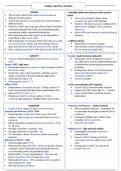
Coding, capacity & duration
CODING + Identified difference between both memory
The format in which information is stored varies in stores.
different memory stores. More recent research shows some
Coding: the process of converting information between exceptions to some older findings.
different forms. However, the idea of acoustic coding in STM
Baddeley (1966): gave 4 groups different lists of words to and semantic coding in LTM is yet to be
remember (acoustically similar, acoustically dissimilar, disproved.
semantically similar, semantically dissimilar). Led to MSM and improved understanding of
Ptps were then given the original words and asked to memory.
recall them in the correct order.
When doing this immediately (STM), they did worse with - Artificial stimuli
acoustically similar words, and when doing it 20mins Words lists meaningless to ptps.
later, they did worse with semantically similar words. May not tell us about coding in everyday
Info is coded acoustically in STM and semantically in LTM. life, for more meaningful info.
Limited application/lacks mundane realism.
CAPACITY + Jacobs’ study has been replicated.
Amount of information that can be held in a memory Old studies may lack adequate controls –
store. e.g., digit spans may be underestimated due
Jacobs (1887): digit span to distractions during testing (extraneous
Researcher reads out a number of digits and ptp recalls in variables).
the correct order. Findings have been confirmed by recent,
Researcher adds a digit each time, until they can no more controlled studies (Bopp and
longer recall them correctly (indicates digit span). Verhaeghen 2005).
Mean span for digits: 9.3 Temporal validity
Mean span for letters: 7.3
Miller (1956) - Miller overestimates STM capacity.
Observations of everyday practice – things come in 7s Cowan (2001): reviewed other research.
(notes on musical scale/days of the week/deadly sins). Capacity of STM is more like 4+/- 1 chunks.
Span of STM is 7 items +/- 2. Lower end of Miller’s estimate is more
People can recall 5 words as easily as 5 letters – appropriate.
‘chunking’ (grouping sets of digits/letters into chunks).
DURATION - Peterson and Peterson – artificial stimuli.
Length of time a piece of info is held in memory. Not completely irrelevant – sometimes try
Peterson and Peterson (1959) - STM to remember meaningless material (phone
Gave students a consonant syllable (e.g., YCG) and numbers).
random 3-digit number to count back from to prevent Consonant syllables don’t reflect most
rehearsal. everyday memory activities.
Told to stop after varying retention intervals (3, 6, 9, 12, Lack external validity.
15, 18 secs).
Average recall after 3 seconds – 80%. + Bahrick et al – high external validity.
Average recall after 18 seconds – 3%. Investigated meaningful memories
STM duration is about 18 seconds unless we verbally (names/faces).
rehearse. Shepard (1967): studies on LTM of
Bahrick et al (1975) – LTM meaningless pictures show lower recall
American ptps aged 17-74. rates.
Tested recall using yearbooks – photo recognition (shown Findings give a more ‘real’ picture of
50 photos, some being from their yearbook) and free duration of LTM.
recall (recalling names of graduating class).
Tested within 15 years of graduation – 90% accurate
photo recognition, 60% accurate free recall.
Tested after 48 years – 70% accurate photo recognition,
30% accurate free recall.
LTM can last up to a lifetime.
CODING + Identified difference between both memory
The format in which information is stored varies in stores.
different memory stores. More recent research shows some
Coding: the process of converting information between exceptions to some older findings.
different forms. However, the idea of acoustic coding in STM
Baddeley (1966): gave 4 groups different lists of words to and semantic coding in LTM is yet to be
remember (acoustically similar, acoustically dissimilar, disproved.
semantically similar, semantically dissimilar). Led to MSM and improved understanding of
Ptps were then given the original words and asked to memory.
recall them in the correct order.
When doing this immediately (STM), they did worse with - Artificial stimuli
acoustically similar words, and when doing it 20mins Words lists meaningless to ptps.
later, they did worse with semantically similar words. May not tell us about coding in everyday
Info is coded acoustically in STM and semantically in LTM. life, for more meaningful info.
Limited application/lacks mundane realism.
CAPACITY + Jacobs’ study has been replicated.
Amount of information that can be held in a memory Old studies may lack adequate controls –
store. e.g., digit spans may be underestimated due
Jacobs (1887): digit span to distractions during testing (extraneous
Researcher reads out a number of digits and ptp recalls in variables).
the correct order. Findings have been confirmed by recent,
Researcher adds a digit each time, until they can no more controlled studies (Bopp and
longer recall them correctly (indicates digit span). Verhaeghen 2005).
Mean span for digits: 9.3 Temporal validity
Mean span for letters: 7.3
Miller (1956) - Miller overestimates STM capacity.
Observations of everyday practice – things come in 7s Cowan (2001): reviewed other research.
(notes on musical scale/days of the week/deadly sins). Capacity of STM is more like 4+/- 1 chunks.
Span of STM is 7 items +/- 2. Lower end of Miller’s estimate is more
People can recall 5 words as easily as 5 letters – appropriate.
‘chunking’ (grouping sets of digits/letters into chunks).
DURATION - Peterson and Peterson – artificial stimuli.
Length of time a piece of info is held in memory. Not completely irrelevant – sometimes try
Peterson and Peterson (1959) - STM to remember meaningless material (phone
Gave students a consonant syllable (e.g., YCG) and numbers).
random 3-digit number to count back from to prevent Consonant syllables don’t reflect most
rehearsal. everyday memory activities.
Told to stop after varying retention intervals (3, 6, 9, 12, Lack external validity.
15, 18 secs).
Average recall after 3 seconds – 80%. + Bahrick et al – high external validity.
Average recall after 18 seconds – 3%. Investigated meaningful memories
STM duration is about 18 seconds unless we verbally (names/faces).
rehearse. Shepard (1967): studies on LTM of
Bahrick et al (1975) – LTM meaningless pictures show lower recall
American ptps aged 17-74. rates.
Tested recall using yearbooks – photo recognition (shown Findings give a more ‘real’ picture of
50 photos, some being from their yearbook) and free duration of LTM.
recall (recalling names of graduating class).
Tested within 15 years of graduation – 90% accurate
photo recognition, 60% accurate free recall.
Tested after 48 years – 70% accurate photo recognition,
30% accurate free recall.
LTM can last up to a lifetime.