

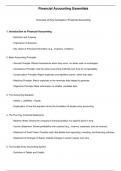
Financial Accounting Essentials
Overview of Key Concepts in Financial Accounting
1. Introduction to Financial Accounting
- Definition and Purpose
- Importance in Business
- Key Users of Financial Information (e.g., investors, creditors)
2. Basic Accounting Principles
- Accrual Principle: Record transactions when they occur, not when cash is exchanged.
- Consistency Principle: Use the same accounting methods over time for comparability.
- Conservatism Principle: Report expenses and liabilities sooner, rather than later.
- Matching Principle: Match expenses to the revenues they helped to generate.
- Objectivity Principle: Base information on reliable, verifiable data.
3. The Accounting Equation
- Assets = Liabilities + Equity
- Explanation of how this equation forms the foundation of double-entry accounting.
4. The Four Key Financial Statements
- Balance Sheet: Shows the company's financial position at a specific point in time.
- Income Statement: Shows profitability over a period (e.g., revenue, expenses, and net income).
- Statement of Cash Flows: Provides cash flow details from operating, investing, and financing activities.
- Statement of Changes in Equity: Details changes in owner's equity over time.
5. The Double-Entry Accounting System
- Definition of Debits and Credits
Overview of Key Concepts in Financial Accounting
1. Introduction to Financial Accounting
- Definition and Purpose
- Importance in Business
- Key Users of Financial Information (e.g., investors, creditors)
2. Basic Accounting Principles
- Accrual Principle: Record transactions when they occur, not when cash is exchanged.
- Consistency Principle: Use the same accounting methods over time for comparability.
- Conservatism Principle: Report expenses and liabilities sooner, rather than later.
- Matching Principle: Match expenses to the revenues they helped to generate.
- Objectivity Principle: Base information on reliable, verifiable data.
3. The Accounting Equation
- Assets = Liabilities + Equity
- Explanation of how this equation forms the foundation of double-entry accounting.
4. The Four Key Financial Statements
- Balance Sheet: Shows the company's financial position at a specific point in time.
- Income Statement: Shows profitability over a period (e.g., revenue, expenses, and net income).
- Statement of Cash Flows: Provides cash flow details from operating, investing, and financing activities.
- Statement of Changes in Equity: Details changes in owner's equity over time.
5. The Double-Entry Accounting System
- Definition of Debits and Credits


