

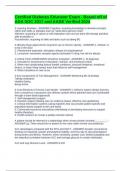
Certified Diabetes Educator Exam - Based off of
ADA SOC 2017 and AADE Verified 2024
3 Learning Domains - ANSWER-Cognitive: acquiring knowledge to develop concepts
rather than skills or attitudes such as "what does glucose mean"
Affective: acquiring of values or self-realization such as how does DM change activities
able to partake in
Psychomotor: acquiring of skills and tasks such as taking BG
3 Obesity drugs approved for long-term use of chronic obesity - ANSWER-1. Orlistat: r/t
to fat in the stool
2. Phentermine-topirmate: stimulates release of norepinephrine
3. Lorcaserin: serotoninc receptor agonist (schedule IV drug, low risk for abuse)
4 Critical Times DSME/DSMS should be evaluated - ANSWER-1. At diagnosis
2. Annually for assessment of education, nutrition, and emotional needs
3. When new complicating factors (health conditions, physical limitations, emotional
factors, or basic living needs) arise that influence self-management
4. When transitions in care occur
4 Key Components of T1D Management - ANSWER-Monitoring BG (6-8x/day)
Taking medication
Healthy Eating
Being Active
6 Core Elements of Chronic Care Model - ANSWER-1. Delivery system design (moving
from a reactive to a proactive care delivery system where planned visits are coordinated
through a team-based approach)
2. Self-management support
3. Decision support (basing care on evidence-based, effective care guidelines)
4. Clinical information systems (using registries that can provide patient-specific and
population-based support to the care team)
5. Community resources and policies (identifying or developing resources to support
healthy lifestyles)
6. Health systems (to create a quality-oriented culture)
A patient should be referred to a nephrology when urinary protein exceeds _________ -
ANSWER-1g. There should be no protein in the urine under normal circumstances.
A1C advantages compared with the FPG and OGTT - ANSWER-Greater convenience
(fasting not required), greater preanalytical stability, and less day-to-day perturbations
during stress and illness. However, lower sensitivity, greater cost, limited availability and
the imperfect correlation between A1C and average glucose in certain individuals.
A1C and Avg Glucose Level - ANSWER-6:126
,7:154
8:183
9:212
10:240
11:269
12:298
A1C Test Frequency Recommendations - ANSWER-Perform at least two times a year
in patients who are meeting treatment goals (and who have stable glycemic control).
Perform test quarterly in patients whose therapy has changed or who are not meeting
glycemic goals.
Point-of-care testing for A1C provides the opportunity for more timely treatment
changes
ADA recommends BG checks when? - ANSWER-prior to meals and snacks
occasional postprandial
at bedtime
prior to exercise
suspect low BG
prior to critical tasks like driving for multiple daily injections
ADA SOC 17 PreDM and DM Screening and Testing - ANSWER-Testing for
prediabetes in asymptomatic people should be considered in adults of any age who are
overweight or obese (BMI ≥25 kg/m2 or ≥23 kg/m2 in Asian Americans) and who have
one or more additional risk factors for diabetes.
For all people, testing should begin at age 45 years.
If tests are normal, repeat testing at 3-year intervals.
FBG, OGTT, A1C equally appropriate.
Identify and, if appropriate, treat cardiovascular disease risk factors.
Testing should be considered in children and adolescents who are overweight or obese
and who have two or more additional risk factors for diabetes.
ADA SOC 2017 - 4 Recommendations for Health Promotion and Disparity Reduction -
ANSWER-1. Tx should be timely, evidence-based, and collaborative.
2. Providers should consider the burden of treatment and self-efficacy of patients when
recommending treatments.
3. Treatment plans should align with the Chronic Care Model
4. Support team-based care, community involvement, patient registries, and decision
support tools to meet patient needs.
ADA SOC 2017 - Diabetes can be classified into the following 4 general categories -
ANSWER-1.Type 1 diabetes (due to autoimmune β-cell destruction, usually leading to
absolute insulin deficiency)
2.Type 2 diabetes (due to a progressive loss of β-cell insulin secretion frequently on the
background of insulin resistance)
, 3.Gestational diabetes mellitus (GDM) (diabetes diagnosed in the second or third
trimester of pregnancy that was not clearly overt diabetes prior to gestation)
4.Specific types of diabetes due to other causes, e.g., monogenic diabetes syndromes
(such as neonatal diabetes and maturity-onset diabetes of the young [MODY]),
diseases of the exocrine pancreas (such as cystic fibrosis), and drug- or chemical-
induced diabetes (such as with glucocorticoid use, in the treatment of HIV/AIDS, or after
organ transplantation)
ADA Stage 1 T1D - ANSWER-Autoimmunity
Normoglycemia
Presymptomatic
Multiple autoantibodies
No IGT or IFG
ADA Stage 2 T1D - ANSWER-Autoimmunity
Dysglycemia
Presymptomatic
Multiple autoantibodies
Dysglycemia: IFG and/or GTT
Increase in A1C
ADA Stage 3 T1D - ANSWER-New-onset hyperglycemia
Symptomatic
Clinical symptoms
Diabetes by standard criteria
Addition of medications to statins can have what impacts
Intestinal absorption inhibitor
Fibrate
Niacin
Which labs should be check - ANSWER-Enhance LDL lowering
Reduce TG levels and raise HDL
Increase HDL and decrease TG, LDL
Lipid profiles, liver enzymes, kidney function
Adult physical activity cardio recommendations w/ T1D or T2D? - ANSWER-150 min or
more of moderate-to-vigorous intensity physical activity per week, spread over at least 3
days/week, with no more than 2 consecutive days without activity. Shorter durations
(minimum 75 min/week) of vigorous-intensity or interval training may be sufficient for
younger and more physically fit individuals.
ADA SOC 2017 and AADE Verified 2024
3 Learning Domains - ANSWER-Cognitive: acquiring knowledge to develop concepts
rather than skills or attitudes such as "what does glucose mean"
Affective: acquiring of values or self-realization such as how does DM change activities
able to partake in
Psychomotor: acquiring of skills and tasks such as taking BG
3 Obesity drugs approved for long-term use of chronic obesity - ANSWER-1. Orlistat: r/t
to fat in the stool
2. Phentermine-topirmate: stimulates release of norepinephrine
3. Lorcaserin: serotoninc receptor agonist (schedule IV drug, low risk for abuse)
4 Critical Times DSME/DSMS should be evaluated - ANSWER-1. At diagnosis
2. Annually for assessment of education, nutrition, and emotional needs
3. When new complicating factors (health conditions, physical limitations, emotional
factors, or basic living needs) arise that influence self-management
4. When transitions in care occur
4 Key Components of T1D Management - ANSWER-Monitoring BG (6-8x/day)
Taking medication
Healthy Eating
Being Active
6 Core Elements of Chronic Care Model - ANSWER-1. Delivery system design (moving
from a reactive to a proactive care delivery system where planned visits are coordinated
through a team-based approach)
2. Self-management support
3. Decision support (basing care on evidence-based, effective care guidelines)
4. Clinical information systems (using registries that can provide patient-specific and
population-based support to the care team)
5. Community resources and policies (identifying or developing resources to support
healthy lifestyles)
6. Health systems (to create a quality-oriented culture)
A patient should be referred to a nephrology when urinary protein exceeds _________ -
ANSWER-1g. There should be no protein in the urine under normal circumstances.
A1C advantages compared with the FPG and OGTT - ANSWER-Greater convenience
(fasting not required), greater preanalytical stability, and less day-to-day perturbations
during stress and illness. However, lower sensitivity, greater cost, limited availability and
the imperfect correlation between A1C and average glucose in certain individuals.
A1C and Avg Glucose Level - ANSWER-6:126
,7:154
8:183
9:212
10:240
11:269
12:298
A1C Test Frequency Recommendations - ANSWER-Perform at least two times a year
in patients who are meeting treatment goals (and who have stable glycemic control).
Perform test quarterly in patients whose therapy has changed or who are not meeting
glycemic goals.
Point-of-care testing for A1C provides the opportunity for more timely treatment
changes
ADA recommends BG checks when? - ANSWER-prior to meals and snacks
occasional postprandial
at bedtime
prior to exercise
suspect low BG
prior to critical tasks like driving for multiple daily injections
ADA SOC 17 PreDM and DM Screening and Testing - ANSWER-Testing for
prediabetes in asymptomatic people should be considered in adults of any age who are
overweight or obese (BMI ≥25 kg/m2 or ≥23 kg/m2 in Asian Americans) and who have
one or more additional risk factors for diabetes.
For all people, testing should begin at age 45 years.
If tests are normal, repeat testing at 3-year intervals.
FBG, OGTT, A1C equally appropriate.
Identify and, if appropriate, treat cardiovascular disease risk factors.
Testing should be considered in children and adolescents who are overweight or obese
and who have two or more additional risk factors for diabetes.
ADA SOC 2017 - 4 Recommendations for Health Promotion and Disparity Reduction -
ANSWER-1. Tx should be timely, evidence-based, and collaborative.
2. Providers should consider the burden of treatment and self-efficacy of patients when
recommending treatments.
3. Treatment plans should align with the Chronic Care Model
4. Support team-based care, community involvement, patient registries, and decision
support tools to meet patient needs.
ADA SOC 2017 - Diabetes can be classified into the following 4 general categories -
ANSWER-1.Type 1 diabetes (due to autoimmune β-cell destruction, usually leading to
absolute insulin deficiency)
2.Type 2 diabetes (due to a progressive loss of β-cell insulin secretion frequently on the
background of insulin resistance)
, 3.Gestational diabetes mellitus (GDM) (diabetes diagnosed in the second or third
trimester of pregnancy that was not clearly overt diabetes prior to gestation)
4.Specific types of diabetes due to other causes, e.g., monogenic diabetes syndromes
(such as neonatal diabetes and maturity-onset diabetes of the young [MODY]),
diseases of the exocrine pancreas (such as cystic fibrosis), and drug- or chemical-
induced diabetes (such as with glucocorticoid use, in the treatment of HIV/AIDS, or after
organ transplantation)
ADA Stage 1 T1D - ANSWER-Autoimmunity
Normoglycemia
Presymptomatic
Multiple autoantibodies
No IGT or IFG
ADA Stage 2 T1D - ANSWER-Autoimmunity
Dysglycemia
Presymptomatic
Multiple autoantibodies
Dysglycemia: IFG and/or GTT
Increase in A1C
ADA Stage 3 T1D - ANSWER-New-onset hyperglycemia
Symptomatic
Clinical symptoms
Diabetes by standard criteria
Addition of medications to statins can have what impacts
Intestinal absorption inhibitor
Fibrate
Niacin
Which labs should be check - ANSWER-Enhance LDL lowering
Reduce TG levels and raise HDL
Increase HDL and decrease TG, LDL
Lipid profiles, liver enzymes, kidney function
Adult physical activity cardio recommendations w/ T1D or T2D? - ANSWER-150 min or
more of moderate-to-vigorous intensity physical activity per week, spread over at least 3
days/week, with no more than 2 consecutive days without activity. Shorter durations
(minimum 75 min/week) of vigorous-intensity or interval training may be sufficient for
younger and more physically fit individuals.


