
Webcare and conversational AI -
literatuur
Week 1
Article 1
Van Noort, G., Willemsen, L. M., Kerkhof, P., & Verhoeven, J. W. (2014). Webcare as an
integrative tool for customer care, reputation management, and online marketing: a
literature review. In: Integrated communications in the postmodern era (pp. 77-99).
Palgrave Macmillan, London.
3 types of response of customers when they are dissatisfied.
1) Stop using an organization's product/service and take their business to a competitor
2) File a complaint with the organization that is responsible for the dissatisfaction
3) Talk about their dissatisfaction with fellow consumers
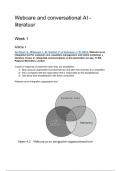
Webcare as an integrative organization tool
,Should one engage in webcare?
Monitoring (social listening) makes it possible to take strategic action.
When to respond?
Literature suggests that responding to complaints in social media is in general a wise thing to
do. Two different approaches: reactive (reply to a customer's request to respond to their
complaint; this can be expressed explicitly or implicitly) and proactive (organizational responses
are not preceded by any direct or indirect request form the complainant to respond).
What to say in webcare?
Sequence of events in which a procedure beginning with communicating the complaints,
generates a process of interaction through with a decision and outcomes occurs. Customers
evaluate each step in this process in terms of its fitness: the perceived fairness of the outcomes
(distributive justice), the procedures used to achieve these outcomes (procedural justice), and
the interpersonal treatment during the interactions between the organizations and the customer
procedures (interactional justice).
According to theories on distributive justice, people evaluate the fairness of outcomes by
calculating the ratio of one's input and the outcome and subsequently compare this outcome to
previous outcomes or outcomes that others have achieved. From this perspective an evaluation
of service recovery would entail evaluating the ratio between the cost and the outcomes. If this
ratio is lower than what the other customer got, or lower than the ratio in previous service
recovery experiences, distributive justice will be perceived as low. Thus fairness of the outcome
is also important in the eyes of the observing audience, and thus for webcare as a tool for
reputation management.
Three response strategies: apologizing and corrective action, justification and denial, and
information/sympathy and compensation -> information is most used in twitter.
What communication style to use in webcare?
Conversational human voice: an engaging and natural style of organizational communication as
perceived by an organization's public based on interactions between individuals in the
organization and individuals in public. Various tactics including the use of message
personalisation (refers to the degree to which a message can be made to address a specific
individual), informal speech (involves casual and expressive language that is exchanged in
everyday conversations and contrast in this sense with the declarative and neutralized language
that is often used in formal corporate communications) and invitational rhetoric (characterized
by a style of communication that is oriented to a negotiated exchange of ideas and opinions with
stakeholders).
,Article 2
Weitzl, W. J. (2019). Webcare’s effect on constructive and vindictive complainants.
Journal of Product & Brand Management, 28(3), 330-347. DOI:
10.1108/JPBM-04-2018-1843.
Negative electronic word-of-mouth (neWOM)
Webcare: the act of engaging in online interactions with [complaining] consumers, by actively
searching the web to address customer feedback.
Constructive complaints: whose personal or collective complaining goals can only be
achieved by receiving a response form the company and who are therefore open (receptive) to
webcare.
Typically seek both social benefits in the form of brand communication (e.g. explanation and
apology) and particularly economic benefits such as compensation offerings for their finance
loss (e.g. refund and replacement).
Redress seeking: ( i.e. consumers utilize online complaints to compensate their
dissatisfaction by demanding a justice restoring recovery) is a classic company dependent
campaigning goal.
Constructive complaints anticipate that complaining on social media is more effective than
voicing a complaint in traditional channels as it empowers the consumer by increasing the
(public) pressure on the brand.
Vindictive complaints: who do not need a response from the company to achieve their goals
and who regard webcare rather as an inappropriate interface in between consumer
conversations.
Vindictive complaints online serve as means to reduce frustration and anxiety associated with a
perceived misconduct or service failure. Companies primarily enable consumers to reduce the
discontent associated with negative consumption emotions by venting. Hey also regard neWOM
as deliberate actions to take revenge on the respective company and to punish or harm it. To
help other consumers and warn them about the brand and to call for collective retaliation
against it. These kinds of complaints can also be a form of entertain .
If a response by the company helps to achieve the complainant's individual goals, he/she is
receptive to webcare and will react positively towards it. A complaint response mismatch is likely
to lead to unfavorable complainants reactions.
, Response strategies typically range on a continuum of the responsibility taken by the brand
from defensive to accommodative responses.
Equity theory: implies that people try to reduce distress by restoring either their physical or
psychological equity when they experience unfairness.
Conclusion
Dissatisfied consumers increasingly trun to social media to share their negative experiences,
thoughts and emotions about a brand with the involved company and other consumers. To
restore the relationship with their clients and to impede unfavorable brand-reactions among
potential customers, many companies have to intervene in these public online complaints by
means of webcare. However marketers often fail to react effectively as they are often guided by
a high degree of uncertainty about the positive (negative) consequences of adequate
(inadequate) responding to online criticism)
Theoretical Implications
literatuur
Week 1
Article 1
Van Noort, G., Willemsen, L. M., Kerkhof, P., & Verhoeven, J. W. (2014). Webcare as an
integrative tool for customer care, reputation management, and online marketing: a
literature review. In: Integrated communications in the postmodern era (pp. 77-99).
Palgrave Macmillan, London.
3 types of response of customers when they are dissatisfied.
1) Stop using an organization's product/service and take their business to a competitor
2) File a complaint with the organization that is responsible for the dissatisfaction
3) Talk about their dissatisfaction with fellow consumers
Webcare as an integrative organization tool
,Should one engage in webcare?
Monitoring (social listening) makes it possible to take strategic action.
When to respond?
Literature suggests that responding to complaints in social media is in general a wise thing to
do. Two different approaches: reactive (reply to a customer's request to respond to their
complaint; this can be expressed explicitly or implicitly) and proactive (organizational responses
are not preceded by any direct or indirect request form the complainant to respond).
What to say in webcare?
Sequence of events in which a procedure beginning with communicating the complaints,
generates a process of interaction through with a decision and outcomes occurs. Customers
evaluate each step in this process in terms of its fitness: the perceived fairness of the outcomes
(distributive justice), the procedures used to achieve these outcomes (procedural justice), and
the interpersonal treatment during the interactions between the organizations and the customer
procedures (interactional justice).
According to theories on distributive justice, people evaluate the fairness of outcomes by
calculating the ratio of one's input and the outcome and subsequently compare this outcome to
previous outcomes or outcomes that others have achieved. From this perspective an evaluation
of service recovery would entail evaluating the ratio between the cost and the outcomes. If this
ratio is lower than what the other customer got, or lower than the ratio in previous service
recovery experiences, distributive justice will be perceived as low. Thus fairness of the outcome
is also important in the eyes of the observing audience, and thus for webcare as a tool for
reputation management.
Three response strategies: apologizing and corrective action, justification and denial, and
information/sympathy and compensation -> information is most used in twitter.
What communication style to use in webcare?
Conversational human voice: an engaging and natural style of organizational communication as
perceived by an organization's public based on interactions between individuals in the
organization and individuals in public. Various tactics including the use of message
personalisation (refers to the degree to which a message can be made to address a specific
individual), informal speech (involves casual and expressive language that is exchanged in
everyday conversations and contrast in this sense with the declarative and neutralized language
that is often used in formal corporate communications) and invitational rhetoric (characterized
by a style of communication that is oriented to a negotiated exchange of ideas and opinions with
stakeholders).
,Article 2
Weitzl, W. J. (2019). Webcare’s effect on constructive and vindictive complainants.
Journal of Product & Brand Management, 28(3), 330-347. DOI:
10.1108/JPBM-04-2018-1843.
Negative electronic word-of-mouth (neWOM)
Webcare: the act of engaging in online interactions with [complaining] consumers, by actively
searching the web to address customer feedback.
Constructive complaints: whose personal or collective complaining goals can only be
achieved by receiving a response form the company and who are therefore open (receptive) to
webcare.
Typically seek both social benefits in the form of brand communication (e.g. explanation and
apology) and particularly economic benefits such as compensation offerings for their finance
loss (e.g. refund and replacement).
Redress seeking: ( i.e. consumers utilize online complaints to compensate their
dissatisfaction by demanding a justice restoring recovery) is a classic company dependent
campaigning goal.
Constructive complaints anticipate that complaining on social media is more effective than
voicing a complaint in traditional channels as it empowers the consumer by increasing the
(public) pressure on the brand.
Vindictive complaints: who do not need a response from the company to achieve their goals
and who regard webcare rather as an inappropriate interface in between consumer
conversations.
Vindictive complaints online serve as means to reduce frustration and anxiety associated with a
perceived misconduct or service failure. Companies primarily enable consumers to reduce the
discontent associated with negative consumption emotions by venting. Hey also regard neWOM
as deliberate actions to take revenge on the respective company and to punish or harm it. To
help other consumers and warn them about the brand and to call for collective retaliation
against it. These kinds of complaints can also be a form of entertain .
If a response by the company helps to achieve the complainant's individual goals, he/she is
receptive to webcare and will react positively towards it. A complaint response mismatch is likely
to lead to unfavorable complainants reactions.
, Response strategies typically range on a continuum of the responsibility taken by the brand
from defensive to accommodative responses.
Equity theory: implies that people try to reduce distress by restoring either their physical or
psychological equity when they experience unfairness.
Conclusion
Dissatisfied consumers increasingly trun to social media to share their negative experiences,
thoughts and emotions about a brand with the involved company and other consumers. To
restore the relationship with their clients and to impede unfavorable brand-reactions among
potential customers, many companies have to intervene in these public online complaints by
means of webcare. However marketers often fail to react effectively as they are often guided by
a high degree of uncertainty about the positive (negative) consequences of adequate
(inadequate) responding to online criticism)
Theoretical Implications


