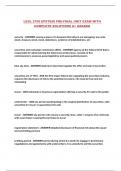
LEGL 2700 EPSTEIN PRE-FINAL UNIT EXAM WITH
COMPLETE SOLUTIONS A+ GRADED
security - ANSWER owning a piece of a business that others are managing; any note,
stock, treasury stock, bond, debenture, evidence of indebtedness, etc
securities and exchange commission (SEC) - ANSWER agency at the federal level that is
responsible for administering the federal securities laws; consists of five
commissioners; possess quasi-legislative and quasi-judicial powers
blue sky laws - ANSWER state level laws that regulate the offer and sale of securities
securities act of 1933 - ANS the first major federal law regulating the securities industry;
requires the disclosure of info to the potential investors; info must be true and not
misleading
issuer - ANS individual or business organization offering a security for sale to the public
underwriter - ANS any person participating in the original distribution of securities; sells
securities for issuer or guarantees the sale
issuer - ANSWER any person who issues a security; thus, seller = anyone who contracts
with a purchaser causing the purchase to occur
registration statement - ANSWER detailed disclosure of financial info about the issuer
and controlling persons
prefiling period - ANSWER period during which it is lawful to engage in preliminary
negotiations and agreements with underwriters; it is unlawful to sell the securities
, waiting period - ANSWER period that is usually 20 days long which allows the SEC to
review; it is still illegal to sell the securities; it is not illegal to solicit offers just can't
accept them yet and form contact
posteffective period - ANSWER period in which now it is legal for the sales to begin
prospectus - ANSWER contains financial information about issuer and controlling
persons; is given to prospective investor; merely need meet the statutory requirements
(does not mean it is a good investment!)
securities and exchange act of 1934 - ANSWER federal law that regulates transfers of
securities after the initial sale (secondary market); created the SEC; illegal to sell
unregistered securities on national exchange; registration requires filing prescribed
forms with stock exchange and SEC
rule 10b-5 - ANSWER principal anti-fraud rule on secondary market fraud issues; civil
and criminal sanctions; applies even if not a registered security
Insider trading - ANSWER the crime of trade on material, non-public information
Tippee - ANSWER the person who learns of material, non-public information from an
insider
Tipper - ANSWER the insider who discloses material, non-public information
Misappropriation theory - ANSWER person is a "temporary insider" if he / she conveys
or uses material, non-public information for money-making purposes
Sarbanes-Oxley Act of 2002 - ANSWER Applies to all public companies in the US and
international companies registered with the SEC; revitalization of the SEC-increased
budget, increase power over governance issues, etc.
Public Company Accounting Oversight Board - ANSWER oversees the accounting firms
that audit public companies; requires the auditing firms not to conduct non-auditing
services
COMPLETE SOLUTIONS A+ GRADED
security - ANSWER owning a piece of a business that others are managing; any note,
stock, treasury stock, bond, debenture, evidence of indebtedness, etc
securities and exchange commission (SEC) - ANSWER agency at the federal level that is
responsible for administering the federal securities laws; consists of five
commissioners; possess quasi-legislative and quasi-judicial powers
blue sky laws - ANSWER state level laws that regulate the offer and sale of securities
securities act of 1933 - ANS the first major federal law regulating the securities industry;
requires the disclosure of info to the potential investors; info must be true and not
misleading
issuer - ANS individual or business organization offering a security for sale to the public
underwriter - ANS any person participating in the original distribution of securities; sells
securities for issuer or guarantees the sale
issuer - ANSWER any person who issues a security; thus, seller = anyone who contracts
with a purchaser causing the purchase to occur
registration statement - ANSWER detailed disclosure of financial info about the issuer
and controlling persons
prefiling period - ANSWER period during which it is lawful to engage in preliminary
negotiations and agreements with underwriters; it is unlawful to sell the securities
, waiting period - ANSWER period that is usually 20 days long which allows the SEC to
review; it is still illegal to sell the securities; it is not illegal to solicit offers just can't
accept them yet and form contact
posteffective period - ANSWER period in which now it is legal for the sales to begin
prospectus - ANSWER contains financial information about issuer and controlling
persons; is given to prospective investor; merely need meet the statutory requirements
(does not mean it is a good investment!)
securities and exchange act of 1934 - ANSWER federal law that regulates transfers of
securities after the initial sale (secondary market); created the SEC; illegal to sell
unregistered securities on national exchange; registration requires filing prescribed
forms with stock exchange and SEC
rule 10b-5 - ANSWER principal anti-fraud rule on secondary market fraud issues; civil
and criminal sanctions; applies even if not a registered security
Insider trading - ANSWER the crime of trade on material, non-public information
Tippee - ANSWER the person who learns of material, non-public information from an
insider
Tipper - ANSWER the insider who discloses material, non-public information
Misappropriation theory - ANSWER person is a "temporary insider" if he / she conveys
or uses material, non-public information for money-making purposes
Sarbanes-Oxley Act of 2002 - ANSWER Applies to all public companies in the US and
international companies registered with the SEC; revitalization of the SEC-increased
budget, increase power over governance issues, etc.
Public Company Accounting Oversight Board - ANSWER oversees the accounting firms
that audit public companies; requires the auditing firms not to conduct non-auditing
services