LBS1 290 Prep Exam
Latest Update
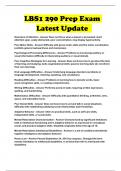
Disorders of Attention - Answer Does not focus when a lesson is presented; short
attention span, easily distracted, poor concentration; may display hyperactivity.
Poor Motor Skills - Answer Difficulty with gross motor skills and fine motor coordination
(exhibits general awkwardness and clumsiness).
Psychological Processing Differences - Answer Problems in processing auditory or
visual information (difficulty in interpreting auditory or visual stimuli).
Poor Cognitive Strategies for Learning - Answer Does not know how to go about the task
of learning and studying; lacks organizational skills; passive learning style (do not direct
their own learning).
Oral Language Difficulties - Answer Underlying language disorders (problems in
language development, listening, speaking, and vocabulary).
Reading Difficulties - Answer Problems in learning how to decode words, basic
word-recognition skills, or reading comprehension.
Writing Difficulties - Answer Performs poorly in tasks requiring written expression,
spelling, and handwriting.
Mathematics Difficulties - Answer Difficulty with quantitative thinking, arithmetic, time,
space, and calculation facts.
Poor Social Skills - Answer Does not know how to act and talk in social situations;
difficulty with establishing satisfying social relationships and friendships.
Adaptive Behavior - Answer refers to practical skills, such as self-care skills,
independent skills, or social skills.
Mental Retardation Characterization - Answer Characterized by significant limitations
both in intellectual functioning and in adaptive behavior as expressed in conceptual,
social, and practical adaptive skills. Disability originates before the age of 18.
Mental Retardation (Intellectual Disabilities) - Answer is a set of conditions that blends
together intelligence and adaptive behavior.
Rosa's Law - Answer Passed September 24, 2010 by congress. Changed the term
mental retardation to intellectual disabilities. In all laws that refer to individuals with
disabilities.
, Intermittent Support - Answer Support provided as needed, and not at all times. Similar
to mild intellectual disabilities.
Limited Support - Answer Support provided on a regular basis for a short period of time.
Similar to moderate intellectual disabilities.
Extensive Support - Answer Support provided on an ongoing and regular basis. Similar
to severe intellectual disabilities.
Pervasive Support - Answer Constant high-intensity help across environments and
involves more staff members. Similar to profound intellectual disabilities.
Emotional/Behavioral Disorders - Answer Students who have emotional disorders or
behavioral disturbances.
Emotional Disorders - Answer Involves feelings about oneself, such as depression or
low self-esteem, that can interfere with a person's outlook on life and the ability to learn.
Behavioral Disorders - Answer 1. Inability to build or maintain satisfactory interpersonal
relationships with peers and teachers.
2. Inappropriate types of behaviors or feelings under normal circumstances.
3. General pervasive mood of unhappiness or depression; Or a tendency to develop
physical symptoms or fears associated with personal or school problems.
Education for All Handicapped Children Act (Passed in 1975) - Answer Guarantees a
free and appropriate public education to children with disabilities. Reauthorized in 1990
and 1997, as the Individuals w/ Disabilities Education Improvement Act (IDEA).
2004 is the most recent version.
Common elements in the various definitions of Learning Disabilities - Answer 1.
Neurological Factors 2. Cognitive Processing Factors 3. Difficulty in academic and
learning. 4. Discrepancy between potential and achievement. 4. Exclusion of other
causes.
Poor Motor Development - Answer Preschooler who cannot catch a ball, hop, jump, or
play w/ manipulative toys.
Language and Speech Disorders - Answer The 4 year old who does not use language to
communicate, has a limited vocabulary, and cannot be understood.
Poor Coginitive Development - Answer The 5 year old who cannot count to 10, name
colors, or work puzzles.
Characteristics Displayed by Preschool Children w/ Developmental Delays - Answer
Poor motor development, language delays, speech disorders, and slow cognitive and
concept delay.
Latest Update
Disorders of Attention - Answer Does not focus when a lesson is presented; short
attention span, easily distracted, poor concentration; may display hyperactivity.
Poor Motor Skills - Answer Difficulty with gross motor skills and fine motor coordination
(exhibits general awkwardness and clumsiness).
Psychological Processing Differences - Answer Problems in processing auditory or
visual information (difficulty in interpreting auditory or visual stimuli).
Poor Cognitive Strategies for Learning - Answer Does not know how to go about the task
of learning and studying; lacks organizational skills; passive learning style (do not direct
their own learning).
Oral Language Difficulties - Answer Underlying language disorders (problems in
language development, listening, speaking, and vocabulary).
Reading Difficulties - Answer Problems in learning how to decode words, basic
word-recognition skills, or reading comprehension.
Writing Difficulties - Answer Performs poorly in tasks requiring written expression,
spelling, and handwriting.
Mathematics Difficulties - Answer Difficulty with quantitative thinking, arithmetic, time,
space, and calculation facts.
Poor Social Skills - Answer Does not know how to act and talk in social situations;
difficulty with establishing satisfying social relationships and friendships.
Adaptive Behavior - Answer refers to practical skills, such as self-care skills,
independent skills, or social skills.
Mental Retardation Characterization - Answer Characterized by significant limitations
both in intellectual functioning and in adaptive behavior as expressed in conceptual,
social, and practical adaptive skills. Disability originates before the age of 18.
Mental Retardation (Intellectual Disabilities) - Answer is a set of conditions that blends
together intelligence and adaptive behavior.
Rosa's Law - Answer Passed September 24, 2010 by congress. Changed the term
mental retardation to intellectual disabilities. In all laws that refer to individuals with
disabilities.
, Intermittent Support - Answer Support provided as needed, and not at all times. Similar
to mild intellectual disabilities.
Limited Support - Answer Support provided on a regular basis for a short period of time.
Similar to moderate intellectual disabilities.
Extensive Support - Answer Support provided on an ongoing and regular basis. Similar
to severe intellectual disabilities.
Pervasive Support - Answer Constant high-intensity help across environments and
involves more staff members. Similar to profound intellectual disabilities.
Emotional/Behavioral Disorders - Answer Students who have emotional disorders or
behavioral disturbances.
Emotional Disorders - Answer Involves feelings about oneself, such as depression or
low self-esteem, that can interfere with a person's outlook on life and the ability to learn.
Behavioral Disorders - Answer 1. Inability to build or maintain satisfactory interpersonal
relationships with peers and teachers.
2. Inappropriate types of behaviors or feelings under normal circumstances.
3. General pervasive mood of unhappiness or depression; Or a tendency to develop
physical symptoms or fears associated with personal or school problems.
Education for All Handicapped Children Act (Passed in 1975) - Answer Guarantees a
free and appropriate public education to children with disabilities. Reauthorized in 1990
and 1997, as the Individuals w/ Disabilities Education Improvement Act (IDEA).
2004 is the most recent version.
Common elements in the various definitions of Learning Disabilities - Answer 1.
Neurological Factors 2. Cognitive Processing Factors 3. Difficulty in academic and
learning. 4. Discrepancy between potential and achievement. 4. Exclusion of other
causes.
Poor Motor Development - Answer Preschooler who cannot catch a ball, hop, jump, or
play w/ manipulative toys.
Language and Speech Disorders - Answer The 4 year old who does not use language to
communicate, has a limited vocabulary, and cannot be understood.
Poor Coginitive Development - Answer The 5 year old who cannot count to 10, name
colors, or work puzzles.
Characteristics Displayed by Preschool Children w/ Developmental Delays - Answer
Poor motor development, language delays, speech disorders, and slow cognitive and
concept delay.