
HUMAN REPRODUCTION
Anatomy - structure
Physiology - function
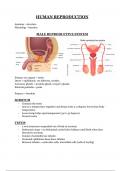
MALE REPRODUCTIVE SYSTEM
Primary sex organs = testis
Ducts = epididymis, vas deferens, urethra
Accessory glands = prostate gland, cowper's glands
External genitalia = penis
Prepuce = foreskin
SCROTUM
- Contains the testis
- Acts as a temperature regulator and keeps testis 2-3 degrees lower than body
temperature
- Lower temp helps spermatogenesis (34 to 35 degrees)
- Protects testis
TESTIS
- 2 oval structures suspended out of body in scrotum
- Embryonic stage = in abdominal cavity below kidneys until birth when they
descend to scrotum
- Consist of seminiferous tubules
- Germinal epithelium lines these tubules
- Between tubules = endocrine cells, interstitial cells (cells of Leydig)
, - Testis produce: sperm by germinal layer and testosterone by interstitial cells
EPIDIDYMIS
- Stores and matures sperm
- Seminiferous tubules join to form epididymis
- Germinal epithelium of seminiferous tubules = sperm
SPERM DUCT/VAS DEFERENS
- Vasectomy = cut vas deferens
- Muscular sperm duct is the continuation of epididymis
- Leaves the scrotum, passes through prostate gland and enters urethra
- It pushes mature sperm forward by peristalsis from epididymis to urethra
(ejaculation)
URETHRA
- Common excretory/urinary and ejaculatory duct
- The duct at the end of the uro-genital system leading to exterior
- Transports urine and semen (never occur together)
PROSTATE GLAND
- Plum-sized
- Surrounds urethra at base of bladder
- Secretes fluid that aids in transport of sperm and contains enzymes to make
sperm more active
- Makes up a third of seminal fluid
COWPERS GLAND
- 2 cowper's gland found at base of penis
- Bulbourethral
- Produces alkaline mucus-like fluid when sexually aroused
- This fluid neutralizes acidic urine and lubricates urethra and external urethral
opening to protect sperm from mechanical damage during ejaculation
, PENIS
- Urethra passes down to male external organ (penis)
- Penis consists of special spongy tissue (erectile tissue)
- Dorsal side of erectile tissue = corpus casanova
- Ventral side = corpus spongiosum
- Primary mechanism that brings about an erection is the dilation of dorsal and
ventral arteries supplying blood to penis
- Allows more blood to fill 3 spongy erectile tissue chambers causing penis to
stiffen and lengthen (erection)
- Without an erection, sperm cannot be transferred to females vagina during sexual
intercourse
- Penis deposits semen and sperm into vagina during copulation
DISTINCTIVE ABOUT THE HUMAN PENIS
- Only mammal without an erectile bone (baculum)
- It relies only on engorgement with blood
- Not attached to abdominal wall but hangs freely
SEMEN
- Semen consists of: sperm from testis and epididymis and seminal fluid from
accessory glands such as the prostate, seminal vesicles and cowper's gland
Anatomy - structure
Physiology - function
MALE REPRODUCTIVE SYSTEM
Primary sex organs = testis
Ducts = epididymis, vas deferens, urethra
Accessory glands = prostate gland, cowper's glands
External genitalia = penis
Prepuce = foreskin
SCROTUM
- Contains the testis
- Acts as a temperature regulator and keeps testis 2-3 degrees lower than body
temperature
- Lower temp helps spermatogenesis (34 to 35 degrees)
- Protects testis
TESTIS
- 2 oval structures suspended out of body in scrotum
- Embryonic stage = in abdominal cavity below kidneys until birth when they
descend to scrotum
- Consist of seminiferous tubules
- Germinal epithelium lines these tubules
- Between tubules = endocrine cells, interstitial cells (cells of Leydig)
, - Testis produce: sperm by germinal layer and testosterone by interstitial cells
EPIDIDYMIS
- Stores and matures sperm
- Seminiferous tubules join to form epididymis
- Germinal epithelium of seminiferous tubules = sperm
SPERM DUCT/VAS DEFERENS
- Vasectomy = cut vas deferens
- Muscular sperm duct is the continuation of epididymis
- Leaves the scrotum, passes through prostate gland and enters urethra
- It pushes mature sperm forward by peristalsis from epididymis to urethra
(ejaculation)
URETHRA
- Common excretory/urinary and ejaculatory duct
- The duct at the end of the uro-genital system leading to exterior
- Transports urine and semen (never occur together)
PROSTATE GLAND
- Plum-sized
- Surrounds urethra at base of bladder
- Secretes fluid that aids in transport of sperm and contains enzymes to make
sperm more active
- Makes up a third of seminal fluid
COWPERS GLAND
- 2 cowper's gland found at base of penis
- Bulbourethral
- Produces alkaline mucus-like fluid when sexually aroused
- This fluid neutralizes acidic urine and lubricates urethra and external urethral
opening to protect sperm from mechanical damage during ejaculation
, PENIS
- Urethra passes down to male external organ (penis)
- Penis consists of special spongy tissue (erectile tissue)
- Dorsal side of erectile tissue = corpus casanova
- Ventral side = corpus spongiosum
- Primary mechanism that brings about an erection is the dilation of dorsal and
ventral arteries supplying blood to penis
- Allows more blood to fill 3 spongy erectile tissue chambers causing penis to
stiffen and lengthen (erection)
- Without an erection, sperm cannot be transferred to females vagina during sexual
intercourse
- Penis deposits semen and sperm into vagina during copulation
DISTINCTIVE ABOUT THE HUMAN PENIS
- Only mammal without an erectile bone (baculum)
- It relies only on engorgement with blood
- Not attached to abdominal wall but hangs freely
SEMEN
- Semen consists of: sperm from testis and epididymis and seminal fluid from
accessory glands such as the prostate, seminal vesicles and cowper's gland


