
Hominid studies
Hominid = an individual in the order primates, including humans and their ancestors
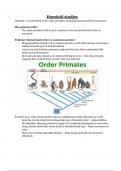
The primate order
- The order primates with its 300+ species, is the 3rd most diverse order of
mammals
Evidence that primates have a common ancestor
- Biogeographical evidence of a common ancestor as all wild primates are found in
lands previously part of Gondwanaland
- Latest research indicates primates originated 85 mya, then continental drift
broke up Gondwanaland
- Most present-day primates are arboreal (living in trees) – this characteristic
suggests they evolved from ancestor that was arboreal
Primates have many characteristics that are adaptations to this arboreal way of life
- Kept the clavicle which forms important part of shoulder joint – helps stabilise
the shoulder, allowing primate to support its weight by hanging from arms alone
- Long, slender limbs that rotate freely at shoulders and hips – helps movement in
trees
- Many have mobile opposable thumbs – helps grasp and hold onto branches
effectively
,Other characteristics that all primates share:
1. Enlarged and complex brain relative to body size
2. Flattened face and reduced snout with reduced sense of smell
3. Eyes that face forward so that the eyes’ visual fields overlap to give stereoscopic
vision
4. Digits with flat nails
5. Molar and premolar teeth with cusps that are low and rounded
6. Complex social behaviour, usually only 1 offspring at a time with extended care
for young
Genetic evidence of a common ancestor:
1. Share large % of DNA (humans share 98.5% of DNA with chimpanzees)
2. Have larger number of olfactory-receptor pseudo-genes that non-primates
(consistent with deterioration of sense of smell in primates) (pseudo-genes =
remnants of genes that are no longer functional)
3. Full trichromatic colour vision (ability to perceive red, green and blue) which is
only found in primates
Sequence of human evolution
Class: mammalia
Order: primates
Superfamilies: hominoidea (and prosimians)
Family: hominidae
Sub-family: homininae (and ponginae)
Tribe: hominini (and gorillini)
, Genetic analysis combined with fossil evidence indicates that:
- Hominidae family split (speciated) into subfamilies about 15 mya
- Homininae subfamily split into 2 tribes about 7.5 mya
- Hominini tribe split into the genera (Homo, Australopithecines and Pan) about
6 mya
How hominidae relate to other
animals
- Phylogenetic tree depicts hypothesis
about evolutionary relationships
among organisms
- Based upon similarities and
differences in physical or genetic
characteristics
- Modern humans and extinct
anthropoids are genetically very
closely linked
Hominid = an individual in the order primates, including humans and their ancestors
The primate order
- The order primates with its 300+ species, is the 3rd most diverse order of
mammals
Evidence that primates have a common ancestor
- Biogeographical evidence of a common ancestor as all wild primates are found in
lands previously part of Gondwanaland
- Latest research indicates primates originated 85 mya, then continental drift
broke up Gondwanaland
- Most present-day primates are arboreal (living in trees) – this characteristic
suggests they evolved from ancestor that was arboreal
Primates have many characteristics that are adaptations to this arboreal way of life
- Kept the clavicle which forms important part of shoulder joint – helps stabilise
the shoulder, allowing primate to support its weight by hanging from arms alone
- Long, slender limbs that rotate freely at shoulders and hips – helps movement in
trees
- Many have mobile opposable thumbs – helps grasp and hold onto branches
effectively
,Other characteristics that all primates share:
1. Enlarged and complex brain relative to body size
2. Flattened face and reduced snout with reduced sense of smell
3. Eyes that face forward so that the eyes’ visual fields overlap to give stereoscopic
vision
4. Digits with flat nails
5. Molar and premolar teeth with cusps that are low and rounded
6. Complex social behaviour, usually only 1 offspring at a time with extended care
for young
Genetic evidence of a common ancestor:
1. Share large % of DNA (humans share 98.5% of DNA with chimpanzees)
2. Have larger number of olfactory-receptor pseudo-genes that non-primates
(consistent with deterioration of sense of smell in primates) (pseudo-genes =
remnants of genes that are no longer functional)
3. Full trichromatic colour vision (ability to perceive red, green and blue) which is
only found in primates
Sequence of human evolution
Class: mammalia
Order: primates
Superfamilies: hominoidea (and prosimians)
Family: hominidae
Sub-family: homininae (and ponginae)
Tribe: hominini (and gorillini)
, Genetic analysis combined with fossil evidence indicates that:
- Hominidae family split (speciated) into subfamilies about 15 mya
- Homininae subfamily split into 2 tribes about 7.5 mya
- Hominini tribe split into the genera (Homo, Australopithecines and Pan) about
6 mya
How hominidae relate to other
animals
- Phylogenetic tree depicts hypothesis
about evolutionary relationships
among organisms
- Based upon similarities and
differences in physical or genetic
characteristics
- Modern humans and extinct
anthropoids are genetically very
closely linked


