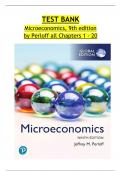
TEST BANK
Microeconomics, 9th edition
by Perloff all Chapters 1 - 20
,Table of contents
g g
1. Introduction
2. Supply and Demand
g g
3. Applying the Supply-and-Demand Model
g g g
4. Consumer Choice g
5. Applying Consumer Theory
g g
6. Firms and Production
g g
7. Costs
8. Competitive Firms and Markets g g g
9. Applying the Competitive Model
g g g
10. General Equilibrium and Economic Welfareg g g g
11. Monopoly
12. Pricing and Advertising g g
13. Oligopoly and Monopolistic Competition g g g
14. Game Theory g
15. Factor Markets g
16. Interest Rates, Investments, and Capital Markets
g g g g g
17. Uncertainty
18. Externalities, Open-Access, and Public Goods g g g g
19. Asymmetric Information g
20. Contracts and Moral Hazards g g g
,Chapterg1 Introduction
1.1 Microeconomics:gThegAllocationgofgScarcegResources
1) Microeconomicsg studiesgthegallocationg of
A) decisiong makers.
B) scarcegresources.
C) models.
D) unlimitedgresources
.gANSWER: B
Section:
Theg Allocationg ofg Scarceg Resource
sgQuestiongStatus: Old
AACSB: Analyticgthinking
2) Microeconomicsg isg oftengcalled
A) priceg theory.
B) decisiongscience.
C) scarcity.
D) resourcegtheory
.gANSWER: A
Section:
Theg Allocationg ofg Scarceg Resource
sgQuestiongStatus: Old
AACSB: Analyticgthinking
3) Mostg microeconomicg modelsg assumeg thatgdecisiong makersgwishgto
A) makegthemselvesg asgwellg offgasg possible.
B) actgselfishly.
C) makeg othersgasg wellg offg asgpossible.
D) Noneg ofgthegabove
.gANSWER: A
Section:
Theg Allocationg ofg Scarceg Resource
sgQuestiongStatus: Old
AACSB: Analyticgthinking
4) Societyg facesg trade-‐‑offsg becauseg of
A) governmentgregulations.
B) profitg motive.
C) facelessgbureaucrats.
, D) scarcity.g
ANSWER: D
Section:
Theg Allocationg ofg Scarceg Resource
sgQuestiongStatus: Old
AACSB: Analyticgthinking
Microeconomics, 9th edition
by Perloff all Chapters 1 - 20
,Table of contents
g g
1. Introduction
2. Supply and Demand
g g
3. Applying the Supply-and-Demand Model
g g g
4. Consumer Choice g
5. Applying Consumer Theory
g g
6. Firms and Production
g g
7. Costs
8. Competitive Firms and Markets g g g
9. Applying the Competitive Model
g g g
10. General Equilibrium and Economic Welfareg g g g
11. Monopoly
12. Pricing and Advertising g g
13. Oligopoly and Monopolistic Competition g g g
14. Game Theory g
15. Factor Markets g
16. Interest Rates, Investments, and Capital Markets
g g g g g
17. Uncertainty
18. Externalities, Open-Access, and Public Goods g g g g
19. Asymmetric Information g
20. Contracts and Moral Hazards g g g
,Chapterg1 Introduction
1.1 Microeconomics:gThegAllocationgofgScarcegResources
1) Microeconomicsg studiesgthegallocationg of
A) decisiong makers.
B) scarcegresources.
C) models.
D) unlimitedgresources
.gANSWER: B
Section:
Theg Allocationg ofg Scarceg Resource
sgQuestiongStatus: Old
AACSB: Analyticgthinking
2) Microeconomicsg isg oftengcalled
A) priceg theory.
B) decisiongscience.
C) scarcity.
D) resourcegtheory
.gANSWER: A
Section:
Theg Allocationg ofg Scarceg Resource
sgQuestiongStatus: Old
AACSB: Analyticgthinking
3) Mostg microeconomicg modelsg assumeg thatgdecisiong makersgwishgto
A) makegthemselvesg asgwellg offgasg possible.
B) actgselfishly.
C) makeg othersgasg wellg offg asgpossible.
D) Noneg ofgthegabove
.gANSWER: A
Section:
Theg Allocationg ofg Scarceg Resource
sgQuestiongStatus: Old
AACSB: Analyticgthinking
4) Societyg facesg trade-‐‑offsg becauseg of
A) governmentgregulations.
B) profitg motive.
C) facelessgbureaucrats.
, D) scarcity.g
ANSWER: D
Section:
Theg Allocationg ofg Scarceg Resource
sgQuestiongStatus: Old
AACSB: Analyticgthinking