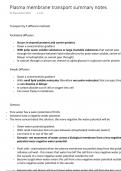
Plasma membrane transport summary notes
01 November 2022 12:21
Transport by 5 different methods
Facilitated diffusion
- Occurs in channel proteins and carrier proteins
- Down a concentration gradient
- With polar water soluble substances or large insoluble substances that cannot pass
through the membrane between lipid molecules (as for polar water soluble, centre of
bilayer is hydrophobic so cannot pass through)
- Ie calcium through a calcium ion channel or alpha glucose in a glucose carrier protein
Simple Diffusion
- Down a concentration gradient
- With small lipid soluble molecules (therefore non polar molecules) that can pass thro
as can dissolve in bilayer
- Ie carbon dioxide out of cell or oxygen into cell
- Can move freely in membrane
Osmosis
- Pure water has a water potential of 0 kPa
- Solutions have a negative water potential
- The more concentrated the solution, the more negative the water potential will be
- Down water potential gradient
- With small molecules that can pass between phospholipid molecules (water)
- Can move in or out of the cell
- Osmosis- net movement of water across a biological membrane from a less negative
potential more negative water potential
- Plant cells - plasmolysed when the plasma membrane has peeled away from the polyb
cellulose cell wall - this means that water has left the cell from a less negative water po
the vacuole to a more negative water potential outside the cell
- Become turgid when water enters the cell from a less negative water potential outside
a more negative water potential in the vacuole
01 November 2022 12:21
Transport by 5 different methods
Facilitated diffusion
- Occurs in channel proteins and carrier proteins
- Down a concentration gradient
- With polar water soluble substances or large insoluble substances that cannot pass
through the membrane between lipid molecules (as for polar water soluble, centre of
bilayer is hydrophobic so cannot pass through)
- Ie calcium through a calcium ion channel or alpha glucose in a glucose carrier protein
Simple Diffusion
- Down a concentration gradient
- With small lipid soluble molecules (therefore non polar molecules) that can pass thro
as can dissolve in bilayer
- Ie carbon dioxide out of cell or oxygen into cell
- Can move freely in membrane
Osmosis
- Pure water has a water potential of 0 kPa
- Solutions have a negative water potential
- The more concentrated the solution, the more negative the water potential will be
- Down water potential gradient
- With small molecules that can pass between phospholipid molecules (water)
- Can move in or out of the cell
- Osmosis- net movement of water across a biological membrane from a less negative
potential more negative water potential
- Plant cells - plasmolysed when the plasma membrane has peeled away from the polyb
cellulose cell wall - this means that water has left the cell from a less negative water po
the vacuole to a more negative water potential outside the cell
- Become turgid when water enters the cell from a less negative water potential outside
a more negative water potential in the vacuole