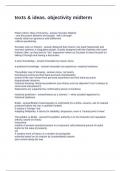
texts & ideas. objectivity midterm
Plato's Meno: Way of Knowing - answer Socratic Method:
- oral discussion between two people, "talk it through"
heavily reliant on ignorance and bafflement
-utilizes questioning
Socrates view on rhetoric - answer Believed that rhetoric can teach falsehoods and
incorrect opinions, it misguides people. Greatly disagreed with the Sophists who used
rhetoric often, as they tried to "win" arguments where as Socrates is more focused on
talking it through and having a discussion.
A priori knowledge - answer knowable by reason alone
a posteriori knowledge - answer knowable via experience, empirical evidence
Thucydides' way of knowing - answer prose, not poetry
knowing by events and first-hand accounts interpretation
events of the war: known from personal experience and first-hand accounts
dispassionate observer
historical knowing: historical positivism (can history ever be objective? Isn't it always at
some level interpretive?)
Statements are supported by confirmatory pieces of evidence
historical positivism - answerhistory as a science — what actually happened vs.
historical relativism
Bridle - answerBridle's historiography is unfinished (it's a finite—bound—set of material
produced before the war in question ended)
It names a "foreign" war
Adapting Wikipedia, it strives for reliability, dispassion, even a "neutral point of view"
Thucydides vs Bridle - answerThucydides' authority is in his character and reputation
(ethos), based on history
exhaustive
relation of ancient events/occasions in a reasoned, self professed pursuit of useful
truths for the sake of posterity.
VS
A modern work of history or a modern encyclopedia
authority based on its creation by (credentialed) experts
peer-review along the way
Plato's Meno: Way of Knowing - answer Socratic Method:
- oral discussion between two people, "talk it through"
heavily reliant on ignorance and bafflement
-utilizes questioning
Socrates view on rhetoric - answer Believed that rhetoric can teach falsehoods and
incorrect opinions, it misguides people. Greatly disagreed with the Sophists who used
rhetoric often, as they tried to "win" arguments where as Socrates is more focused on
talking it through and having a discussion.
A priori knowledge - answer knowable by reason alone
a posteriori knowledge - answer knowable via experience, empirical evidence
Thucydides' way of knowing - answer prose, not poetry
knowing by events and first-hand accounts interpretation
events of the war: known from personal experience and first-hand accounts
dispassionate observer
historical knowing: historical positivism (can history ever be objective? Isn't it always at
some level interpretive?)
Statements are supported by confirmatory pieces of evidence
historical positivism - answerhistory as a science — what actually happened vs.
historical relativism
Bridle - answerBridle's historiography is unfinished (it's a finite—bound—set of material
produced before the war in question ended)
It names a "foreign" war
Adapting Wikipedia, it strives for reliability, dispassion, even a "neutral point of view"
Thucydides vs Bridle - answerThucydides' authority is in his character and reputation
(ethos), based on history
exhaustive
relation of ancient events/occasions in a reasoned, self professed pursuit of useful
truths for the sake of posterity.
VS
A modern work of history or a modern encyclopedia
authority based on its creation by (credentialed) experts
peer-review along the way