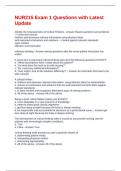
NUR215 Exam 1 Questions with Latest
Update
Identify the Characteristics of Critical Thinkers - Answer-Raises questions and problems
--> clear and concise
Gathers and assesses relevant information using abstract ideas
well reasoned conclusions and solutions --> tested against relevant standards
open minded
effective communication
reflective thinking - Answer-asking questions after the nurse-patient interaction has
ended
A nurse who is exercising critical thinking asks all of the following questions EXCEPT:
a. "What assumptions have I made about this patient?"
b. "So what does this have to do with nursing?"
c. "Do I need any additional information?"
d. "How might I look at this situation differently?" - Answer-So what does this have to do
with nursing?
A critical thinker:
a. Gathers and assesses relevant information, using abstract ideas for interpretation
b. Arrives at conclusions and solutions that are well reasoned and tests them against
relevant standards
c. Is open-minded and recognizes alternative ways of seeing problems
d. All of the above - Answer-All of the above
Being a good critical thinker makes you EXCEPT:
a. more adaptable in a new economy of knowledge
b. better to make good clinical judgments.
c. get less sleep at night because the brain is always working
d. be responsible and accountable for decisions as a professional nurse. - Answer-get
less sleep at night because the brain is always working
The development of critical thinking skills is crucial as you provide nursing care for
patients with increasingly complex conditions.
a. True
a. False - Answer-True
Critical thinking skills provide you with a powerful means of
a. determining patient needs.
b. interpreting physician orders.
c. intervening appropriately.
d. All of the above - Answer-All of the above
, Quality improvement process - Answer-framework to systematically improve the way
care is delivered to patients
measured
analyzed
improved
controlled
Root Cause Analysis - Answer-An analytical technique used to determine the basic
underlying reason that causes a variance or a defect or a risk
A root cause may underlie more than one variance or defect or risk
Don't just put out the fire, find a way to prevent it
Core Measures - Answer-national standardized best practices to improve patient care
created by the join commission.
for patient with a a specific disease (e.g., heart failure) or who need a specific treatment
(e.g., an immunization)
designed to treat the majority with a specific illness
HCAHPS - Answer-Hospital Consumer Assessment of Healthcare Providers and
Systems
a set of surveys that ask patients to report on their healthcare experiences
What is the TJC and how do they affect quality of care? - Answer-TJC: the joint
commission
improve healthcare for the public by evaluating healthcare organizations and inspiring
them to excel in providing safe, effective, and high quality care
The most common emotional responses to illness - Answer-Denial
Anger and irritability
Attempting to gain control
Depression and despair
acceptance
At what level of government are the practice of nursing laws made and regulated? -
Answer-State
SBN: state board nursing --> protect the public from harm of incompetent practitioners
Categories of malpractice negligence - Answer-1. failure to follow standards of care
2. failure to use equipment in a responsible manner
3. failure to communicate
4. failure to seek document
5. failure to assess and monitor
6. failure to act as a patient advocate
Update
Identify the Characteristics of Critical Thinkers - Answer-Raises questions and problems
--> clear and concise
Gathers and assesses relevant information using abstract ideas
well reasoned conclusions and solutions --> tested against relevant standards
open minded
effective communication
reflective thinking - Answer-asking questions after the nurse-patient interaction has
ended
A nurse who is exercising critical thinking asks all of the following questions EXCEPT:
a. "What assumptions have I made about this patient?"
b. "So what does this have to do with nursing?"
c. "Do I need any additional information?"
d. "How might I look at this situation differently?" - Answer-So what does this have to do
with nursing?
A critical thinker:
a. Gathers and assesses relevant information, using abstract ideas for interpretation
b. Arrives at conclusions and solutions that are well reasoned and tests them against
relevant standards
c. Is open-minded and recognizes alternative ways of seeing problems
d. All of the above - Answer-All of the above
Being a good critical thinker makes you EXCEPT:
a. more adaptable in a new economy of knowledge
b. better to make good clinical judgments.
c. get less sleep at night because the brain is always working
d. be responsible and accountable for decisions as a professional nurse. - Answer-get
less sleep at night because the brain is always working
The development of critical thinking skills is crucial as you provide nursing care for
patients with increasingly complex conditions.
a. True
a. False - Answer-True
Critical thinking skills provide you with a powerful means of
a. determining patient needs.
b. interpreting physician orders.
c. intervening appropriately.
d. All of the above - Answer-All of the above
, Quality improvement process - Answer-framework to systematically improve the way
care is delivered to patients
measured
analyzed
improved
controlled
Root Cause Analysis - Answer-An analytical technique used to determine the basic
underlying reason that causes a variance or a defect or a risk
A root cause may underlie more than one variance or defect or risk
Don't just put out the fire, find a way to prevent it
Core Measures - Answer-national standardized best practices to improve patient care
created by the join commission.
for patient with a a specific disease (e.g., heart failure) or who need a specific treatment
(e.g., an immunization)
designed to treat the majority with a specific illness
HCAHPS - Answer-Hospital Consumer Assessment of Healthcare Providers and
Systems
a set of surveys that ask patients to report on their healthcare experiences
What is the TJC and how do they affect quality of care? - Answer-TJC: the joint
commission
improve healthcare for the public by evaluating healthcare organizations and inspiring
them to excel in providing safe, effective, and high quality care
The most common emotional responses to illness - Answer-Denial
Anger and irritability
Attempting to gain control
Depression and despair
acceptance
At what level of government are the practice of nursing laws made and regulated? -
Answer-State
SBN: state board nursing --> protect the public from harm of incompetent practitioners
Categories of malpractice negligence - Answer-1. failure to follow standards of care
2. failure to use equipment in a responsible manner
3. failure to communicate
4. failure to seek document
5. failure to assess and monitor
6. failure to act as a patient advocate