HTML Basics Questions and Answers
Already Passed
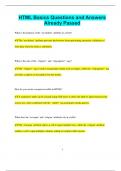
What is the purpose of the `novalidate` attribute in a form?
✔✔The `novalidate` attribute prevents the browser from performing automatic validation of
form data when the form is submitted.
What is the role of the `<figure>` and `<figcaption>` tags?
✔✔The `<figure>` tag is used to encapsulate media such as images, while the `<figcaption>` tag
provides a caption or description for that media.
How do you create a responsive table in HTML?
✔✔A responsive table can be created using CSS styles to allow the table to adjust based on the
screen size, often combined with the `<table>` tag and proper media queries.
What does the `rowspan` and `colspan` attributes do in a table?
✔✔The `rowspan` attribute allows a cell to span multiple rows, while the `colspan` attribute
enables a cell to span multiple columns, aiding in complex table layouts.
1
, What is the purpose of the `<progress>` tag?
✔✔The `<progress>` tag represents the completion progress of a task, visually indicating how
much of the task has been completed.
How can you create a section that is visually distinct from the rest of the content?
✔✔A section can be visually distinct by using the `<section>` tag combined with CSS styles,
such as background colors, margins, and padding.
What is the significance of the `lang` attribute in the HTML tag?
✔✔The `lang` attribute specifies the language of the document, helping search engines and
browsers render the content correctly and improve accessibility.
What is the difference between the `<b>` and `<strong>` tags?
✔✔The `<b>` tag is used for styling text in bold without implying importance, while the
`<strong>` tag indicates that the text is of strong importance, often rendered in bold.
What does the `<main>` tag represent in an HTML document?
✔✔The `<main>` tag is used to identify the main content of a webpage, which is directly related
to the primary topic and should be unique to each page.
2
Already Passed
What is the purpose of the `novalidate` attribute in a form?
✔✔The `novalidate` attribute prevents the browser from performing automatic validation of
form data when the form is submitted.
What is the role of the `<figure>` and `<figcaption>` tags?
✔✔The `<figure>` tag is used to encapsulate media such as images, while the `<figcaption>` tag
provides a caption or description for that media.
How do you create a responsive table in HTML?
✔✔A responsive table can be created using CSS styles to allow the table to adjust based on the
screen size, often combined with the `<table>` tag and proper media queries.
What does the `rowspan` and `colspan` attributes do in a table?
✔✔The `rowspan` attribute allows a cell to span multiple rows, while the `colspan` attribute
enables a cell to span multiple columns, aiding in complex table layouts.
1
, What is the purpose of the `<progress>` tag?
✔✔The `<progress>` tag represents the completion progress of a task, visually indicating how
much of the task has been completed.
How can you create a section that is visually distinct from the rest of the content?
✔✔A section can be visually distinct by using the `<section>` tag combined with CSS styles,
such as background colors, margins, and padding.
What is the significance of the `lang` attribute in the HTML tag?
✔✔The `lang` attribute specifies the language of the document, helping search engines and
browsers render the content correctly and improve accessibility.
What is the difference between the `<b>` and `<strong>` tags?
✔✔The `<b>` tag is used for styling text in bold without implying importance, while the
`<strong>` tag indicates that the text is of strong importance, often rendered in bold.
What does the `<main>` tag represent in an HTML document?
✔✔The `<main>` tag is used to identify the main content of a webpage, which is directly related
to the primary topic and should be unique to each page.
2