

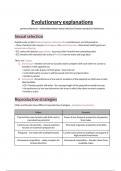
Evolutionary explanations
partner preferences - relationship between sexual selection & human reproductive behaviours
Sexual selection
Explains why certain disadvantageous characteristics (evolutionary) are still passed on
↳ these characteristics may be advantageous for sexual selection - determines which genes are
passed onto offspring
↳ EG: males who behave aggressively - to protect their female from competing males
↳ EG: females with characteristic traits of fertility (narrow waist and large hips)
There are 2 types:
1. Intrasexual - members of one sex (usually males) compete with each other for access to
members of the opposite sex
↳ victors can mate & pass on their genes - losers do not
↳ traits that lead to success in will be passed onto the next generation
↳ female is passive
2. Intersexual - the preference of one sex for members of the opposite sex that have certain
ideal qualities
↳ EG: if females prefer tall males - the average height of the population would increase
↳ the preference of one sex determines the areas in which the other sex must compete
↳ female is active
Reproductive strategies
Males and females have different reproductive strategies - anisogamy/ asymmetry
Males Females
Can fertilise many females with little cost to Fewer & less frequent production of gametes
reproductive potential than males
Cant be sure of paternity - natural selection Time limit of gamete production (monthly)
focuses on maximum pregnancies
Polygamy - one male with multiple females Careful mate selection leading to monogamy &
high parental investment
Intrasexual competition - males compete for Intersexual competition - females chose from
female attention available males
,Eval (AO3)
Buss (1989)
↳ explored what males & females look for in a long term partner (marriage)
↳ over 10,000 participants in 37 cultures
Women desired males with good financial prospects
↳ evolutionary approach - preference for resources
Men were attracted to younger & attractive mates
↳ evolutionary approach - sign of fertility (good health)
Suggests partner preference is universal - regardless of culture
Research has alpha bias - Clark & Hatfield (1989)
↳ female choosiness is a reality of heterosexual relationships
Asked university students (university campus) “will you go to bed with me tonight?”
↳ no women agreed
↳ 75% men agreed
Supports idea that there are gender differences in sexual selection
↳ similarities aren’t often recorded - research focus on differences
Suffer from evolutionary reductionism
↳ argue that strategies for choosing a mate are due to genetic inheritance & reproductive success
BUT this isn’t the case in real life - individual differences must be considered
EG - evolutionary explanations don’t account for homosexual relationships that are not formed on
the basis of reproduction - there is no evolutionary advantage
Factors affecting attraction
self disclosure, physical attractiveness, & filter theory
Self disclosure
= revealing personal information to another person that may not be shared with others
↳ thoughts, feelings & experiences
SD allows for a partner to reveal their ‘true self’ - increasing intimacy & attraction
Altman & Taylor (1973) - Social Penetration Theory
↳ gradually revealing information about emotions & experiences to a partner - followed by
listening to reciprocal SD from them allows partners to develop deeper trust
● Uses an ‘onion metaphor’ to describe SD
1. Breadth - general topics/info about yourself
↳ hobbies & interests
, 2. Depth - more personal info revealed later on (off limits at the start)
↳ religious/political beliefs & difficult experiences
Reis & Shaver (1988)
↳ reciprocity is a feature of successful SD
There must be a balance of SD for a relationship to be successful & develop further
↳ both partners should share what really matters to them (reciprocal) - leads to greater intimacy &
relationship satisfaction
Eval (AO3)
Support - Laurenceau (2005)
↳ participants told to write diary entry of relationship
SD & perception of disclosure in a partner led to greater intimacy
↳ reverse true = relationships with a lack of intimacy had a lack of SD
Supports positive effect of SD on intimacy & attraction in relationships
Culture bias (SPT)
↳ SPT developed due to research in western individualist cultures
↳ doesn’t apply to collectivist cultures
Tang et al
Men & women in the USA disclosed more sexual thoughts/feelings to partners than in China
BUT level of relationship satisfaction was high in both cultures
↳ SD isn’t a requirement for successful relationships in all cultures
= type of SD varies depending on culture
Nomothetic approach (SPT)
↳ claims that high SD will lead to great relationship satisfaction
↳ can’t explain all relationship types
↳ ignores the other factors that can influence relationships (culture/personality)
EG: ignores physical attractiveness
↳ Halo effect (Dion 1972) & Matching Hypothesis (Walster 1969)
EG: ignores similarity of attitudes
↳ Filter theory (Kerkhoff & Davis 1962)
= research into romantic relationships should take an idiographic approach
↳ studies all couples’ unique experiences
Real life applications
↳ couples counselling
EG: Less skilled partners (limited communication skills) encouraged to focus on developing SD to
develop intimacy & improve satisfaction/connection to others
The success of couples counselling increases the validity of the SPT to explain factors affecting
attraction in romantic relationships
partner preferences - relationship between sexual selection & human reproductive behaviours
Sexual selection
Explains why certain disadvantageous characteristics (evolutionary) are still passed on
↳ these characteristics may be advantageous for sexual selection - determines which genes are
passed onto offspring
↳ EG: males who behave aggressively - to protect their female from competing males
↳ EG: females with characteristic traits of fertility (narrow waist and large hips)
There are 2 types:
1. Intrasexual - members of one sex (usually males) compete with each other for access to
members of the opposite sex
↳ victors can mate & pass on their genes - losers do not
↳ traits that lead to success in will be passed onto the next generation
↳ female is passive
2. Intersexual - the preference of one sex for members of the opposite sex that have certain
ideal qualities
↳ EG: if females prefer tall males - the average height of the population would increase
↳ the preference of one sex determines the areas in which the other sex must compete
↳ female is active
Reproductive strategies
Males and females have different reproductive strategies - anisogamy/ asymmetry
Males Females
Can fertilise many females with little cost to Fewer & less frequent production of gametes
reproductive potential than males
Cant be sure of paternity - natural selection Time limit of gamete production (monthly)
focuses on maximum pregnancies
Polygamy - one male with multiple females Careful mate selection leading to monogamy &
high parental investment
Intrasexual competition - males compete for Intersexual competition - females chose from
female attention available males
,Eval (AO3)
Buss (1989)
↳ explored what males & females look for in a long term partner (marriage)
↳ over 10,000 participants in 37 cultures
Women desired males with good financial prospects
↳ evolutionary approach - preference for resources
Men were attracted to younger & attractive mates
↳ evolutionary approach - sign of fertility (good health)
Suggests partner preference is universal - regardless of culture
Research has alpha bias - Clark & Hatfield (1989)
↳ female choosiness is a reality of heterosexual relationships
Asked university students (university campus) “will you go to bed with me tonight?”
↳ no women agreed
↳ 75% men agreed
Supports idea that there are gender differences in sexual selection
↳ similarities aren’t often recorded - research focus on differences
Suffer from evolutionary reductionism
↳ argue that strategies for choosing a mate are due to genetic inheritance & reproductive success
BUT this isn’t the case in real life - individual differences must be considered
EG - evolutionary explanations don’t account for homosexual relationships that are not formed on
the basis of reproduction - there is no evolutionary advantage
Factors affecting attraction
self disclosure, physical attractiveness, & filter theory
Self disclosure
= revealing personal information to another person that may not be shared with others
↳ thoughts, feelings & experiences
SD allows for a partner to reveal their ‘true self’ - increasing intimacy & attraction
Altman & Taylor (1973) - Social Penetration Theory
↳ gradually revealing information about emotions & experiences to a partner - followed by
listening to reciprocal SD from them allows partners to develop deeper trust
● Uses an ‘onion metaphor’ to describe SD
1. Breadth - general topics/info about yourself
↳ hobbies & interests
, 2. Depth - more personal info revealed later on (off limits at the start)
↳ religious/political beliefs & difficult experiences
Reis & Shaver (1988)
↳ reciprocity is a feature of successful SD
There must be a balance of SD for a relationship to be successful & develop further
↳ both partners should share what really matters to them (reciprocal) - leads to greater intimacy &
relationship satisfaction
Eval (AO3)
Support - Laurenceau (2005)
↳ participants told to write diary entry of relationship
SD & perception of disclosure in a partner led to greater intimacy
↳ reverse true = relationships with a lack of intimacy had a lack of SD
Supports positive effect of SD on intimacy & attraction in relationships
Culture bias (SPT)
↳ SPT developed due to research in western individualist cultures
↳ doesn’t apply to collectivist cultures
Tang et al
Men & women in the USA disclosed more sexual thoughts/feelings to partners than in China
BUT level of relationship satisfaction was high in both cultures
↳ SD isn’t a requirement for successful relationships in all cultures
= type of SD varies depending on culture
Nomothetic approach (SPT)
↳ claims that high SD will lead to great relationship satisfaction
↳ can’t explain all relationship types
↳ ignores the other factors that can influence relationships (culture/personality)
EG: ignores physical attractiveness
↳ Halo effect (Dion 1972) & Matching Hypothesis (Walster 1969)
EG: ignores similarity of attitudes
↳ Filter theory (Kerkhoff & Davis 1962)
= research into romantic relationships should take an idiographic approach
↳ studies all couples’ unique experiences
Real life applications
↳ couples counselling
EG: Less skilled partners (limited communication skills) encouraged to focus on developing SD to
develop intimacy & improve satisfaction/connection to others
The success of couples counselling increases the validity of the SPT to explain factors affecting
attraction in romantic relationships


