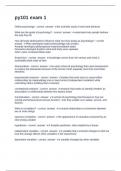
PY 101 exam 3
Cognitive Dissonance - correct answer ✔Leon Festinger
dissonance occurs when our behavior contradicts our attitudes- causes
anxiety and tension
motivated to reduce the dissonance by change behaviors or attitudes,
rationalize the discrepancies
how others influence us - correct answer ✔conformity, compliance,
obedience, group influences, social norms, attitudes and beliefs
conformity - correct answer ✔a change in behavior or belief or both to
conform to a group norm as a result of real or imagined group pressure
sherif study - correct answer ✔completely dark room with a stationary point
of light, asked how much the light moved, light appears to move even though
it isn't because our eyes move spontaneously, when two people are asked
they revise their estimates until they are similar
informational influence - correct answer ✔stems from our desire to be correct
in situations in which the correct action or judgement is uncertain and we need
information
asch study - correct answer ✔Participants were asked to select the line
closest in line to length X. When cohorts gave obviously wrong answers, more
than 1/3 of the subjects conformed and agreed with the incorrect choices.
Depends on group size: 7 is optimal.
normative influence - correct answer ✔stems from our desire to gain the
approval and avoid the disapproval of other people
, compliance - correct answer ✔acting in accordance to a direct request from
another person or group
foot-in-the-door
door-in-the-face
low-balling
that's not all
foot-in-the-door - correct answer ✔start small & build on that
compliance to a large request is gained by prefacing it with a very
small,almost mindless request
door-in-the-face - correct answer ✔opposite of foot-in-the-door
start with a large unreasonable request (denied) followed with a more
reasonable, smaller request
low-balling - correct answer ✔compliance to a costly request is achieved by
first getting compliance to an attractive, less costly request
then go back on or renege on the less costly request
works because we want to remain consistent in our actions
that's not all - correct answer ✔a second "better" or is made before an
individual is given the chance to respond to a first request
more likely to comply to a request after a build-up to make the request sound
"better"
obedience - correct answer ✔A form of compliance that occurs when people
follow direct commands, usually from someone in a position of authority
Cognitive Dissonance - correct answer ✔Leon Festinger
dissonance occurs when our behavior contradicts our attitudes- causes
anxiety and tension
motivated to reduce the dissonance by change behaviors or attitudes,
rationalize the discrepancies
how others influence us - correct answer ✔conformity, compliance,
obedience, group influences, social norms, attitudes and beliefs
conformity - correct answer ✔a change in behavior or belief or both to
conform to a group norm as a result of real or imagined group pressure
sherif study - correct answer ✔completely dark room with a stationary point
of light, asked how much the light moved, light appears to move even though
it isn't because our eyes move spontaneously, when two people are asked
they revise their estimates until they are similar
informational influence - correct answer ✔stems from our desire to be correct
in situations in which the correct action or judgement is uncertain and we need
information
asch study - correct answer ✔Participants were asked to select the line
closest in line to length X. When cohorts gave obviously wrong answers, more
than 1/3 of the subjects conformed and agreed with the incorrect choices.
Depends on group size: 7 is optimal.
normative influence - correct answer ✔stems from our desire to gain the
approval and avoid the disapproval of other people
, compliance - correct answer ✔acting in accordance to a direct request from
another person or group
foot-in-the-door
door-in-the-face
low-balling
that's not all
foot-in-the-door - correct answer ✔start small & build on that
compliance to a large request is gained by prefacing it with a very
small,almost mindless request
door-in-the-face - correct answer ✔opposite of foot-in-the-door
start with a large unreasonable request (denied) followed with a more
reasonable, smaller request
low-balling - correct answer ✔compliance to a costly request is achieved by
first getting compliance to an attractive, less costly request
then go back on or renege on the less costly request
works because we want to remain consistent in our actions
that's not all - correct answer ✔a second "better" or is made before an
individual is given the chance to respond to a first request
more likely to comply to a request after a build-up to make the request sound
"better"
obedience - correct answer ✔A form of compliance that occurs when people
follow direct commands, usually from someone in a position of authority