PLTW PBS Unit 3.1.pdf file:///C:/Users/HP/Desktop/New%20folder%20(4)/PLTW%20PBS%
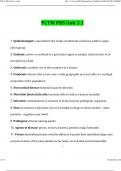
PLTW PBS Unit 3.1
1. Epidemiologist: a specialist in the study of outbreaks of disease within a popu-
lation group
2. Endemic: native or confined to a particular region or people; characteristic of or
prevalent in a field
3. Outbreak: a sudden rise in the incidence of a disease
4. Pandemic: disease that occurs over a wide geographic area and affects a veryhigh
proportion of the population.
5. Nosocomial disease: hospital acquired infection
6. Microbial (bacterial) cells: bacterial cells on and in a human noramlly
7. Infection: contamination or invasion of body tissue by pathogenic organisms
8. Host: an animal or plant that acts as a biological refuge in which another - often
parasitic - organism may dwell.
9. Pathogens: disease causing agents
10. Agents of disease: prions, viruses, bacteria, protists, fungi, helminths
11. Prions: misfolded proteins with the ability to transmit their misfolded shape onto
normal variants of the same protein in the body; several fatal and transmissible
1/2
1 of 5 10/24/2024, 8:40
,PLTW PBS Unit 3.1.pdf file:///C:/Users/HP/Desktop/New%20folder%20(4)/PLTW%20PBS%
neurodegenerative diseases are caused
12. Viruses: very tiny 'germs' of genetic material surrounded by a protein coat that
cause disease
13. Bacteria: single-celled organisms that can be a harmful strain in the body
including pneumonia, meningitis, and food poisoning.
14. Protists: single-celled organisms, also called 'protozoa', that are responsible fora
range of diseases, including dysentery and flesh eating.
15. Fungi: invades the tissue via spores and can cause disease that's confined tothe
skin, spreads into tissue, bones, and organs, or affects the whole body.
16. Helminths: parasitic worms that can dwell in the GI track
17. B-cells: a type of white blood cell that functions in the humoral immunity com-
ponent of the adaptive immune system by secreting antibodies.
18. T-cells: one of the important white blood cells of the immune system that play a
central role in the adaptive immune response.
19. Mode of transmission: Indirect and direct
20. Portal of entry/exit: skin and mucous membranes, respiratory tract, urinary
tract, GI tract, reproductive tract, blood
21. Susceptible hosts: Children, elderly, people with weaker immune systems
22. Reservoir: People, animals, the environment
2/2
2 of 5 10/24/2024, 8:40
PLTW PBS Unit 3.1
1. Epidemiologist: a specialist in the study of outbreaks of disease within a popu-
lation group
2. Endemic: native or confined to a particular region or people; characteristic of or
prevalent in a field
3. Outbreak: a sudden rise in the incidence of a disease
4. Pandemic: disease that occurs over a wide geographic area and affects a veryhigh
proportion of the population.
5. Nosocomial disease: hospital acquired infection
6. Microbial (bacterial) cells: bacterial cells on and in a human noramlly
7. Infection: contamination or invasion of body tissue by pathogenic organisms
8. Host: an animal or plant that acts as a biological refuge in which another - often
parasitic - organism may dwell.
9. Pathogens: disease causing agents
10. Agents of disease: prions, viruses, bacteria, protists, fungi, helminths
11. Prions: misfolded proteins with the ability to transmit their misfolded shape onto
normal variants of the same protein in the body; several fatal and transmissible
1/2
1 of 5 10/24/2024, 8:40
,PLTW PBS Unit 3.1.pdf file:///C:/Users/HP/Desktop/New%20folder%20(4)/PLTW%20PBS%
neurodegenerative diseases are caused
12. Viruses: very tiny 'germs' of genetic material surrounded by a protein coat that
cause disease
13. Bacteria: single-celled organisms that can be a harmful strain in the body
including pneumonia, meningitis, and food poisoning.
14. Protists: single-celled organisms, also called 'protozoa', that are responsible fora
range of diseases, including dysentery and flesh eating.
15. Fungi: invades the tissue via spores and can cause disease that's confined tothe
skin, spreads into tissue, bones, and organs, or affects the whole body.
16. Helminths: parasitic worms that can dwell in the GI track
17. B-cells: a type of white blood cell that functions in the humoral immunity com-
ponent of the adaptive immune system by secreting antibodies.
18. T-cells: one of the important white blood cells of the immune system that play a
central role in the adaptive immune response.
19. Mode of transmission: Indirect and direct
20. Portal of entry/exit: skin and mucous membranes, respiratory tract, urinary
tract, GI tract, reproductive tract, blood
21. Susceptible hosts: Children, elderly, people with weaker immune systems
22. Reservoir: People, animals, the environment
2/2
2 of 5 10/24/2024, 8:40