

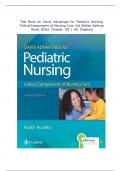
Test c Bank c for c Davis c Advantage c for c Pediatric c Nursing
c CriticalcComponents cof cNursing cCare c3rd cEdition cKathryn
c Rudd, c2024), c Chapter c 122 c | c All c Chapters
,Chapter c 1 c Issues c and c Trends c in c Pediatric c Nursing
Multiple c Choice
Identifythechoicethatbestcompletesthestatementoranswersthequestion.
1. The cnurse chas cprovided ca cpresentation cto cmiddle cschool cchildren cabout cnursing
cas ca ccareer. c One c of c the c children c stated c that c he c wanted c to c be c a c pediatric
c nurse, c because c he cwants c to c take c care c of c babies c and c little c “kids.” c What
c would c be c an c appropriate c response cto c this c middle c school–aged c child?
c c c “Nursing c is c a c general c practice; c all c nurses c must c know c how c to
c take c care c of call c ages c of c patients.”
c c c c“As c a c pediatric c nurse, c you c would c get c to c care c for c babies c and
c little c kids c as cwell c as c children c through c their c teenage c years.”
c c c c“What c you c are c describing c is c actually c a c neonatal c nurse.
c Neonatal c nurses cwork c with c newborn c babies, c toddlers, c and
c preschool-age c children.”
c c c c“Being c a c pediatric c nurse c requires c a c master’s c degree, c so
c be c sure c to cwork c hard c in c school!”
2. The c medical-surgical c float c nurse c is c assigned c to c the c pediatric c unit c for c the
c first c time c and cstates c that c the c skills c are c “the c same c as c general c nursing
c since c children c are c little c adults cwith csmaller cbodies.” cWhat ccomponent cof
cpediatric cnursing ccontraindicates cthis cstatement?
Pediatric c nursing c involves c care c based c on c the c developmental c level c of c the c patient.
Pediatric c nursing c involves c the c patient’s c family c in c the c plan
c of c care. cPediatric cnursing cin cbased con cprevention cof
cinfectious cdiseases. cPediatric c nursing c involves c cultural
c sensitivity c in c patient c care.
3. The cculturally csensitive cpediatric cnurse cis caware cof cthe cracial cmakeup cof
cthe cU.S. cpopulation. cWhich cof cthe cfollowing creflects cthe cdemographics cof
cthe cU.S. cpediatric cpopulation c in c 2018, c based c on c U.S. c Census c Bureau
c data?
c c c The c American c Indian c and c Alaska c Native c population
c represent c one- cfifth c of c the c pediatric c population.
c c c cAbout c half c of c the c children c fall c in c the c category c of c something
c other c than cWhite c non- c Hispanic.
The c population c of c Asian c children c decreased c from c 2015 c to c 2018.
There c was c no c change c in c the c population c of c Non-Hispanic
c children c who crepresent c two c or c more c races c between c 2015 c and
c 2018.
4. The cnurse cat ca cfamily cclinic cis cproviding ccare cto can cadolescent cpatient
cdiagnosed cwith cdiabetes. cThe cpatient chas cverbalized cdiscomfort cwith cthe
cfeelings cof cisolation cwhen cunable c to c drink c alcohol c with c their c friends. c Which
c of c the c following c would c be c the c most cappropriate c response c to c this
c statement?
c c c “Drinking calcohol cis cnot conly cillegal cbut cdangerous cfor cyour cblood
csugar ccontrol c and c overall c well-being.”
,c c c c“You c can c still c drink c alcohol, c in c moderation, c if c you c control
c the c sugar cspike c with c more c insulin.”
c c c c“Prepare c for c alcohol c intake c with c more c water c and c less
c carbohydrates cbefore c drinking c to c slow c sugar c spikes.”
c c c c“It c is c understandable c that c you c want c to c be c included, c but c perhaps c we c can
, work c out c a c plan c on c how c to c work c through c those c situations.”
c c c Which c statement c best c describes c the c common c core c concepts c of c the
c different c models cof c pediatric c nursing?
1. All c models c focus c on c the c open c communication c between c the c child c and c nurse.
2. All c models c focus c on c importance c of c family c relationship c to c the c child.
3. All c models c focus c on c safeguarding c the c child’s c dignity c during c care.
4. All c models c focus c on c coordination c of c care c needs c that c arise c during c illness.
c c c Which c of c the c following c tasks c is c associated c with c the c pediatric c medical c home
c care c model cof c pediatric c nursing?
1. The c nurse c refers c the c family c to c a c childhood c cancer c support
c group c prior c to cdischarge c from c the c hospital.
2. The c nurse c includes c a c simple c explanation c of c the c procedure c to
c the c child cbased c on c the c child’s c developmental c level.
3. The c nurse c includes c the c family’s c cultural
c celebrations c andcobservations c while c providing c care
c to c the c child.
4. The c nurse c develops c the c plan c of c care c with c the c child c and c family
c as c the c focal cpoint c of c the c interventions.
c c c The cpediatric cnurse cbegins ca cresearch cproject con c8-year-old cpatients cwith cthe
cmedical cdiagnosis cof cpediatric cacute-onset cneuropsychiatric csyndrome c(PANS).
cThe cfamily chas cconsented cto cthe cresearch, cbut cas cthe cnurse cbegins cto
cadminister cthe cintervention, cthe cpatient c refuses c to c cooperate. c What c is c the
c appropriate c response c to c this c refusal?
1. The cnurse cshould cdiscuss cwith cthe cfamily cthe coptions
cof cperforming c the c intervention c without c the c child’s
c knowledge.
2. The c nurse c should c explain c to c the c child c that c this c is c necessary c and
c promise c acreward c at c the c end c of c the c research c project.
3. The c nurse c should c refuse c to c perform c the c intervention c until
c the c child cconsents c to c the c intervention c and c project.
4. The c nurse c should c discuss c the c pros c and c cons c of c the
c research c project cwith c the c child c and c focus c on c the c outcomes.
c c c A c nurse c is c providing c relationship-based c care c to c a c pediatric c patient.
c Which c of c the cfollowing c is c a c challenge c the c nurse c is c likely c to c encounter
c while c using c this c model c of ccare?
1. Maintaining c a c sterile c field c for c a c procedure c with c a c restless c toddler
2. Communicating c with c the c blended c family c on c regular c basis
3. Treating cchildren c with c antibiotic-resistant c illnesses
4. Caring c for c a c larger c number c of c children c with c autism
c spectrum cdisorders c and c childhood c depression
c c c The cpediatric cnurse cdesires cto cexpand chis cor cher ccareer coptions cto cbecome
cthe chospital’s c nurse c educator c of c pediatrics. c Which c of c the c following c is
c necessary c for c this cnurse c to c achieve c this c career c goal?
1. The c nurse c is c recommended c to c earn c a c minimum c of c a c master’s c degree c in c nursing
2. The c nurse c must c earn c a c minimum c of c a c doctorate c degree c in c nursing.
3. The c nurse c must c implement c and c develop c research c in c nursing c practice.
c CriticalcComponents cof cNursing cCare c3rd cEdition cKathryn
c Rudd, c2024), c Chapter c 122 c | c All c Chapters
,Chapter c 1 c Issues c and c Trends c in c Pediatric c Nursing
Multiple c Choice
Identifythechoicethatbestcompletesthestatementoranswersthequestion.
1. The cnurse chas cprovided ca cpresentation cto cmiddle cschool cchildren cabout cnursing
cas ca ccareer. c One c of c the c children c stated c that c he c wanted c to c be c a c pediatric
c nurse, c because c he cwants c to c take c care c of c babies c and c little c “kids.” c What
c would c be c an c appropriate c response cto c this c middle c school–aged c child?
c c c “Nursing c is c a c general c practice; c all c nurses c must c know c how c to
c take c care c of call c ages c of c patients.”
c c c c“As c a c pediatric c nurse, c you c would c get c to c care c for c babies c and
c little c kids c as cwell c as c children c through c their c teenage c years.”
c c c c“What c you c are c describing c is c actually c a c neonatal c nurse.
c Neonatal c nurses cwork c with c newborn c babies, c toddlers, c and
c preschool-age c children.”
c c c c“Being c a c pediatric c nurse c requires c a c master’s c degree, c so
c be c sure c to cwork c hard c in c school!”
2. The c medical-surgical c float c nurse c is c assigned c to c the c pediatric c unit c for c the
c first c time c and cstates c that c the c skills c are c “the c same c as c general c nursing
c since c children c are c little c adults cwith csmaller cbodies.” cWhat ccomponent cof
cpediatric cnursing ccontraindicates cthis cstatement?
Pediatric c nursing c involves c care c based c on c the c developmental c level c of c the c patient.
Pediatric c nursing c involves c the c patient’s c family c in c the c plan
c of c care. cPediatric cnursing cin cbased con cprevention cof
cinfectious cdiseases. cPediatric c nursing c involves c cultural
c sensitivity c in c patient c care.
3. The cculturally csensitive cpediatric cnurse cis caware cof cthe cracial cmakeup cof
cthe cU.S. cpopulation. cWhich cof cthe cfollowing creflects cthe cdemographics cof
cthe cU.S. cpediatric cpopulation c in c 2018, c based c on c U.S. c Census c Bureau
c data?
c c c The c American c Indian c and c Alaska c Native c population
c represent c one- cfifth c of c the c pediatric c population.
c c c cAbout c half c of c the c children c fall c in c the c category c of c something
c other c than cWhite c non- c Hispanic.
The c population c of c Asian c children c decreased c from c 2015 c to c 2018.
There c was c no c change c in c the c population c of c Non-Hispanic
c children c who crepresent c two c or c more c races c between c 2015 c and
c 2018.
4. The cnurse cat ca cfamily cclinic cis cproviding ccare cto can cadolescent cpatient
cdiagnosed cwith cdiabetes. cThe cpatient chas cverbalized cdiscomfort cwith cthe
cfeelings cof cisolation cwhen cunable c to c drink c alcohol c with c their c friends. c Which
c of c the c following c would c be c the c most cappropriate c response c to c this
c statement?
c c c “Drinking calcohol cis cnot conly cillegal cbut cdangerous cfor cyour cblood
csugar ccontrol c and c overall c well-being.”
,c c c c“You c can c still c drink c alcohol, c in c moderation, c if c you c control
c the c sugar cspike c with c more c insulin.”
c c c c“Prepare c for c alcohol c intake c with c more c water c and c less
c carbohydrates cbefore c drinking c to c slow c sugar c spikes.”
c c c c“It c is c understandable c that c you c want c to c be c included, c but c perhaps c we c can
, work c out c a c plan c on c how c to c work c through c those c situations.”
c c c Which c statement c best c describes c the c common c core c concepts c of c the
c different c models cof c pediatric c nursing?
1. All c models c focus c on c the c open c communication c between c the c child c and c nurse.
2. All c models c focus c on c importance c of c family c relationship c to c the c child.
3. All c models c focus c on c safeguarding c the c child’s c dignity c during c care.
4. All c models c focus c on c coordination c of c care c needs c that c arise c during c illness.
c c c Which c of c the c following c tasks c is c associated c with c the c pediatric c medical c home
c care c model cof c pediatric c nursing?
1. The c nurse c refers c the c family c to c a c childhood c cancer c support
c group c prior c to cdischarge c from c the c hospital.
2. The c nurse c includes c a c simple c explanation c of c the c procedure c to
c the c child cbased c on c the c child’s c developmental c level.
3. The c nurse c includes c the c family’s c cultural
c celebrations c andcobservations c while c providing c care
c to c the c child.
4. The c nurse c develops c the c plan c of c care c with c the c child c and c family
c as c the c focal cpoint c of c the c interventions.
c c c The cpediatric cnurse cbegins ca cresearch cproject con c8-year-old cpatients cwith cthe
cmedical cdiagnosis cof cpediatric cacute-onset cneuropsychiatric csyndrome c(PANS).
cThe cfamily chas cconsented cto cthe cresearch, cbut cas cthe cnurse cbegins cto
cadminister cthe cintervention, cthe cpatient c refuses c to c cooperate. c What c is c the
c appropriate c response c to c this c refusal?
1. The cnurse cshould cdiscuss cwith cthe cfamily cthe coptions
cof cperforming c the c intervention c without c the c child’s
c knowledge.
2. The c nurse c should c explain c to c the c child c that c this c is c necessary c and
c promise c acreward c at c the c end c of c the c research c project.
3. The c nurse c should c refuse c to c perform c the c intervention c until
c the c child cconsents c to c the c intervention c and c project.
4. The c nurse c should c discuss c the c pros c and c cons c of c the
c research c project cwith c the c child c and c focus c on c the c outcomes.
c c c A c nurse c is c providing c relationship-based c care c to c a c pediatric c patient.
c Which c of c the cfollowing c is c a c challenge c the c nurse c is c likely c to c encounter
c while c using c this c model c of ccare?
1. Maintaining c a c sterile c field c for c a c procedure c with c a c restless c toddler
2. Communicating c with c the c blended c family c on c regular c basis
3. Treating cchildren c with c antibiotic-resistant c illnesses
4. Caring c for c a c larger c number c of c children c with c autism
c spectrum cdisorders c and c childhood c depression
c c c The cpediatric cnurse cdesires cto cexpand chis cor cher ccareer coptions cto cbecome
cthe chospital’s c nurse c educator c of c pediatrics. c Which c of c the c following c is
c necessary c for c this cnurse c to c achieve c this c career c goal?
1. The c nurse c is c recommended c to c earn c a c minimum c of c a c master’s c degree c in c nursing
2. The c nurse c must c earn c a c minimum c of c a c doctorate c degree c in c nursing.
3. The c nurse c must c implement c and c develop c research c in c nursing c practice.


